
Top Down Bottom Up Blinds and Shades: A Toronto Guide to Two-Way Light and Privacy Control

Top down bottom up blinds solve a problem almost every Toronto window has, which is that you usually want light and privacy at the same time. A standard shade forces a choice. Pull it down and the room goes private but dim. Raise it and you get daylight along with a clear view straight into your home from the sidewalk or the building across the street. A top down bottom up shade gives you both, because it moves from the top as well as the bottom. This guide covers how the design works, which shades offer it, what the cordless rules in Canada changed, the rooms where it earns its place, and what to think about before you order.
What Are Top Down Bottom Up Blinds?
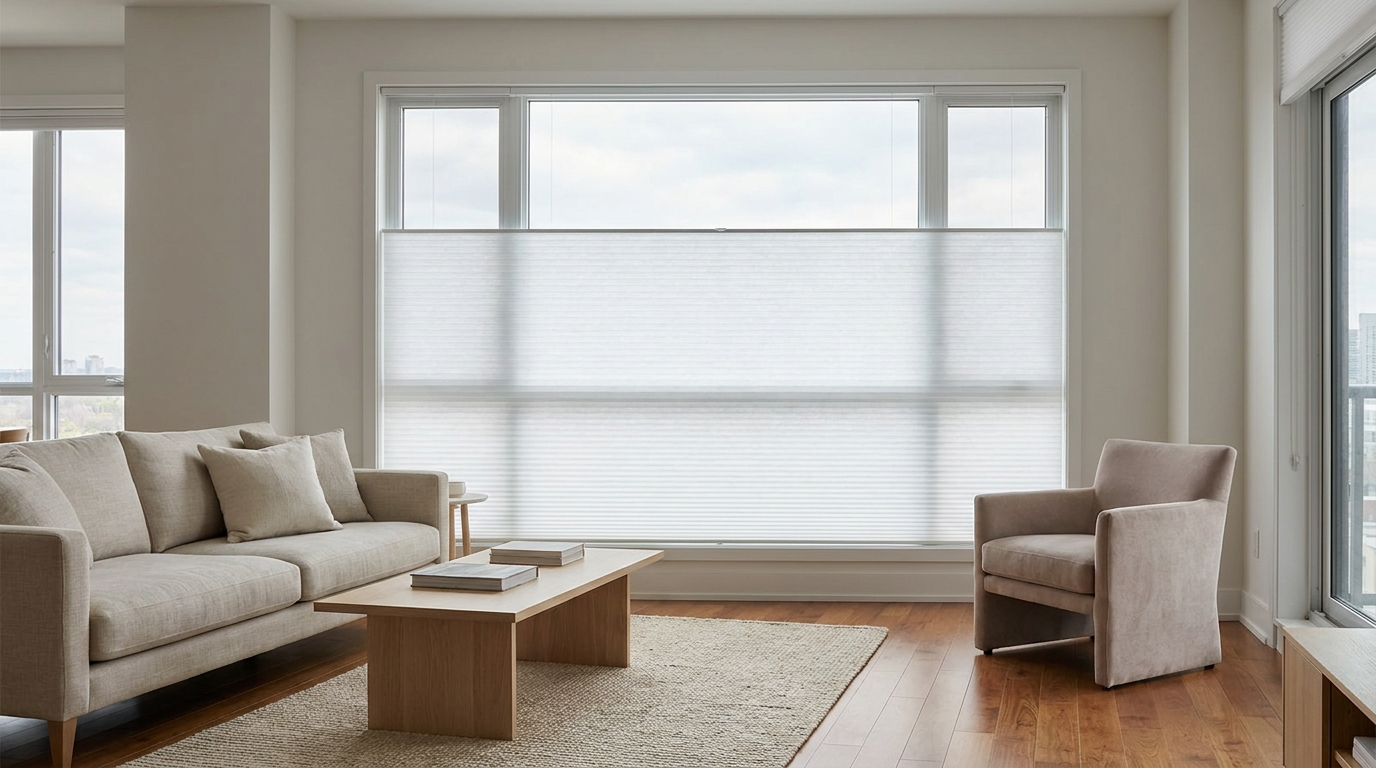
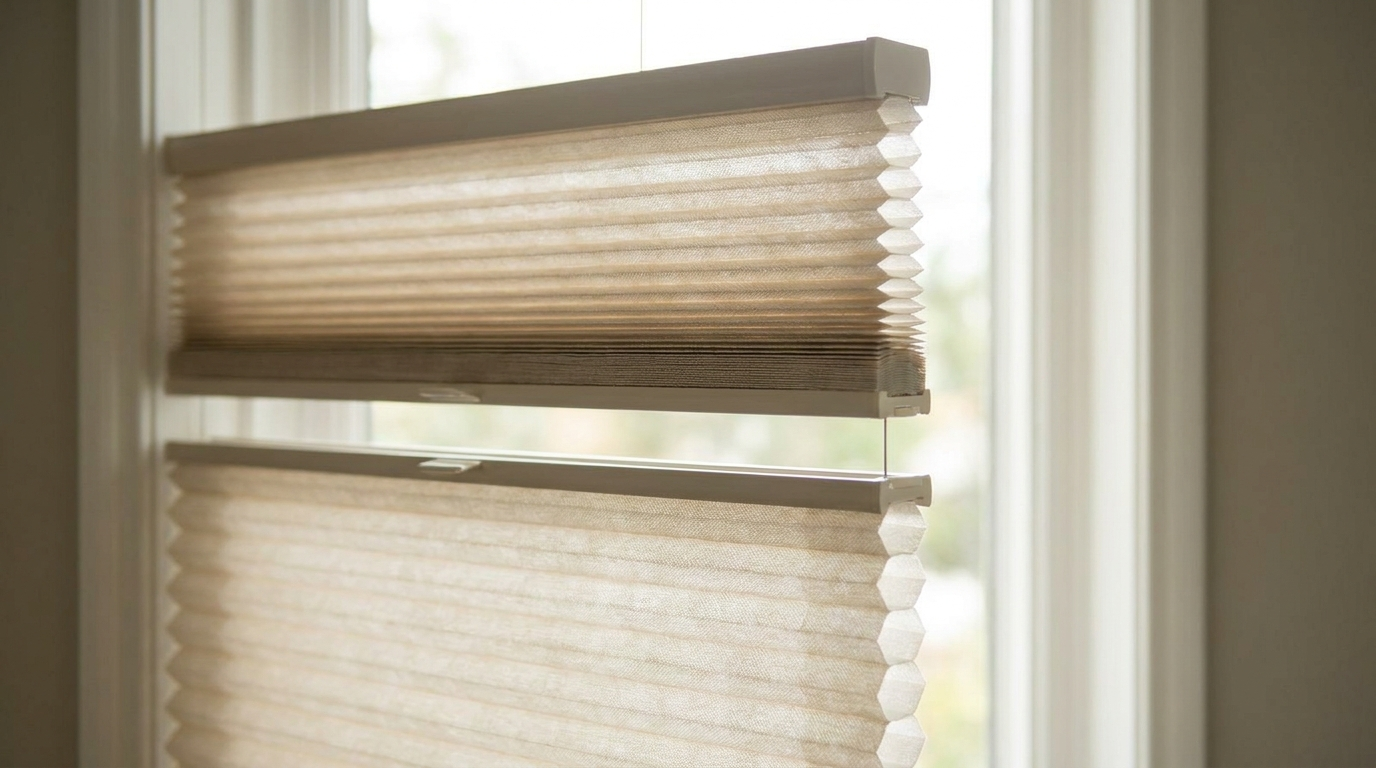
Top down bottom up blinds are shades built with two moving rails instead of one, so you can lower the shade from the top, raise it from the bottom, or set both at once. The fabric floats between a top rail and a middle rail, which lets you open a gap at the top of the window for light and sky while the bottom of the glass stays covered. People also call the feature TDBU, and it shows up most often on cellular and pleated shades.
The plain version of a shade only moves up from the sill. The top down bottom up version adds a second point of control, and that one change is what makes it so useful in a city full of close sightlines. You decide exactly which part of the window is open and which part is covered.
How Top Down Bottom Up Operation Works
There are two rails you can move. The head rail stays fixed at the top of the window. Below it sits the middle rail, and below that the bottom rail rests on the sill when the shade is fully raised. To let light in high on the window, you pull the middle rail down, which drops the top section of fabric and opens a gap near the ceiling. To cover the lower glass, you lift the bottom rail up. Set the two rails wherever you like and the covered band sits in the middle of the window, open above and open below only if you want it that way.
Most homeowners settle into one favourite position, usually the lower two thirds covered for privacy with the top third open for daylight, and adjust from there as the sun moves or the evening comes.
Why Two-Way Control Matters in Toronto Homes
Toronto packs a lot of windows close together. Semi-detached homes look straight into the neighbour’s kitchen, downtown condos face the tower across the road, and main-floor rooms sit a few steps from a busy sidewalk. In all of those, the daylight you want tends to come from the upper part of the window, which is above eye level, while the privacy you need is lower down where people can actually see in. Top down bottom up shades line up with that reality. You keep the bright band at the top open and the private band at the bottom closed.
The feature also helps with plants on a sill that want light, with rooms where you want to watch the street without being watched back, and with north-facing spaces that need every bit of daylight they can get. It sits alongside the other tools we reach for when a room has a privacy problem to solve, and it pairs naturally with the light-first thinking behind our guide to blocking glare without darkening a room.
Are Top Down Bottom Up Blinds Banned in Canada?
No, they are not banned. The confusion comes from a change to cord safety rules, not to the shades themselves. In 2019 the federal government brought in the Corded Window Coverings Regulations to reduce the strangulation risk that loose, reachable cords pose to young children. The rules restrict hazardous accessible cords on window coverings sold in Canada, which you can read about in the Government of Canada announcement on corded window coverings.
The older top down bottom up shades used two long pull cords, one for each rail, so the corded versions largely came off the market. What replaced them is better. Today the feature comes cordless, with a small handle on each rail that you move by hand, or motorized, where each section runs on its own quiet motor. So you can absolutely buy top down bottom up shades in Canada. You just buy the safe, cord-free version, which is a good outcome for family homes. If child and pet safety is driving your search, our guide to child safe window coverings and our walk-through on childproofing window blinds are worth a look.
Which Shades Come as Top Down Bottom Up?
The feature is not a shade type on its own. It is an operating style that gets built into certain fabric shades. Cellular shades are the most common home for it, but you have a few options depending on the look you want.
| Shade type | Look and feel | Why it suits top down bottom up | Best for |
|---|---|---|---|
| Cellular (honeycomb) | Soft, textured, insulating | Lightweight fabric stacks tightly, so both rails move cleanly | Most rooms, especially where warmth matters |
| Pleated | Crisp single-layer folds | Similar stacking to cellular at a lower price | Budget-friendly light filtering |
| Roman | Tailored fabric folds, upscale | Adds a soft, decorative look with two-way control | Living and dining rooms wanting a richer feel |
| Sheer and layered | Light, diffused | Available on some designs for a gentle glow up high | Rooms where you want soft light, not a clear view |
Cellular and Honeycomb Shades
This is the natural pairing and the one you will see most. The honeycomb cells trap air, so the shade insulates well, and the fabric is light enough that both rails glide easily. It is also the type where top down bottom up feels most at home, since the same shade that saves energy in a Toronto winter can open at the top for daylight. Our full guide to cellular shades and honeycomb blinds goes deeper on fabrics, cell sizes, and energy savings.
Pleated Shades
Pleated shades use a single layer of fabric folded into crisp pleats. They stack much like cellular shades, so top down bottom up works well, and they usually cost a little less. The trade-off is insulation, since a pleated shade does not have the air-pocket cells that make a cellular shade so good at holding heat.
Roman Shades
If you want a softer, more decorative result, top down bottom up is available on some Roman shades. You get the tailored fabric folds that dress up a living or dining room, with the same two-way control. It reads more like a piece of the room’s decor than a functional shade. For the wider comparison between soft fabric styles, our piece on roller blinds versus Roman shades and our overview of what Roman shades are both help.
Top Down Bottom Up Compared to a Standard Bottom-Up Shade
The difference sounds small on paper and feels large in daily use. Here is how the two operating styles line up.
| Feature | Standard bottom-up shade | Top down bottom up shade |
|---|---|---|
| Light from the top | Only when the whole shade is raised | Yes, without exposing the lower window |
| Privacy at eye level | Yes, but the room goes darker | Yes, while daylight still enters up high |
| Best window position | Fully up or fully down | Any split you choose |
| Cost | Lower | Slightly higher for the extra rail and hardware |
| Ideal rooms | Private rooms with a good view | Street-facing and close-neighbour windows |
For a room that already has privacy and a view you enjoy, a plain bottom-up shade is fine and costs less. The two-way version pays off where the lower window is the problem, which describes a lot of Toronto glass.
Cordless, Motorized, and No-Drill Options
Since the corded versions are gone, you choose between operating the rails by hand or by motor. Both are cordless in the sense that matters for safety.
| Option | How it works | Good to know |
|---|---|---|
| Cordless manual | Small handle on each rail, moved by hand | No cords, lowest cost, easy for reachable windows |
| Motorized | Each section runs on its own motor, by remote or app | Two motors for full two-way control, best for high or wide windows |
| No-drill mount | Tension or bracket fit inside the frame | Suits renters and tricky trim, depends on frame depth |
Motorized top down bottom up shades use a separate motor for each rail, so the top and bottom move independently from a remote or your phone, and you can set schedules or scenes. If you are leaning that way, our guides to how smart blinds work and integrating motorized blinds with home automation cover the setup. Renters and anyone who would rather not put holes in the trim can look at a no-drill installation, though the fit depends on how deep the window frame is.
Best Rooms for Top Down Bottom Up Blinds
Some windows are made for this feature and others do not need it. Here is where it earns its keep in a typical Toronto home.
| Room | Why it works |
|---|---|
| Bedrooms | Privacy at the bed while morning light comes in from the top |
| Bathrooms and ensuites | Cover the lower glass fully, keep daylight and airflow up high |
| Street-facing living rooms | Watch the street without the street watching you |
| Nurseries | Cordless safety plus gentle, controllable light |
| Home offices | Light on the ceiling, glare kept off the screen at eye level |
| Ground-floor condos | Privacy from the sidewalk with an open, bright top |
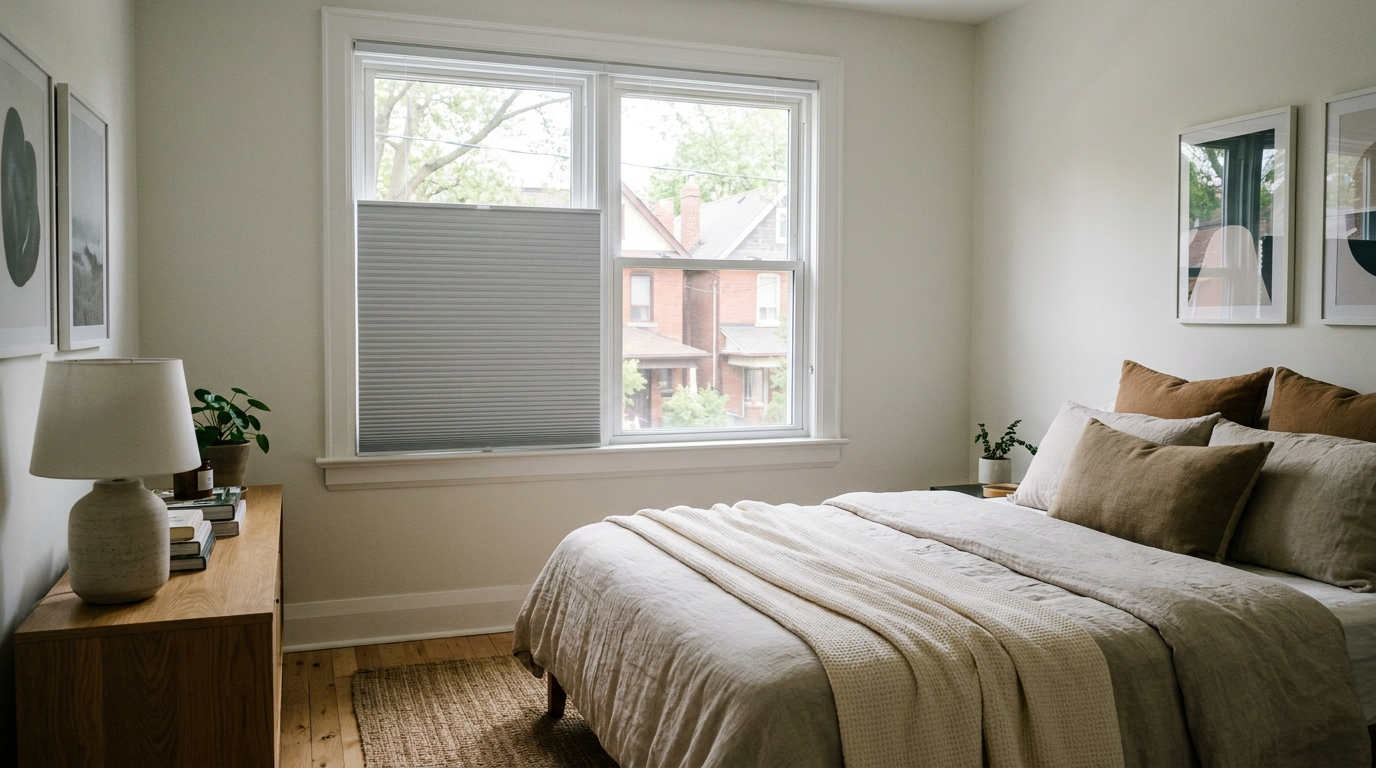
In a bedroom, the split does the work a curtain cannot, giving you a private wall of fabric at the bottom and soft daylight above. In a home office, opening the top and closing the middle band throws light toward the ceiling and keeps the sun off your monitor. For a bright, open condo with a lot of glass, the feature keeps the sidewalk view out while the room stays full of light, which is exactly the balance we aim for when helping with condo blind selection.
Light Control and Privacy
The reason to buy this feature is control, so it helps to picture the positions you actually use. Lower the top a hand’s width and you get a bright strip of daylight near the ceiling with full privacy everywhere else. Open the top halfway for a brighter room that still hides the lower glass. Raise the bottom a little on a low window to block the sidewalk while keeping most of the view. Close everything for the most cover the fabric allows.
One point to be honest about is that a light-filtering fabric still lets a soft glow and shadows through when it is closed, so it is not total privacy after dark with the lights on. For a bedroom that needs real darkness, you want a blackout fabric, and even then the small gaps at the sides of any shade let a little light past. We get into that trade-off in our guide to blackout roller shades for better sleep, and it is worth weighing before you pick a fabric.
Blackout or Light Filtering?
Top down bottom up comes in both. A light-filtering fabric is the popular choice because the whole point is to enjoy daylight, and it suits living rooms, kitchens, and offices. A blackout fabric makes sense in bedrooms and nurseries where sleep comes first, and you still keep the two-way operation. Many homes mix the two, room by room.
Measuring and Installation
Top down bottom up shades need an accurate measure like any custom covering, with one extra consideration. The design adds a middle rail and a slightly larger stack of fabric at the top when the shade is fully raised, so the head rail area needs enough room. On a shallow window frame, that can steer you toward an outside mount. Whether an inside or outside mount fits your window is the kind of call a measure settles quickly, and our guide to inside mount versus outside mount explains the difference.
Getting the numbers right is the whole game, since a custom shade is built to the measurement you give. If you want to understand what a proper measure involves, our how to measure windows for shades walk-through and the more detailed step-by-step measuring guide both help, or you can leave it to us. Large or hard-to-reach windows, the kind we cover in our piece on the best blinds for large windows, are usually where a professional measure and a motorized option make the most sense.
What Drives the Cost of Top Down Bottom Up Blinds?
Top down bottom up costs a little more than the same shade in a plain bottom-up version, because of the extra middle rail and the hardware that lets both sections move. It is a modest step up, not a different price class. Rather than quote a figure that would not match your windows, here are the factors that move the number.
| Cost driver | Effect on price |
|---|---|
| Shade type | Cellular and Roman cost more than basic pleated |
| Fabric and opacity | Blackout and designer fabrics add to the base |
| Window size and count | Larger and more numerous windows cost more |
| Operation | Motorized costs more than cordless manual, with two motors for full control |
| Mount and install | Difficult access or specialty shapes add labour |
The only way to get a real number is to have the windows measured and the fabric chosen. A free in-home consultation gives you a firm quote based on your actual openings, and it is also a good chance to see why we think custom window coverings are worth the small premium over stock sizes.
Cleaning and Maintenance
These shades are low fuss. Dust them every couple of weeks with a soft brush attachment or a hair dryer on a cool setting, which lifts dust out of cellular pockets and pleats without pressing it in. For a mark, blot gently with a lightly damp cloth and let the fabric dry fully before you raise it. Keep the rails free of grit so they glide, and avoid soaking the fabric, since cellular and pleated materials do not like heavy water. Handled this way, a good shade keeps working smoothly for years.
Are Top Down Bottom Up Blinds Any Good?
For the right window, they are one of the most useful features you can add to a shade. They fix the exact daily problem of a street-facing or close-neighbour window, they come cordless and safe, and the cost over a plain shade is small. Where they are less worth it is a private upstairs room with a view you love and no neighbours looking in, since there a standard shade does the job for less. The honest summary is that top down bottom up is excellent value where privacy and light fight each other, and unnecessary where they do not.
Choosing the Right Top Down Bottom Up Shade
Pulling it together, the decision comes down to a few questions. Which windows have a privacy problem at the bottom and daylight worth keeping at the top, since those are the ones that benefit? Do you want the insulation of a cellular shade, the lower price of a pleated one, or the decorative look of a Roman? Cordless by hand, or motorized for high and wide windows? And light filtering for daytime brightness or blackout for a bedroom? Working through those with someone who measures and installs these every day takes out the guesswork. The same two-way thinking also applies to specialty windows, from a bay window to a sliding glass door, where the right covering depends on how the opening is used.
Talk to Canadian Blinds Pros
Canadian Blinds Pros designs and installs custom shades and blinds for homes and businesses across Toronto and the GTA. If top down bottom up shades are on your list, the best next step is a free in-home consultation, where we measure your windows, bring fabric samples in the light of your own rooms, and give you a firm quote with no pressure. You can book your free consultation here, browse finished projects in our window coverings gallery, or explore the full range of custom window shades we build. If you are outside the core city, we serve surrounding communities too, including Mississauga.
Frequently Asked Questions About Top Down Bottom Up Blinds
What are top down bottom up blinds?
They are shades with two movable rails, so you can lower the shade from the top, raise it from the bottom, or set both at once. That lets you open the top of the window for light while keeping the lower glass covered for privacy. The feature is most common on cellular and pleated shades.
Can you get top down bottom up blinds in Canada?
Yes. They are widely sold across Canada, including the Toronto area. Since the corded versions were phased out under cord safety rules, today you buy them cordless or motorized, both of which are safe for homes with children and pets.
Are top down bottom up blinds banned in Canada?
No. The shades are not banned. Cord safety regulations restricted hazardous accessible cords, which removed the old corded versions from the market. Cordless and motorized top down bottom up shades remain fully available and are the safer choice.
Are top down bottom up blinds any good?
For street-facing and close-neighbour windows they are very good, because they give privacy at the bottom and daylight at the top at the same time. For a private room with a view and no neighbours looking in, a standard shade does the job for less.
What types of shades come as top down bottom up?
Cellular or honeycomb shades are the most common, followed by pleated shades at a lower price and Roman shades for a decorative look. Some sheer and layered designs offer it as well. It is an operating style added to these shades rather than a shade type of its own.
How do top down bottom up shades work?
The head rail stays fixed at the top. You move the middle rail down to open a gap for light near the ceiling, and you lift the bottom rail up to cover the lower window for privacy. Setting both rails puts the covered band wherever you want it on the glass.
Are top down bottom up blinds cordless?
The versions sold today are, yes. You operate the rails with a small handle by hand, or with a motor by remote or app. The long pull cords used on older models were phased out under Canada’s cord safety rules.
Can top down bottom up blinds be motorized?
Yes. Motorized versions use a separate motor for each section, so the top and bottom move independently from a remote or your phone, and you can add schedules or scenes. Motorization is popular for high or wide windows that are hard to reach by hand.
Are top down bottom up shades good for privacy?
They are one of the better options for daytime privacy, because you can cover the exact part of the window people see through while daylight still enters up high. For full privacy after dark with lights on, choose a blackout fabric, and remember that small side gaps still let a little light past.
Do top down bottom up cellular shades help with insulation?
Yes. The honeycomb cells trap a layer of air over the glass, which slows heat moving in or out, so they help keep rooms warmer in winter and cooler in summer. That energy benefit is a big reason cellular is the most popular base for the feature.
Are top down bottom up blinds good for bedrooms?
They work well. You get privacy at the bed with morning light coming in from the top. For a room that needs real darkness for sleep, pick a blackout fabric so the two-way control comes with proper light blocking.
Can you get top down bottom up blackout blinds?
Yes. Top down bottom up comes in both light-filtering and blackout fabrics. A blackout version keeps the two-way operation while blocking most light, which suits bedrooms and nurseries. Even so, the side gaps at any shade let a small amount of light through.
Do top down bottom up blinds cost more than regular shades?
A little more, yes. The extra middle rail and the hardware that lets both sections move add a modest amount over the same shade in a plain bottom-up version. It is a small step up rather than a different price class.
Can top down bottom up blinds be installed without drilling?
Often, yes. No-drill mounts use tension or brackets that grip inside the window frame, which suits renters and trim you would rather not damage. The fit depends on the depth of the frame, so a quick measure confirms whether it will hold securely.
What is the difference between top down bottom up and day night blinds?
They are different things. Top down bottom up describes two-way operation from the top and bottom. Day night usually refers to zebra or dual shades that alternate sheer and solid fabric bands. Some cellular shades combine day and night fabrics with top down bottom up operation, which is where the terms overlap.
Are top down bottom up blinds child safe?
The cordless and motorized versions sold today are, since they have no long reachable cords for a child or pet to reach. That is a direct result of Canada’s cord safety rules, which pushed the whole category toward cord-free operation.
Which rooms benefit most from top down bottom up shades?
Street-facing living rooms, bedrooms, bathrooms, nurseries, home offices, and ground-floor condos benefit most, because all of them need privacy low on the window while wanting daylight up high. Private upper-floor rooms with a good view usually do not need the feature.
How do you clean top down bottom up cellular shades?
Dust them every couple of weeks with a soft brush attachment or a cool hair dryer to lift dust out of the cells and pleats. For marks, blot gently with a lightly damp cloth and let the fabric dry before raising it. Avoid soaking the fabric, since cellular material does not like heavy water.