
Bathroom and Kitchen Blinds in Toronto: A Complete Guide to Moisture-Resistant Window Coverings
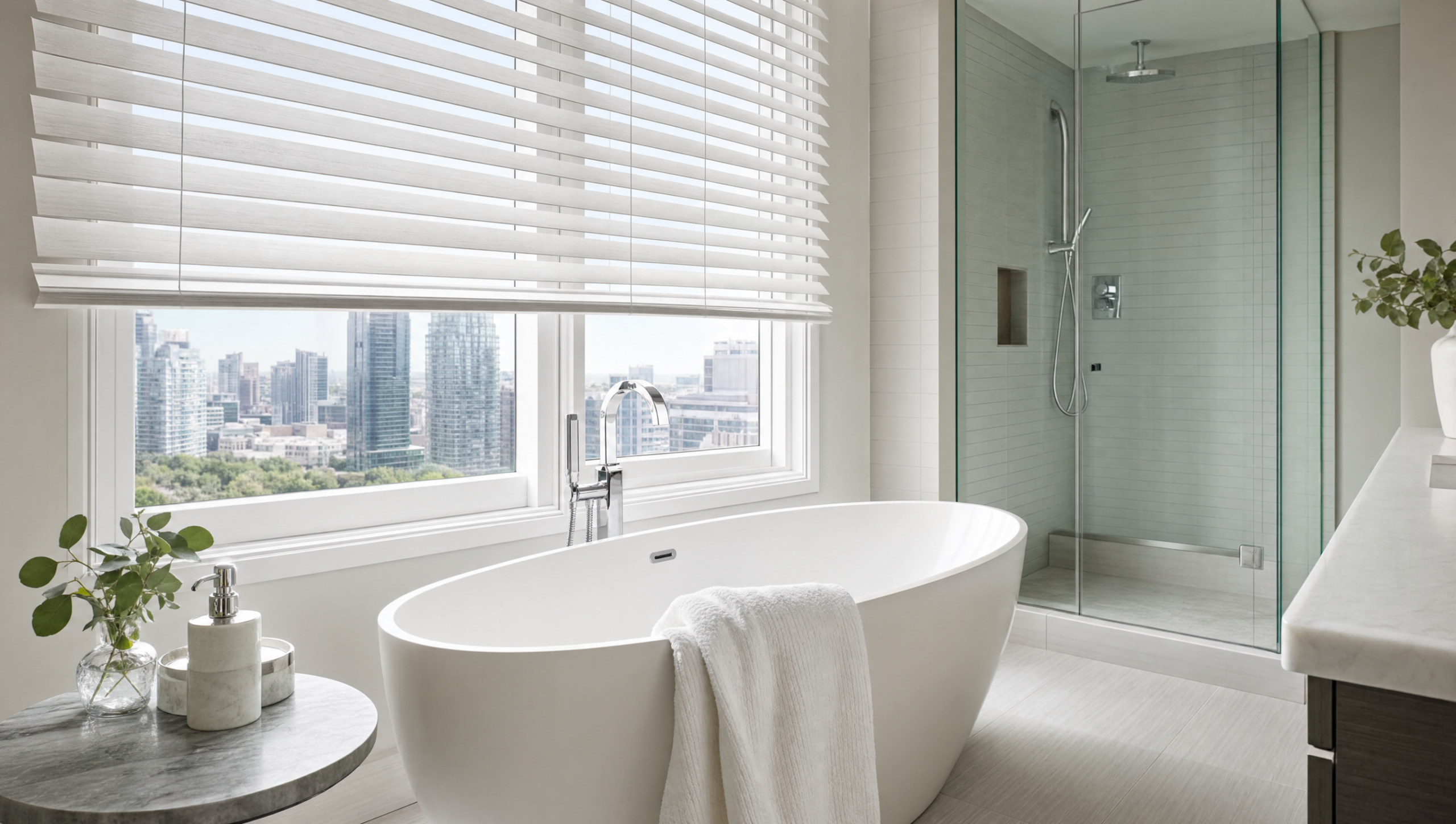

Steam from a hot shower, splashes at the sink, humidity that lingers long after the fan clicks off. Bathrooms and kitchens ask more of a window covering than any other room in a Toronto home. The wrong material warps, spots, or grows mould within a season, while the right one handles moisture for years and wipes clean in seconds. This guide walks through which blinds and shades actually hold up in wet rooms, how to handle privacy over a tub or a sink, and what to think about before you order.
Canadian Blinds Pros fits custom window coverings across Toronto and the GTA every week, and bathrooms and kitchens come with their own short list of materials that work. If you want the quick version: faux wood, aluminum, PVC roller and solar shades, and moisture-appropriate cellular shades are the dependable choices, and real wood belongs almost anywhere except a steamy bathroom.
Why Bathrooms and Kitchens Need Different Blinds
Most rooms only need a window covering to manage light and privacy. Wet rooms add a third demand: the covering has to survive a humid, splash-prone, sometimes greasy environment without falling apart. That single difference rules out a surprising number of popular options.
The Real Enemy Is Moisture, Not Just Water
A direct splash is easy to picture, but the quieter problem is humidity. Every shower pushes warm, moisture-heavy air into the room, and it settles on cool surfaces including your window and whatever hangs in front of it. Natural materials swell and shrink as they absorb and release that moisture, which is how real wood slats bow and how woven fabrics start to smell. Persistent damp also feeds mould, which is why Health Canada recommends keeping indoor humidity in check and ventilating wet rooms well. You can read their guidance on addressing moisture and mould in the home. A window covering that resists moisture and cleans easily is part of keeping that balance.
Privacy Comes First in a Bathroom
Bathroom windows sit close to the street, the driveway, or a neighbour’s wall far more often than living room windows do, and the room is where privacy matters most. That changes the goal. You usually want something that blocks the sightline at the bottom of the window while still letting daylight in up high, rather than a covering you throw fully open or fully shut. It is worth planning for privacy from the start rather than treating it as an afterthought.
Kitchens Add Grease, Heat, and Splashes
Kitchens are humid too, but they bring their own twist. Cooking throws a fine film of grease into the air that eventually lands on nearby surfaces, so a wipeable covering beats a fabric one over the sink or near the stove. Heat and open flame near a cooktop add a safety angle as well, which is a good reason to keep any covering clear of the burners and to lean toward materials that clean up with a damp cloth.
The Best Moisture-Resistant Materials
The material matters more than the style. A roller shade in the right fabric will outlast a wood blind in a bathroom every time. Here are the materials that earn their place in a wet room, and the ones to leave for drier parts of the house.
Faux Wood and Vinyl Blinds
Faux wood is the workhorse of bathroom window coverings. Made from PVC or a composite, it gives you the warm look of painted wood slats without the swelling and cracking that real wood suffers in humidity. It wipes clean, resists warping, and handles steam without complaint, which is why it turns up at the top of nearly every list of bathroom-friendly options. If you like the horizontal-slat look, faux wood is usually the smart pick. Our guide to Venetian blinds in faux wood and aluminum covers slat sizes and finishes in more detail.
Aluminum Blinds
Aluminum mini blinds are the other classic moisture-proof choice. The slats are rustproof, thin, and inexpensive, and they tilt to fine-tune light and privacy. They read a little more utilitarian than faux wood, so they suit a laundry room, a basement bathroom, or a rental where budget leads the decision. They also fit tight window frames well because the slats are so slim.
Roller and Solar Shades
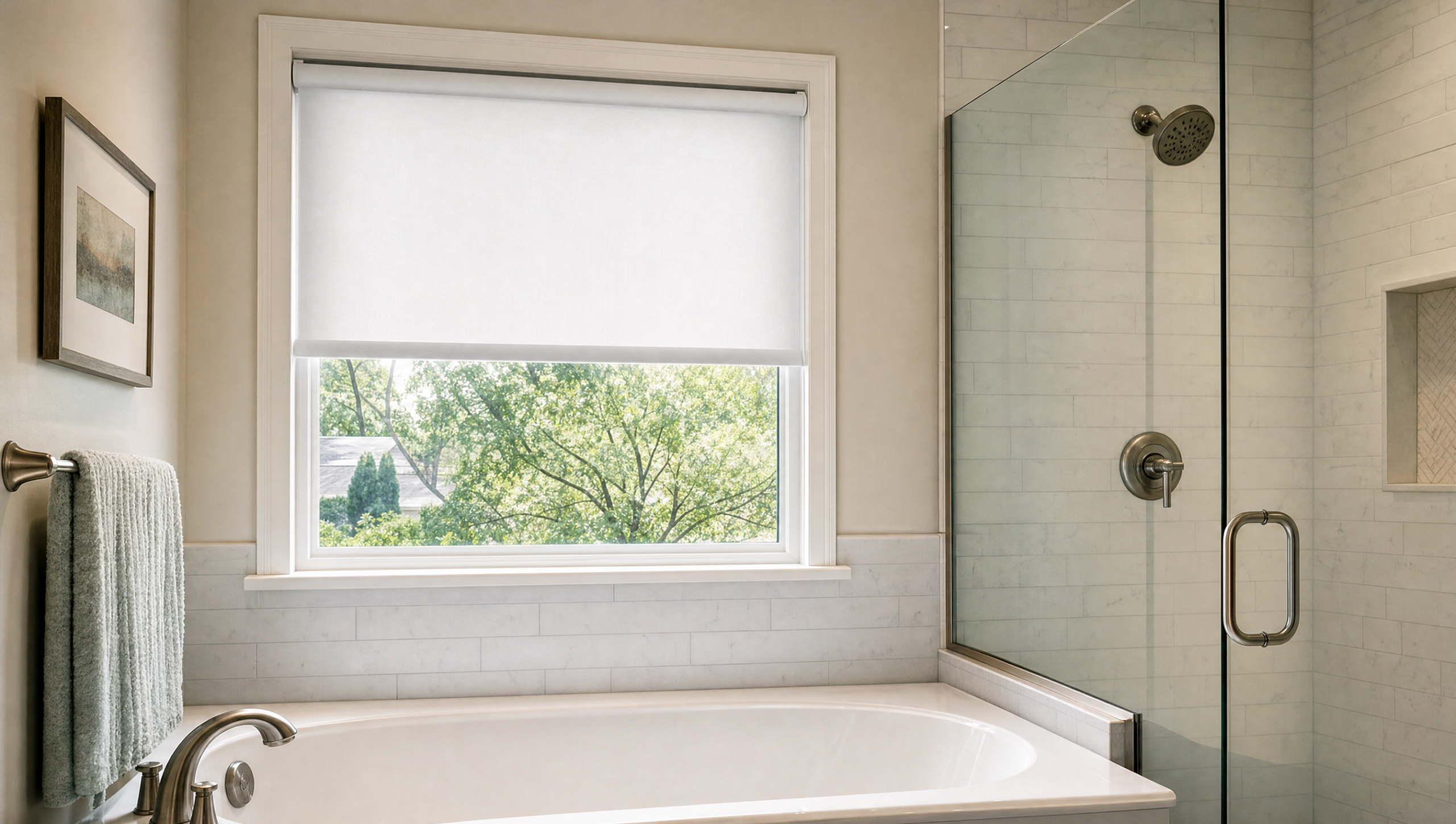
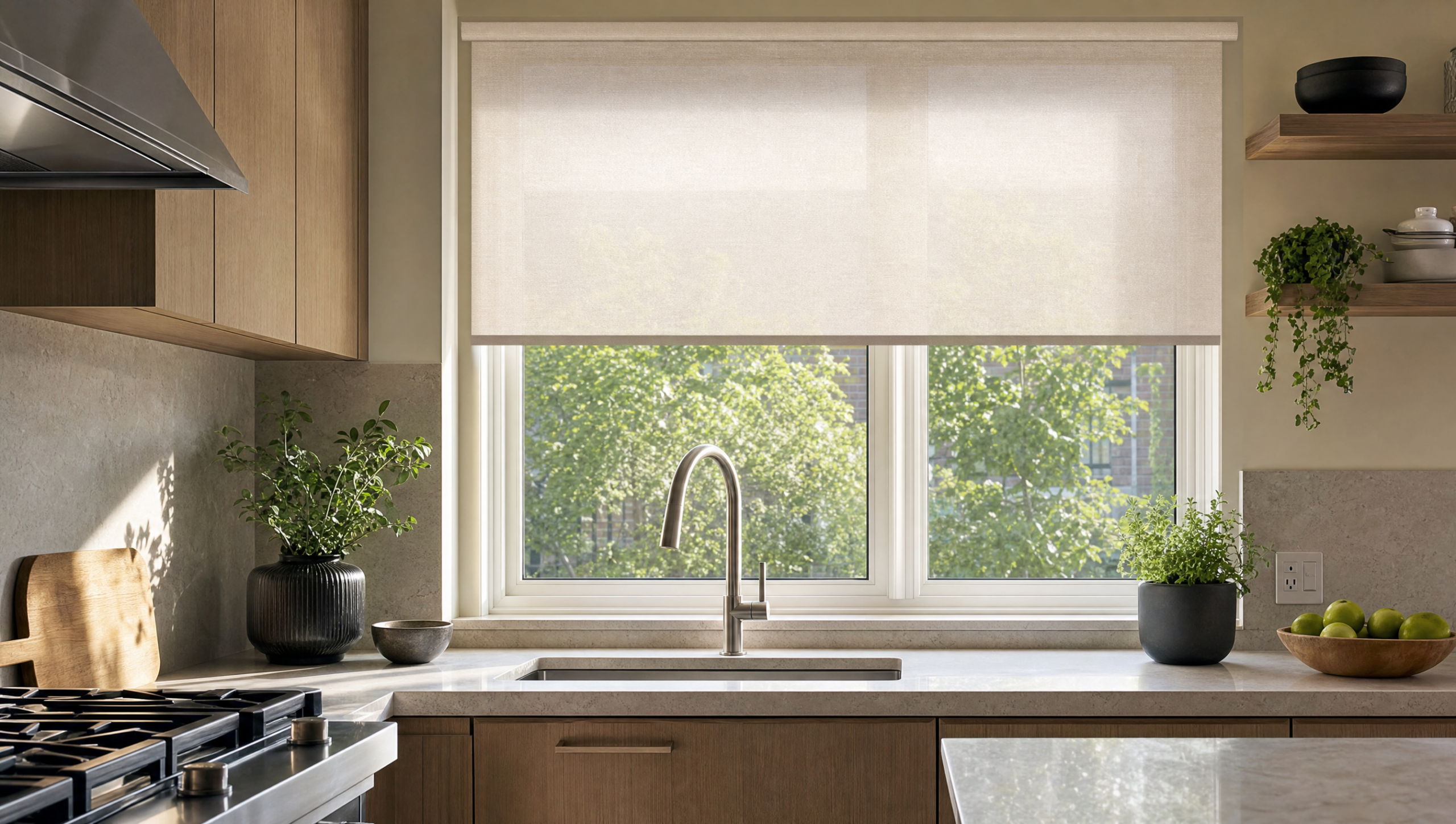
A roller shade in a vinyl, PVC-coated, or solar-screen fabric is one of the most practical wet-room coverings going. There is no cord ladder or slats to trap grime, the fabric wipes down with a cloth, and a solar screen keeps a view to the backyard while cutting glare over the kitchen sink. Choose a light-filtering or solar fabric for a kitchen and a room-darkening one for a bathroom that faces a neighbour. If reaching a shade above the tub is awkward, a motorized roller shade solves that neatly. Our walkthrough on choosing roller blinds for a room is a good next read.
Cellular (Honeycomb) Shades
Cellular shades are worth considering in a bathroom that runs cold, because the honeycomb pockets add insulation at the window. The catch is the fabric: standard honeycomb fabric can absorb moisture and is slow to dry, so you want a moisture-appropriate or spun-lace style if it will sit near a shower. Ask about the specific fabric before you commit. They shine in a powder room or a bathroom with light steam rather than a small, poorly ventilated one. See our full guide to cellular and honeycomb shades for the fabric options.
Vinyl Vertical Blinds and Panel Tracks
For a wide kitchen window or a patio door off the kitchen, vinyl vertical blinds and panel tracks handle moisture and heavy use gracefully. Vinyl vanes wipe clean, resist warping, and slide out of the way when you carry groceries through the door. They are a sensible answer where a horizontal covering would be awkward on a very wide opening.
Waterproof Shutters
Polymer and vinyl shutters, sometimes sold as waterproof or California-style shutters, give a bathroom a built-in, high-end look while standing up to humidity. The louvres tilt for privacy and light like a wood shutter would, but the material will not warp near a tub. They cost more than a blind or a roller shade, though many homeowners like that they read as part of the room rather than an add-on. Our buyer’s guide to California shutters explains the material choices.
Materials to Avoid in Wet Rooms
Real wood blinds and shutters top the avoid list, because natural timber absorbs moisture, then bows, splits, and lets its finish peel. Woven wood and bamboo shades bring the same problem plus a tendency to hold damp and develop a musty smell. Fabric Roman shades and untreated linen or cotton do not belong right beside a shower either, since they soak up steam and dry slowly. Save all of those for a bedroom or living room where the air stays dry. Our comparison of wooden versus faux wood blinds lays out the trade-off clearly.
| Material | Moisture resistance | Best room | Notes |
|---|---|---|---|
| Faux wood blinds | Excellent | Bathroom, kitchen | Warm slat look, wipes clean, will not warp |
| Aluminum blinds | Excellent | Bathroom, laundry, basement | Rustproof, slim, budget-friendly |
| Vinyl or PVC roller shade | Excellent | Bathroom, kitchen | No slats to trap grime, wipes down fast |
| Solar screen shade | Very good | Kitchen over the sink | Keeps the view, cuts glare |
| Cellular (honeycomb) | Good with the right fabric | Powder room, light-steam bathroom | Adds insulation; choose a moisture-rated fabric |
| Vinyl vertical or panel track | Excellent | Wide kitchen window, patio door | Slides aside for traffic |
| Polymer or vinyl shutter | Excellent | Bathroom | Built-in look, higher cost |
| Real wood blinds or shutters | Poor | Keep out of wet rooms | Warps, cracks, finish peels in humidity |
| Woven wood or bamboo | Poor | Keep out of wet rooms | Holds damp, can smell musty |
| Fabric Roman shade | Poor near water | Dry rooms only | Absorbs steam, dries slowly |
Best Blinds for Bathrooms, Window by Window
The right answer for a bathroom depends on where the window sits and how much steam reaches it. A window across the room from the shower has an easier life than one right above the tub.
Windows Right Beside or Above the Tub or Shower
This is the harshest spot in the house for a window covering, so lean into fully waterproof materials: faux wood, aluminum, a PVC roller shade, or a polymer shutter. Skip anything fabric-heavy or natural here. If the window is high or hard to reach over the tub, a cordless or motorized covering saves you from stretching across a wet surface.
Frosted or Small Privacy Windows
Plenty of bathrooms already have frosted or textured glass for privacy, so the covering is really about controlling daylight and finishing the look. A slim aluminum blind or a simple roller shade does the job without crowding a small window. If you want light without a full blind, a top-down bottom-up shade lets you drop the top for daylight while the bottom stays closed.
Bathrooms With No Window or Ventilation
An interior bathroom with no window still deserves attention, because trapped humidity is exactly what feeds mould. There is no covering to choose here, but the moisture lesson carries over to nearby rooms: run the fan, keep the door open after a shower, and treat any covering on a connected hallway or bedroom window as part of the same humidity picture.
| Bathroom window | Top recommendation | Why |
|---|---|---|
| Above or beside the tub | Faux wood, PVC roller, or polymer shutter | Fully waterproof, handles direct steam |
| Small frosted window | Aluminum blind or plain roller shade | Manages light without crowding the frame |
| Street-facing window | Top-down bottom-up or room-darkening roller | Privacy at eye level, daylight up high |
| High or hard-to-reach window | Motorized roller or shade | No reaching across a wet surface |
| Cold basement bathroom | Moisture-rated cellular shade | Adds insulation at the glass |
Best Blinds for Kitchen Windows
Kitchens are busier than bathrooms and the window locations vary more, so it helps to think zone by zone. The custom window shades that suit a window over the sink are not the same ones you would hang beside a stove.
The Window Over the Sink
The sink window sees splashes and daily use, so a wipeable roller shade or a faux wood blind is ideal. A solar screen is a favourite here because it tames afternoon glare while keeping a view to the yard, which matters when you spend real time at the sink. Cordless operation keeps things tidy when your hands are wet.
Windows Near the Stove
A window right beside the cooktop needs a wipeable, low-fuss covering that clears grease easily, and it should sit clear of the burners. Aluminum and vinyl handle airborne grease better than fabric, and a covering that raises fully out of the way reduces any risk near an open flame. Keep long fabric coverings away from a gas range entirely.
Patio and Garden Doors Off the Kitchen
Many Toronto kitchens open onto a deck or backyard through a sliding or garden door. Vinyl vertical blinds and panel tracks are built for that opening, since they slide fully aside and wipe clean. If you would rather not touch them at all, motorized options work well on doors you use often. For a whole-home view of matching coverings to each space, our room-by-room blinds guide is a useful companion.
| Kitchen zone | Top recommendation | Why |
|---|---|---|
| Over the sink | Solar or vinyl roller shade | Keeps the view, cuts glare, wipes clean |
| Beside the stove | Aluminum blind or vinyl roller | Clears grease, raises clear of the flame |
| Wide picture window | Panel track or faux wood | Covers a broad span neatly |
| Patio or garden door | Vinyl vertical or panel track | Slides aside for daily traffic |
Privacy and Light Control in Wet Rooms
Getting privacy and daylight to coexist is the quiet art of a good bathroom or kitchen window. A few features make it easier.
Top-Down Bottom-Up for Bathroom Privacy
A top-down bottom-up shade opens from the top as well as the bottom, so you can pull the top down for morning light while the lower half stays shut against the street. It is one of the most useful features for a bathroom, and it works with several moisture-friendly fabrics. If privacy is your first concern anywhere in the home, our roundup of the best blinds for privacy without losing daylight goes deeper.
Day-Night and Light-Filtering Choices
Day-night or zebra-style shades alternate sheer and solid bands, letting you shift from a soft filtered view to full privacy with a small pull. In a kitchen you will often want light-filtering fabric to keep the room bright, while a bathroom that faces a neighbour usually calls for room-darkening. Frosted window film is a fine companion to any of these when you want permanent privacy on the lower glass and a covering only for light.
Mounting: Inside vs Outside, Drill vs No-Drill
How a covering mounts changes how it looks and how easy it is to fit around bathroom and kitchen fixtures like tile, a backsplash, or a deep sill.
Inside Mount vs Outside Mount in Tight Bathrooms
An inside mount sits inside the window frame for a clean, built-in look and needs enough depth to hold the headrail. An outside mount fixes above and around the opening, which covers an awkward or shallow frame and blocks more light at the edges. Bathrooms often have shallow frames or tile right up to the glass, so the choice is worth checking before you order. Our breakdown of inside mount versus outside mount covers the depth requirements.
No-Drill Options for Renters and Tile
If you rent, or if you would rather not drill into tile, tension and adhesive-mounted shades give you a damage-free fit on many bathroom and kitchen windows. They work best on lighter coverings and smaller windows. Our guide to no-drill blinds for renters and condos explains where they hold and where a drilled bracket is still the better call.
| Mount type | Best for | Watch for |
|---|---|---|
| Inside mount | Deep frames, a clean built-in look | Needs enough depth; slight light gaps at edges |
| Outside mount | Shallow frames, blocking more light | Covers surrounding wall or tile |
| No-drill (tension or adhesive) | Renters, tile, smaller windows | Suited to lighter coverings |
Cordless and Child-Safe Options for Family Bathrooms
Bathrooms and kitchens are rooms where young children spend time, and dangling cords are a known hazard. Health Canada sets out clear blind cord safety guidance, and choosing cordless or motorized operation removes the reachable cord entirely. It also happens to be tidier in a wet room, where a cord would only collect grime. If children are part of the picture, start with our notes on cordless blinds and child-safe window coverings.
Cleaning and Maintaining Blinds in Humid Rooms
Half of keeping a wet-room covering looking good is choosing a material that cleans easily, and the other half is a quick routine. Hard surfaces like faux wood, aluminum, and vinyl wipe down with a damp cloth and a little mild soap, and that is usually all they need. Roller and solar shades take a wipe as well, plus an occasional vacuum with a brush attachment. The point of a wipeable material is that a monthly pass keeps grease and soap film from building into a problem.
Ventilation does the heavy lifting on mould. Run the exhaust fan during and after a shower, leave the covering open to dry between uses, and keep the room’s humidity down. A covering that dries quickly, which is exactly what the hard and synthetic materials do, gives mould far less to work with.
| Material | How to clean | How often |
|---|---|---|
| Faux wood or aluminum | Damp cloth, mild soap, dry the slats | Monthly, more near a stove |
| Vinyl or PVC roller | Wipe with a damp cloth | Monthly |
| Solar screen | Vacuum with a brush, spot-wipe | Every one to two months |
| Cellular shade | Vacuum gently; check the fabric care | As needed |
| Vinyl vertical or panel | Wipe each vane, clean the track | Monthly |
What It Costs and What Drives the Price
Prices for wet-room coverings vary with the material, the size of the window, and the features you add, so the honest answer is that it depends. Aluminum and basic vinyl rollers sit at the affordable end, faux wood and quality roller fabrics fall in the middle, and shutters and motorization sit at the top. A free in-home consultation is the fastest way to a real number, since custom sizing and mounting are priced to the actual window. The table below shows what moves the figure up or down.
| Cost driver | Effect on price |
|---|---|
| Material | Aluminum and vinyl are lowest; shutters are highest |
| Window size and shape | Larger or specialty windows cost more |
| Motorization | Adds cost but removes cords and reach issues |
| Fabric or finish | Solar screens and premium fabrics add to the base |
| Number of windows | Outfitting several at once is usually more efficient |
Measuring and Installation
Wet-room windows reward careful measuring, because tile, a backsplash, a deep sill, or a nearby faucet can all get in the way of a covering that looked fine on paper. Measure the width in three places and the height in three places, and note the frame depth if you want an inside mount. If you are fitting a condo or a tricky opening, our guide on how to measure your windows walks through it step by step. A professional measure and install takes the guesswork out entirely, which matters most on the windows that are hardest to reach.
Condo bathrooms and kitchens have their own quirks, from shallow frames to building rules about what shows from outside. Our Toronto condo window covering guide covers those details for high-rise homes.
Questions to Ask Before You Order
A short checklist saves a lot of second-guessing. Run through these before you commit to a covering for a bathroom or kitchen.
| Question | Why it matters |
|---|---|
| Is the material genuinely moisture-resistant? | Rules out real wood and untreated fabric near water |
| How close is the window to the shower or stove? | Decides how waterproof or wipeable it needs to be |
| Do I need privacy at eye level, daylight up high, or both? | Points to top-down bottom-up or day-night styles |
| Will children use the room? | Favours cordless or motorized operation |
| Is the frame deep enough for an inside mount? | Decides inside versus outside mount |
| Do I own or rent? | Renters may prefer no-drill mounting |
| How easy is it to clean? | Wipeable materials save time in busy rooms |
Frequently Asked Questions
What type of blinds are best in a bathroom?
Faux wood blinds, aluminum blinds, PVC or vinyl roller shades, and polymer shutters are the best bathroom blinds because they resist moisture, will not warp, and wipe clean. For a bathroom that runs cold, a moisture-rated cellular shade adds insulation. Avoid real wood and untreated fabric near the shower.
What are the best blinds for a kitchen window?
Over the sink, a solar or vinyl roller shade keeps the view while cutting glare and wiping clean. Beside the stove, aluminum or vinyl clears grease and raises clear of the flame. For a wide window or patio door, vinyl vertical blinds and panel tracks handle the span and slide aside for traffic.
Are faux wood blinds good for bathrooms?
Yes. Faux wood is one of the top bathroom choices because it gives you the look of painted wood slats without the warping and cracking real wood suffers in humidity. It handles steam, wipes clean, and holds its finish, which makes it a dependable pick for windows near a tub or shower.
Can I put real wood blinds in a bathroom?
It is not recommended. Real wood absorbs moisture, then bows and cracks over time in a humid bathroom, and its finish tends to peel. Faux wood gives you nearly the same look while standing up to steam, so it is almost always the smarter choice in a wet room. Save real wood for dry rooms.
Do bathroom blinds get mouldy?
Moisture-resistant materials like faux wood, aluminum, and vinyl resist mould because they do not hold water and dry quickly. Mould is far more likely on fabric or natural materials that stay damp. Good ventilation and keeping room humidity down, as Health Canada advises, are the biggest factors in preventing it.
What can I put on a bathroom window for privacy?
A top-down bottom-up shade gives privacy at eye level while letting daylight in up high. Room-darkening roller shades, tilted aluminum or faux wood blinds, and frosted window film also work well. Many homeowners combine frosted film on the lower glass with a light covering above for the best of both.
Which is better for a bathroom, curtains or blinds?
Blinds usually win in a bathroom because fabric curtains absorb steam, dry slowly, and can develop a musty smell or mould. A moisture-resistant blind or roller shade wipes clean and holds up to humidity. Curtains suit a dry powder room, but near a shower a hard or synthetic covering is the safer bet.
What are the best blinds for a window over the shower or tub?
Choose fully waterproof materials for this spot: faux wood, aluminum, a PVC roller shade, or a polymer shutter. If the window is high or hard to reach, cordless or motorized operation means you never have to stretch across a wet surface. Skip anything fabric-heavy or natural directly above a tub.
Are no-drill blinds any good for bathrooms?
No-drill blinds work well on lighter coverings and smaller bathroom or kitchen windows, and they spare tile and rental walls from holes. Tension and adhesive mounts hold a modest roller shade or blind reliably. For a large or heavy covering, a drilled bracket is still the sturdier option.
What color bathroom blinds look best?
White and soft neutrals are the most popular because they keep a bathroom feeling bright and clean and pair with almost any tile. A warm faux wood tone adds cosiness, while a darker shade suits a bold, modern room. The finish matters as much as the colour, so choose one that hides water spots well.
Do blinds near a stove pose a fire risk?
A covering right beside a cooktop should be kept clear of the burners, and long fabric coverings do not belong next to a gas range. Wipeable materials like aluminum and vinyl are safer choices near cooking, and a covering that raises fully out of the way reduces any risk near an open flame.
Are cellular shades suitable for bathrooms?
They can be, with the right fabric. Standard honeycomb fabric absorbs moisture and dries slowly, so a moisture-rated or spun-lace style is the one to use near steam. Cellular shades add welcome insulation in a cold basement bathroom or a powder room with light steam, but a small unventilated bathroom is a tougher test.
What is the best window covering for a kitchen over the sink?
A solar screen roller shade is a popular pick over the sink because it cuts glare and keeps a view to the yard while wiping clean of splashes. A vinyl roller or faux wood blind works well too. Cordless operation is handy at a sink, where your hands are often wet.
How do I clean blinds in a humid room?
Hard materials like faux wood, aluminum, and vinyl wipe down with a damp cloth and mild soap, which is usually all they need. Roller and solar shades take a wipe plus an occasional vacuum with a brush attachment. A quick monthly pass keeps grease and soap film from building up.
Should bathroom blinds be inside or outside mount?
An inside mount looks built-in and needs a frame deep enough for the headrail, which some bathrooms lack. An outside mount suits a shallow or tiled frame and blocks more light at the edges. Check the frame depth before ordering, or have the window measured so the mount matches the opening.
Can blinds help with condensation on bathroom windows?
Blinds do not stop condensation, which comes from warm humid air meeting cold glass, but a moisture-resistant covering will not be damaged by it the way wood or fabric would. Running the fan, lowering humidity, and choosing a material that dries fast are what keep condensation from becoming a mould problem.
Ready to Fit Out Your Bathroom or Kitchen?
The safest way to get a wet-room window right is to see the materials in your own space and have the window measured properly. Canadian Blinds Pros offers a free in-home consultation across Toronto and the GTA, where you can compare faux wood, roller, cellular, and shutter options against your tile, light, and privacy needs. Book a free consultation or browse our window blinds gallery to see how different coverings look in real Toronto homes.