
Roller Shades in Toronto: A Complete Buyer’s Guide to Fabrics, Opacity, Mounting, and Motorization
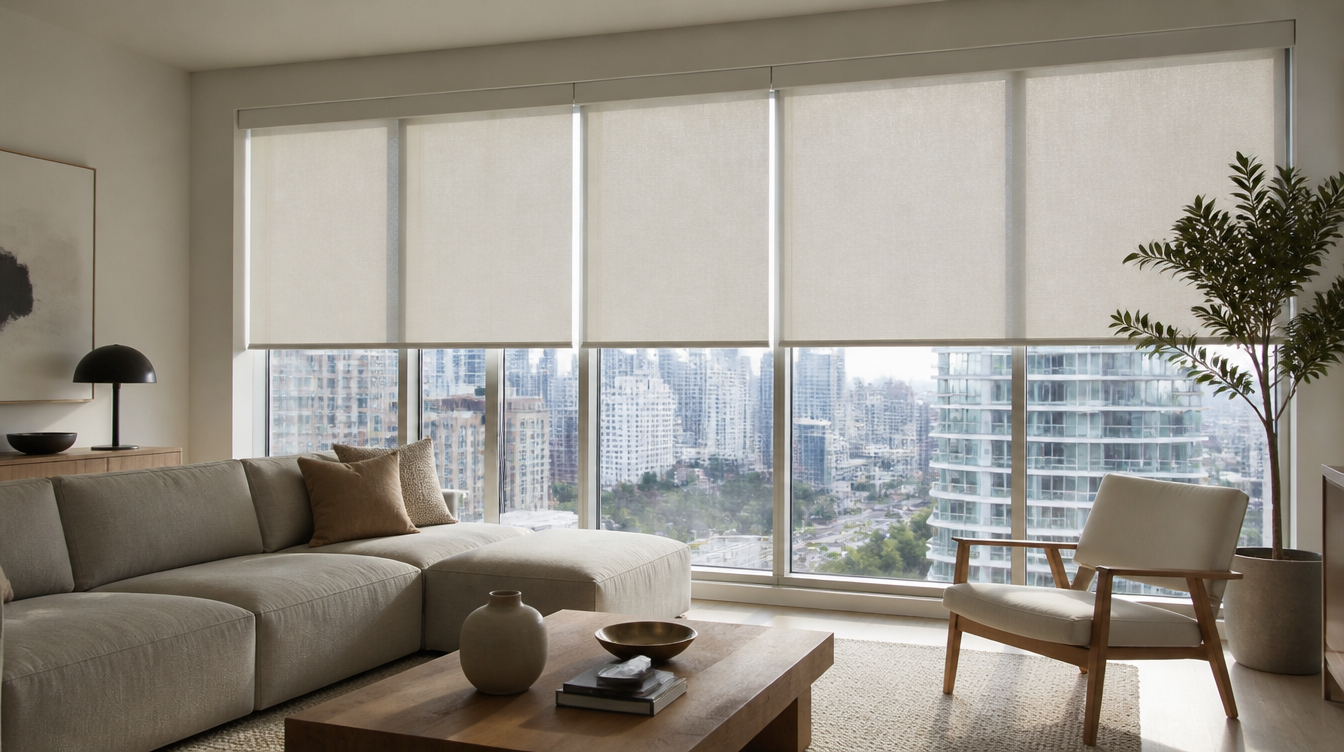

Roller shades are the quiet workhorse of Toronto window coverings. One clean panel of fabric wraps around a slim tube at the top, drops straight down over the glass, and rolls back up out of sight when you want the view. There are no slats to dust, no cords swagging across the window, and no fussy folds to line up. For a lot of homes and condos across the GTA, that simplicity is the whole appeal.
The catch is that “roller shades” covers a much wider range than most people expect. The same basic mechanism can give you a sheer sunscreen that keeps the skyline visible, a soft light filtering panel for a living room, or a true blackout shade for a west facing bedroom. The fabric you pick, the way the roll is finished at the top, and the control you choose all change how the shade looks and how it lives day to day. Get those three decisions right and a roller shade will outlast most of the furniture in the room.
This guide walks through how roller shades actually work, the fabric and opacity choices that matter most, the hardware and control options, where they fit best in a Toronto home, what drives the price, and how to measure, install, and keep them clean. If you are weighing them against other styles, we will point you to the right comparisons along the way.
What Are Roller Shades?
A roller shade is a single piece of fabric attached to a rotating tube mounted at the top of the window. Turning the tube winds the fabric up or lets it down, so the shade covers as much or as little of the glass as you like. It is one of the oldest and most reliable window covering designs, and modern versions add better fabrics, cleaner hardware, and cordless or motorized control.
The parts are easy to picture. There is the tube or roller, the fabric itself, a bottom bar or hem bar that adds weight so the shade hangs flat, brackets that hold the tube to the wall or window frame, and a control system such as a bead chain, a spring, or a motor. Some roller shades add a decorative top treatment called a cassette or a fascia, which we cover further down.
Because everything rolls into a compact cylinder, a raised roller shade takes up very little space and shows very little hardware. That low profile is a big reason designers keep reaching for them in modern homes and offices where clean sightlines matter.
Roller Shades or Roller Blinds: Is There a Difference?
People use both names, and in Canada they usually mean the same product. “Roller blind” is the more common phrase in the UK and Australia, while “roller shade” is used more often in North America. When someone says roller blinds, they are almost always talking about the same fabric-on-a-tube design. You will also see them sold as roller window shades, window roller blinds, and pull down shades. We use roller shades and roller blinds interchangeably here.
Fabric and Opacity: The Choice That Matters Most
Before you think about hardware or color, decide how much light you want the shade to let through. This is the single decision that shapes how a room feels, and it is the one people most often get wrong. Roller shade fabrics fall into three broad families: light filtering, blackout, and solar or screen. Each one handles daylight, privacy, and the view in a different way.
Light Filtering Roller Shades
Light filtering fabrics are the middle ground and the most popular choice for main living spaces. They soften and diffuse daylight so a room stays bright without harsh glare, and they give you daytime privacy because people outside cannot make out detail through the fabric. At night, with interior lights on, a light filtering shade shows silhouettes, so it is not the right pick where you need full privacy after dark. For a living room, dining room, or home office, this is usually the sweet spot.
Blackout Roller Shades
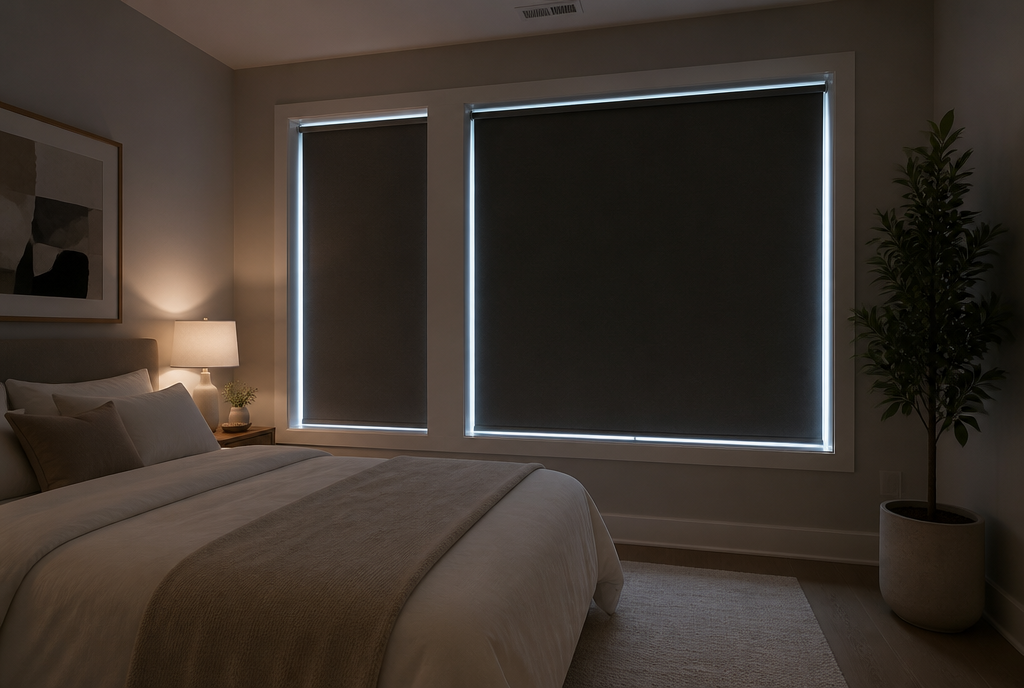
Blackout fabric is woven or coated to stop light passing through the material itself. Lowered, the panel blocks essentially all light through the fabric, which is why it is the go to for bedrooms, nurseries, and media rooms. One thing to understand is that a standard roller shade still leaves small gaps along the sides and bottom where light sneaks around the edges, so a blackout roller is not the same as a fully darkened room unless you add side channels or an outside mount that overlaps the frame. We get into that trade off in our guide to blackout roller shades, and it is worth reading before you order for a bedroom.
Solar and Screen Roller Shades
Solar shades, sometimes called sunscreen or screen shades, use an open weave that cuts glare and blocks a large share of UV while keeping the view to the outside. They are rated by openness factor, a percentage that tells you how tightly the fabric is woven. A lower openness factor such as 3 percent blocks more sun and gives more privacy but dims the view slightly, while a higher factor such as 10 percent keeps the view crisp but lets in more light and offers less daytime privacy. Solar fabrics are popular for condos with big south and west windows and for offices with screen glare. The Attachments Energy Rating Council keeps independent performance data on these fabrics, and you can read more about how coverings are rated at the Attachments Energy Rating Council.
Comparing the Three Fabric Types
| Fabric type | Daytime privacy | Night privacy | Keeps the view | Best rooms |
|---|---|---|---|---|
| Light filtering | Good | Limited, shows silhouettes | No, diffuses it | Living, dining, home office |
| Blackout | Full | Full through the fabric | No | Bedrooms, nurseries, media rooms |
| Solar or screen | Depends on openness factor | Low | Yes, keeps the outside visible | Condos, offices, sunny views |
If a single fabric will not do everything a room needs, many Toronto homeowners run two roller shades on one window, a solar or light filtering shade for the day and a blackout shade for the night. That double roller setup is common in bedrooms with a great view. If you want the softer look of a sheer with a solid panel behind it in one unit, take a look at sheer shades and zebra blinds, both of which are close cousins of the roller shade.
Roller Shade Hardware: Open Roll, Cassette, and Fascia
The mechanism is the same across roller shades, but the way the top is finished changes the look and, in some spots, the performance. There are three common ways to treat the headrail.
Open Roll
An open roll leaves the tube and the wrapped fabric exposed at the top. It is the most budget friendly finish and the most minimal, and it suits a casual or industrial room. The trade off is that the roll and brackets are visible, and there is no cover to help seal light at the very top of the window.
Cassette
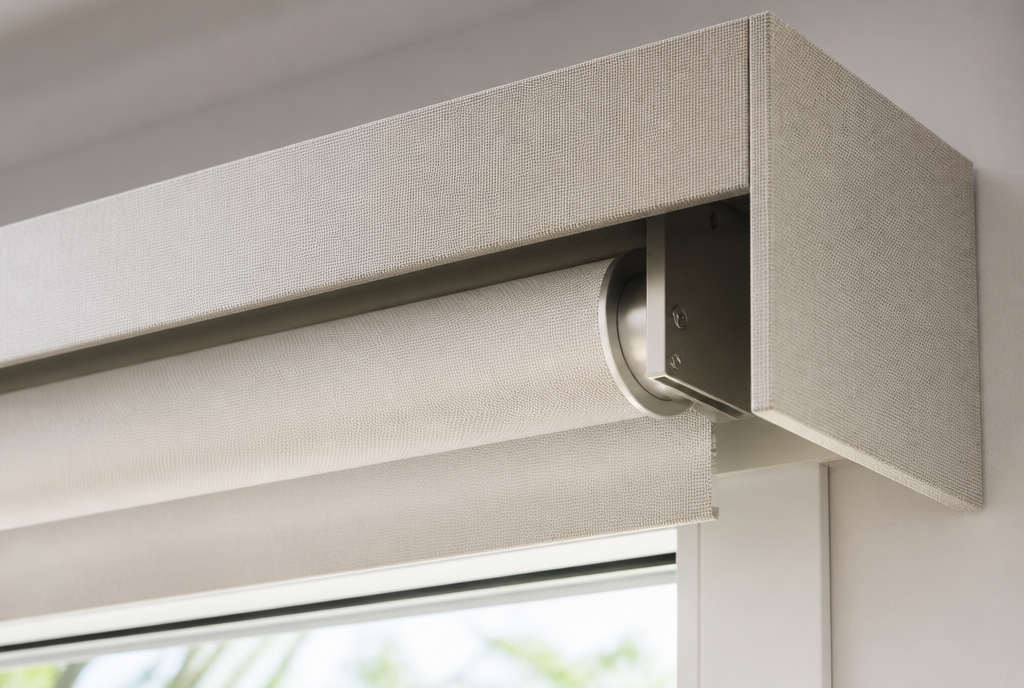
A cassette is an enclosure, usually aluminum, that wraps around the rolled up fabric and hides the tube. It gives the shade a clean, finished edge at the top and can be wrapped in matching fabric so it disappears into the design. A cassette also helps close the light gap along the top of the shade, which is useful for bedrooms.
Fascia
A fascia is a flat front panel that runs across the top and conceals the roll from the front while leaving the back open. It reads as a crisp horizontal line and is a favorite in contemporary interiors. Like a cassette, it hides the hardware, and it pairs well with wide windows where you want an uninterrupted top edge.
| Headrail finish | Look | Hides hardware | Helps with top light gap | Relative cost |
|---|---|---|---|---|
| Open roll | Minimal, casual | No | No | Lowest |
| Cassette | Clean, wrapped edge | Yes | Yes | Higher |
| Fascia | Flat modern line | Front only | Partial | Higher |
Control Options: Chain, Cordless, and Motorized
How you raise and lower the shade is a real decision, not an afterthought. It affects safety, convenience, and cost, and it is hard to change later without new hardware.
Bead Chain
The classic control is a continuous bead chain, usually plastic or metal, looped on one side. It is inexpensive, reliable, and easy to operate on large shades because the chain gives you leverage. The downside is the loop itself, which is a strangulation hazard around young children and pets unless it is secured. Health Canada regulates corded window coverings for this reason, and any chain should be tensioned to the wall and kept well out of reach. You can read the federal rules in the Corded Window Coverings Regulations.
Cordless and Spring Roller
A cordless roller shade uses a spring mechanism inside the tube. You give the bottom bar a gentle tug to release it and guide it up or down by hand. With no chain or loop, it is the safest choice for homes with kids or pets and gives the cleanest look. Cordless works best on small and medium shades, since very large or heavy panels can be awkward to operate by hand. If safety is driving your decision, our comparison of corded versus cordless blinds lays out the pros and cons.
Motorized and Smart Roller Shades
Motorized roller shades put a small motor inside the tube so you can raise and lower them with a remote, a wall switch, an app, or a voice assistant. They are excellent for hard to reach windows, for a whole wall of shades you want to move together, and for anyone who wants to schedule shades to close against the afternoon sun. Motors run on rechargeable batteries or can be hardwired during a renovation. Battery motors are the easy retrofit, while hardwiring makes sense when the walls are already open. For a full walk through, see how to automate roller shades and our overview of motorized blinds.
| Control | Child and pet safety | Best for | Relative cost |
|---|---|---|---|
| Bead chain | Needs a tensioner, keep out of reach | Large or heavy shades on a budget | Lowest |
| Cordless spring | Safest, no accessible cord | Small to medium shades, kids and pets | Moderate |
| Motorized | Safe, no accessible cord | High or wide windows, whole rooms, scheduling | Highest |
Inside Mount or Outside Mount
Where the shade sits relative to the window opening changes both the look and how well it controls light. An inside mount installs the shade inside the window frame, giving a clean built in look that shows off the trim. It needs enough depth in the frame for the brackets, and it leaves the usual small light gaps at the sides. An outside mount installs the shade on the wall or trim above the opening, so the fabric overlaps the frame. That overlap covers more of the light gap and can make a small window look larger, at the cost of hiding the trim.
For blackout in a bedroom, an outside mount with generous overlap, or an inside mount paired with side channels, controls edge light far better than a plain inside mount. For a crisp modern look on a well built window, an inside mount usually wins. We break down the full decision in our guide to inside mount versus outside mount blinds.
| Factor | Inside mount | Outside mount |
|---|---|---|
| Look | Built in, shows the trim | Covers the trim, can enlarge the window |
| Light control at edges | Small side gaps remain | Overlap seals more light |
| Depth needed | Requires enough frame depth | Works on shallow frames |
| Best use | Clean modern rooms, good trim | Bedrooms, small or uneven windows |
Best Rooms and Windows for Roller Shades in Toronto
Roller shades are flexible enough to work almost anywhere, but the right fabric and control change from room to room.
Living and Dining Rooms
Light filtering fabric in a neutral tone keeps these rooms bright and private during the day while protecting furniture and floors from fading. A cassette or fascia gives the finished look most people want in the main living space. If you have a great view, a solar shade keeps it visible while cutting glare on the television.
Bedrooms and Nurseries
This is blackout territory. Pair a blackout fabric with side channels or a generous outside mount to keep morning light out, and choose cordless or motorized control for safety around a crib. A double roller with a solar shade for the day and a blackout shade for the night gives you the best of both.
Kitchens and Bathrooms
Moisture and steam call for fabrics that resist warping and are easy to wipe down. Solar and vinyl coated roller fabrics handle humidity well, and their smooth surface cleans easily. Cordless or motorized control keeps you from reaching over a sink or stove. Our guide to bathroom and kitchen blinds covers moisture resistant options in more detail.
Patio Doors and Wide Windows
A single roller shade can span a fairly wide window, but very wide sliders often look and work better with a different style. For a patio door you use daily, weigh a wide roller against panel track blinds or vertical blinds, both built for sideways traffic. For a large picture window that you do not walk through, a wide motorized roller is often the cleanest answer.
Condos and High Rise Windows
Condo living rooms with floor to ceiling glass are a natural fit for solar and light filtering rollers, which tame the sun without hiding the skyline. Many buildings have rules about what is visible from outside, so a neutral backing keeps things consistent across the facade. Our Toronto condo window covering guide covers building rules and no drill options, and renters will want the no drill blinds guide for damage free mounting.
Home Offices
Screen glare is the enemy in a home office. A solar shade with a low openness factor cuts the sun on your monitor while keeping the room from feeling boxed in, and motorization lets you drop the shade as the sun moves without leaving your desk.
Roller Shades and Toronto’s Climate
Toronto asks a lot of a window covering. Summers bring strong afternoon sun that heats south and west rooms and fades furnishings, while winters bring long cold nights when heat escapes through the glass. Roller shades help on both ends. Solar and light filtering fabrics block a large share of solar heat gain in summer, and any lowered shade adds a small layer of insulation on winter nights by slowing the movement of air against the cold glass.
Roller shades are not the top performer for insulation. If cutting heating and cooling bills is your main goal, cellular shades trap air in their honeycomb pockets and lead the field. Roller shades sit in the practical middle, giving useful sun control and a modest thermal benefit in a slim, easy to live with package. For the full picture on saving energy, see our guide to energy efficient window coverings and our look at cellular shades. If summer heat is your worry, we compare the best options for that in which shades reduce summer heat. ENERGY STAR guidance from Natural Resources Canada is a useful reference on window efficiency, available at Natural Resources Canada.
What Roller Shades Cost in Toronto
Prices vary widely because a roller shade is really a set of choices, and each one moves the number. Rather than quote a figure that would be out of date by the time you read it, it helps to understand what drives the cost so you can see where your money goes. For a detailed local breakdown, see our article on how much roller shades cost in Toronto.
| Cost driver | What raises the price |
|---|---|
| Window size | Wider and taller shades use more fabric and a stronger tube |
| Fabric | Designer, blackout, and premium solar fabrics cost more than basic ones |
| Headrail finish | A cassette or fascia adds cost over an open roll |
| Control | Cordless costs more than chain, motorized costs the most |
| Number of windows | Whole home orders cost more overall but often lower the per window price |
| Installation | Professional measuring and installation add labour but reduce fit mistakes |
Custom roller shades cost more than an off the shelf panel from a big box store, and the reason is fit and lifespan. A made to measure shade fits the exact opening, uses better fabric and hardware, and tends to last far longer, which usually makes it the better value over the years you will own it. If you want to weigh that trade off, our piece on whether custom blinds are worth it is a good next read.
How to Measure for Roller Shades
Accurate measurements are the difference between a shade that looks built in and one that never sits right. The method depends on your mount type, so decide that first.
For an inside mount, measure the width of the window opening at the top, middle, and bottom, and use the narrowest of the three. Measure the height from the top of the opening to the sill at the left, middle, and right, and use the longest. Check that the frame is deep enough for the brackets and any cassette. For an outside mount, decide how far you want the shade to overlap the opening, usually a few centimetres on each side and above, then measure the full width and height you want the fabric to cover.
Two habits save a lot of grief. Measure with a steel tape rather than a cloth one, and write down width before height every time, since the industry always lists width first. If you are ordering several windows, label each measurement by room and location. When the stakes are high, such as a wall of expensive motorized shades, a professional measure is cheap insurance.
Installation
Installing a roller shade is one of the more approachable window covering jobs. The brackets screw to the frame for an inside mount or to the wall or trim for an outside mount, the tube clips into the brackets, and you level it before tightening. The details that trip people up are drilling into the right material, getting the brackets perfectly level so the shade rolls straight, and handling motor wiring or battery mounting cleanly.
Renters and condo owners who cannot drill have options, from tension based and adhesive mounts to bracket systems that clip onto the window frame. Those approaches only suit lighter shades, so check the weight limits. Our no drill blinds guide covers what works and what does not. For large, heavy, or motorized shades, professional installation is worth it, both for the finish and to protect the warranty.
Cleaning and Maintenance
One of the best things about roller shades is how little upkeep they need. The flat fabric has nowhere for dust to settle the way it does on slatted blinds, so routine care is quick.
For regular cleaning, run a vacuum with a brush attachment over the fabric on a low setting, or wipe it with a dry microfibre cloth, working from top to bottom. For spots, blot gently with a slightly damp cloth and mild soap, then let the shade air dry fully before rolling it up, since rolling it damp can leave marks or mildew. Vinyl and solar fabrics tolerate a damp wipe better than delicate light filtering fabrics, so always check the manufacturer care notes for your specific fabric. Avoid harsh cleaners and scrubbing, which can damage the finish or coating.
Child and Pet Safety
Corded window coverings are a known strangulation hazard for young children, and Health Canada has regulated them accordingly. The safest path with roller shades is to choose cordless or motorized control, which removes the accessible cord entirely. If you do use a bead chain, install the tensioning device that anchors the chain to the wall and keeps it taut, and route it out of reach of cribs, beds, and play areas. Keep furniture children can climb away from windows with any cord. The federal requirements are set out in the Corded Window Coverings Regulations, and our overview of corded versus cordless blinds explains the safe choices.
How to Choose the Right Roller Shade
Pulling it together, most decisions come down to a short list of questions about each window. Answer these and the right shade usually becomes obvious.
| Question | What it decides |
|---|---|
| How dark does the room need to get? | Blackout, light filtering, or solar fabric |
| Do you need privacy after dark? | Blackout, or a second shade, over solar alone |
| Are there kids or pets in the home? | Cordless or motorized control |
| Is the window high, wide, or hard to reach? | Motorized control |
| Do you want to hide the hardware? | Cassette or fascia over open roll |
| Is the frame deep enough? | Inside mount versus outside mount |
Still deciding between roller shades and another style? Our comparisons of roller blinds versus roman shades and zebra blinds versus roller blinds walk through the differences, and our guide on how to choose roller blinds for every room pulls the room by room advice together.
Working With Canadian Blinds Pros
Roller shades reward getting the details right, and that is easier with someone who fits them every week. Canadian Blinds Pros works with homeowners, condo residents, renters, designers, and offices across Toronto and the GTA to match fabric, opacity, hardware, and control to each room, then measure and install so everything hangs and rolls the way it should. If you want to compare fabrics in your own light and talk through the choices for your windows, reach out for a free in home consultation. You can also browse related options like blackout blinds and zebra blinds to see what fits your space.
Frequently Asked Questions About Roller Shades
What are roller shades?
Roller shades are window coverings made from a single panel of fabric that winds around a tube at the top of the window. You raise and lower them with a chain, a cordless spring, or a motor, and the fabric rolls up into a compact cylinder when open. They come in light filtering, blackout, and solar fabrics.
Are roller shades and roller blinds the same thing?
Yes, in Canada the two names refer to the same product. Roller blind is more common in British and Australian English, while roller shade is used more in North America. Both describe a flat panel of fabric on a rolling tube, so you can shop for either name and expect the same design.
Do roller shades block all light?
Only blackout fabric stops light through the material, and even then a standard roller leaves small gaps at the sides and bottom. To get close to full darkness, pair a blackout fabric with side channels or a generous outside mount that overlaps the frame. Light filtering and solar fabrics are designed to let some daylight through.
What is the openness factor on a solar shade?
Openness factor is the percentage of the fabric that is open weave. A lower number such as 3 percent blocks more sun and glare and gives more privacy but dims the view a little, while a higher number such as 10 percent keeps the view crisp and lets in more light. Most homes land somewhere in the 3 to 5 percent range.
Are roller shades good for bedrooms?
Yes, with the right setup. Choose a blackout fabric and control edge light with side channels or an outside mount for the darkest result. Cordless or motorized control is safest around cribs and beds. Many people run a double roller, a solar shade for the day and a blackout shade for night.
Can roller shades work on large or patio door windows?
A single roller can cover a fairly wide window, and a motorized wide roller suits large picture windows well. For patio doors you walk through daily, panel track blinds or vertical blinds usually work better because they slide sideways rather than rolling straight down.
Are cordless roller shades safer for kids?
Yes. Cordless and motorized roller shades have no accessible cord or chain loop, which removes the strangulation hazard that corded coverings pose to young children and pets. Health Canada regulates corded window coverings, so cordless or motorized control is the recommended choice for homes with children.
How do I clean roller shades?
For routine care, vacuum with a brush attachment on low or wipe with a dry microfibre cloth from top to bottom. For spots, blot gently with a slightly damp cloth and mild soap, then let the shade dry fully before rolling it up. Vinyl and solar fabrics tolerate damp cleaning better than delicate light filtering ones.
How long do roller shades last?
A quality custom roller shade often lasts many years with light use and basic care. Lifespan depends on fabric quality, how often the shade is operated, exposure to strong sun, and the control mechanism. Cheaper stock shades tend to wear or fade sooner, which is part of why custom shades often cost less over time.
Should I choose inside mount or outside mount?
Inside mount gives a clean built in look and shows the trim, but leaves small side gaps and needs enough frame depth. Outside mount overlaps the opening, controls edge light better, and can make a window look larger. For bedroom blackout, outside mount or side channels perform best.
Are motorized roller shades worth it?
They are worth it for hard to reach windows, whole walls of shades you want to move together, and anyone who wants to schedule shades against the sun. Battery motors retrofit easily, while hardwiring suits a renovation. The convenience and safety of no cords make them popular even on accessible windows.
Do roller shades help with energy costs?
They help modestly. Solar and light filtering fabrics cut summer solar heat gain, and any lowered shade adds a small insulating layer on cold winter nights. For the biggest energy savings, cellular shades outperform rollers because their honeycomb pockets trap air. Rollers offer a practical balance of sun control and slim design.
What is the difference between a cassette and a fascia?
A cassette is an enclosure that wraps fully around the rolled fabric and hides the tube on all sides, and it can be fabric wrapped. A fascia is a flat front panel that hides the roll from the front while leaving the back open. Both give a cleaner finished look than an exposed open roll.
Can I install roller shades myself?
Small cordless or chain roller shades are a manageable DIY job if you can drill level brackets into the right material. Large, heavy, or motorized shades are better installed professionally for a clean finish and to protect the warranty. Renters can use no drill mounts on lighter shades.
What is a double roller shade?
A double roller mounts two shades on one window, usually a solar or light filtering shade in front for daytime and a blackout shade behind for night. It gives you glare control and a view during the day and full darkness in the evening, all from one bracket system. It is popular in bedrooms with a view.
Are roller shades a good choice for condos in Toronto?
Yes. Their slim profile and clean look suit floor to ceiling condo glass, solar fabrics tame the sun while keeping the skyline visible, and no drill options work where drilling is restricted. Check your building rules on what is visible from outside, since many condos require a neutral backing for a consistent facade.