
Energy Efficient Window Coverings in Toronto: A Complete Guide to Cutting Heating and Cooling Costs
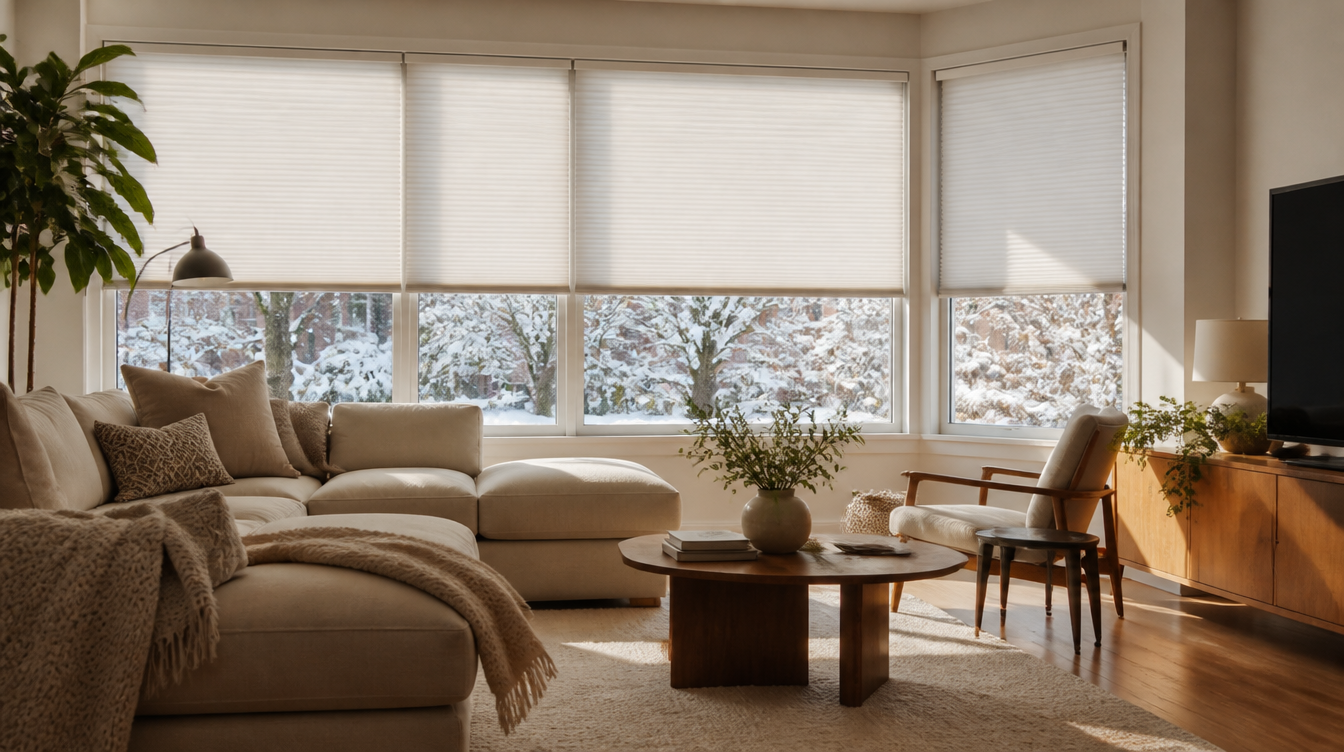

Toronto asks a lot of your windows. They face January mornings that sit well below freezing, July afternoons that push indoor temperatures up fast, and shoulder seasons that swing between the two in a single week. Glass is the thinnest part of any wall, so it is usually where comfort and energy quietly leak away. The right window covering does not turn a window into a wall, but it adds a layer that slows heat moving in the wrong direction, and over a Toronto heating and cooling year that adds up.
This guide walks through how energy efficient window coverings work, which styles insulate best, and how to set them up for both a cold Toronto winter and a hot, humid summer. It is written for homeowners, condo residents, and renters across Toronto and the GTA who want lower bills and a steadier, more comfortable home, without the marketing hand-waving.
Do window coverings actually save energy? Yes. A well-fitted shade or drape traps a pocket of still air against the glass, which slows heat loss in winter and blocks solar heat gain in summer. Cellular honeycomb shades insulate best, layered treatments do more than one alone, and a snug fit matters as much as the fabric you pick.
How Window Coverings Save Energy
Heat always moves from warm to cold. In winter your heated indoor air pushes toward the cold glass and escapes. In summer the sun pours radiant heat through the window and warms everything inside. A window covering sits in the middle of that exchange and slows it down. It does this in three ways, and understanding them makes every product choice easier.
Still air is the real insulator
The single most important idea here is trapped air. Air that cannot move is a surprisingly good insulator, which is why a down jacket, a double-pane window, and a honeycomb shade all work on the same principle. When a covering holds a layer of still air between the room and the glass, warm air can no longer sweep across the cold surface and carry heat away. The Attachments Energy Rating Council, the independent body that tests and rates window attachments, builds its whole rating system around how well a shade or blind manages this air layer and the heat that crosses it. You can read more about how window attachments are rated on the Attachments Energy Rating Council site.
Winter heat loss through Toronto windows
On a cold night, single and older double-pane windows lose heat fast through conduction, and drafty frames let warm air convect straight out. Glass also radiates your room’s warmth outward. A covering with a sealed air pocket cuts the convection and slows the conduction, so the surface facing the room stays warmer and the furnace cycles less often. It will not match the performance of replacing an old window, but it is a fraction of the cost and it works every night of the season.
Summer heat gain and solar radiation
Summer is the opposite problem. The enemy is solar radiation, the direct sunlight streaming through east, south, and west windows that heats floors, furniture, and air. Here the goal is to reflect or absorb that light before it becomes trapped heat. Light-coloured and reflective fabrics facing outward bounce sunlight back, while the still-air layer again slows the transfer. This is why a shade that is great in winter is not automatically the best summer performer, and why so many Toronto homes end up layering.
What R-value and energy ratings mean
R-value measures resistance to heat flow, so a higher number insulates better. A bare double-pane window has a low R-value, and any covering adds to it, some far more than others. You do not need to memorize numbers. Just know that a thick, sealed, air-trapping covering raises the assembly’s resistance more than a thin, loose one. For the summer side of the equation, the useful measures are how much solar heat a covering blocks and how much light it lets through. Canada’s ENERGY STAR program, run by Natural Resources Canada, is the national reference point for energy performance in windows and related products.
The Most Energy Efficient Window Coverings, Ranked
Not every style insulates equally. Here is how the common options stack up for a Toronto climate, from strongest to most modest, with the trade-offs that matter.
Cellular honeycomb shades
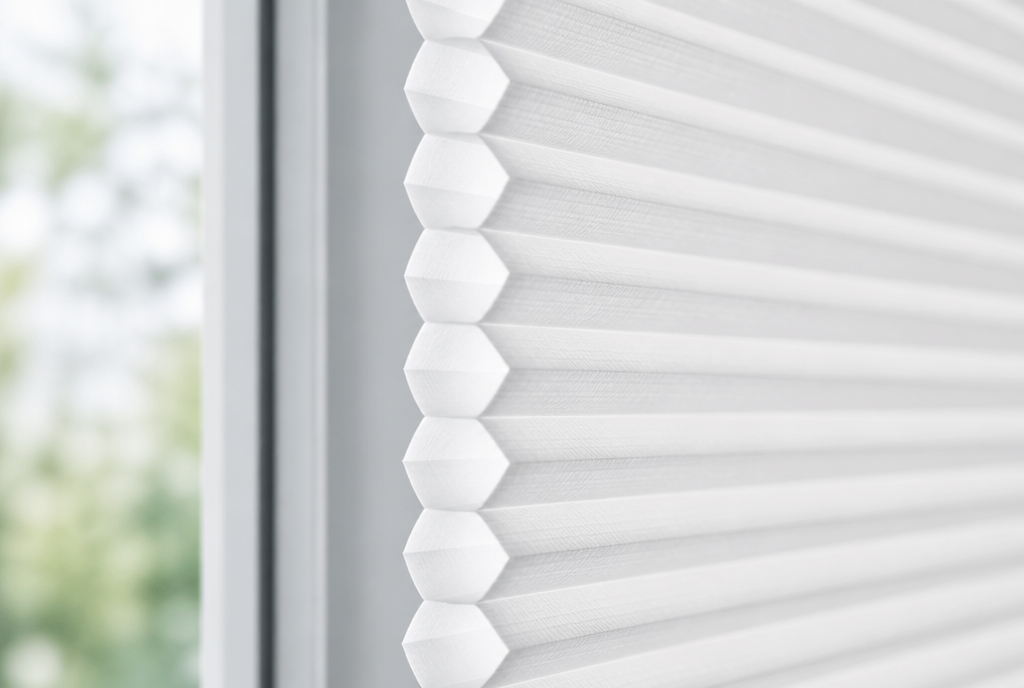
Cellular shades are the clear leader. Their pleated fabric forms honeycomb-shaped pockets that hold air along the entire face of the window, which is exactly the still-air layer that insulation depends on. Single-cell versions insulate well; double-cell versions add a second row of pockets and insulate more, which is the choice most Toronto homes make for bedrooms and north-facing rooms. They come in light-filtering and blackout fabrics, so you can pair insulation with privacy or darkness. If energy is your main reason for shopping, start here. Our full Toronto guide to cellular shades and honeycomb blinds covers cell counts, fabrics, and fit in detail.
Insulated Roman shades and lined fabrics
Roman shades made with a thick or thermal-lined fabric add real insulating value, because the fabric itself is dense and, when mounted snugly, holds air against the glass. They bring a soft, tailored look that suits living rooms and bedrooms. A lined Roman shade will not match a double-cell honeycomb pocket for pure numbers, but it is a strong performer when you also want the fabric aesthetic.
Roller and solar shades
Roller shades are versatile, and their summer behaviour depends heavily on the fabric. Solar shades use an open-weave fabric rated by openness, from around one percent up to fourteen percent, where a lower number blocks more sun and glare while keeping some view. For cutting summer heat gain on bright east and west windows they are excellent, and a light or reflective backing helps bounce sunlight away. For winter insulation a plain roller is modest on its own, which is why rollers are often layered with drapery. If you are weighing the two, our comparison of solar shades versus blinds and the piece on blackout versus solar shades lay out the differences.
Curtains, drapery, and thermal panels
Full-length drapery is one of the most underrated energy tools in a Toronto home. Heavy or thermal-lined curtains that run floor to ceiling and slightly past the window on each side create a large trapped-air layer and seal the edges of the opening. Closed on a winter night they cut heat loss noticeably; opened on a sunny winter day they let free solar heat in. In summer, light-coloured or reflective-lined panels keep radiant heat out. Drapery also pairs beautifully with a shade for a two-layer system. See our custom curtains and drapery guide for fabric weights and hanging tips.
Shutters and plantation-style panels
Interior shutters, including the California and plantation styles, add a solid physical barrier and a small air gap between the panel and the glass. Closed louvers reduce both winter heat loss and summer heat gain, and because they are rigid and long-lasting they are a favourite for windows you want to look sharp for decades. They cost more up front than most shades. Our Toronto guide to California shutters covers materials and value.
Zebra and sheer shades
Zebra and sheer shades are prized for light control rather than insulation. Their alternating sheer and solid bands, or soft sheer vanes, give you dial-in daylight and daytime privacy, and they do add a modest air layer when lowered fully. Think of them as comfort-and-style products with a light energy bonus, not as your primary insulator. You can read how they handle heat and cold in our overview of zebra blinds and our Toronto sheer shades guide.
Venetian and vertical blinds
Horizontal Venetian blinds and vertical blinds are excellent for precise light and glare control, and tilted slats can bounce summer sun away from the room. Because slatted products have gaps between the vanes, they insulate the least of the group, so on the coldest nights they leak more heat than a sealed shade. They still earn their place on patio doors and wide windows where their function shines. See the Venetian blinds guide and the vertical blinds guide for where each fits.
| Window covering | Winter insulation | Summer heat control | Best role |
|---|---|---|---|
| Cellular / honeycomb (double cell) | Excellent | Very good | Primary insulator, bedrooms, north rooms |
| Cellular / honeycomb (single cell) | Very good | Good | Everyday energy shade |
| Thermal-lined drapery | Very good (closed) | Good (light colours) | Living rooms, layering partner |
| Interior shutters | Good | Good | Long-term, view windows |
| Insulated Roman shades | Good | Moderate | Style plus insulation |
| Solar / roller shades | Modest (alone) | Excellent (glare and gain) | Sunny east and west windows |
| Zebra / sheer shades | Modest | Moderate | Light control with a small bonus |
| Venetian / vertical blinds | Lower | Good (tilt to deflect) | Patio doors, glare control |
A Winter and Summer Strategy for Toronto
Owning an energy efficient covering is only half the job. Operating it with the seasons is what actually lowers the bill. The same shade can save energy in January and waste an opportunity in July if you leave it in one position all year.
Winter: trap heat at night, invite sun by day
On cold nights, close your insulating shades and drapes fully to build the still-air layer and keep radiant heat in the room. During sunny winter days, open coverings on south and west windows to let free solar heat warm the space, then close them again as the sun drops. This simple daily rhythm turns your windows into a small, free heat source instead of a constant drain.
Summer: block the sun before it gets in
In summer, reverse the logic. Keep shades down on east windows through the morning and on west windows through the afternoon and early evening, when low, intense sun drives the worst heat gain. Light-coloured and solar fabrics reflect the most. Blocking sunlight at the window, before it becomes trapped indoor heat, is far more effective than trying to cool the room afterward, so proactive shading eases the load on your air conditioner.
| Season and time | Goal | What to do |
|---|---|---|
| Winter night | Keep heat in | Close insulating shades and drapes fully |
| Winter sunny day | Capture free heat | Open south and west coverings, close at dusk |
| Summer morning | Block east sun | Lower solar or light shades on east windows |
| Summer afternoon | Block west sun | Lower shades on west and south windows |
| Summer night | Vent cool air | Raise shades, open windows if it is cool |
Fit and Mounting Make or Break Performance
A covering only insulates as well as it seals. A gorgeous cellular shade with a two-inch gap around the edges leaks air past the fabric and gives back much of its advantage. The fit details below are where a custom, professionally measured product pulls ahead of a stock size.
Inside mount versus outside mount
An inside mount sits cleanly within the window frame and looks tailored, but it leaves small side gaps where air can slip past. An outside mount, installed on the wall above and beyond the opening, overlaps the frame on all sides and seals far better, which is why outside mounting often wins when energy is the priority. The trade-off is appearance and depth. Our breakdown of inside mount versus outside mount weighs both.
Side channels and sealed edges
For the best winter performance, some cellular and roller shades can be fitted with side channels or tracks that close the gap along the edges, turning a good shade into a near-sealed panel. Full-length drapery achieves a similar seal by overlapping the wall on each side and pooling slightly at the floor. Sealing the perimeter is the difference between a shade that looks insulating and one that measurably is.
Top-down bottom-up for daylight without the heat penalty
A top-down bottom-up shade lowers from the top or raises from the bottom, so you can pull daylight in high on the window while keeping the lower half covered for privacy. In winter it lets you harvest sun through the upper glass without fully opening the window to heat loss. Our guide to top down bottom up blinds shows how the two-way control works.
Layering: The Fastest Way to Better Numbers
No single covering is perfect at everything, so the most energy-efficient Toronto homes usually run two layers. A common and effective pairing is a cellular or solar shade at the glass with a drapery panel over it. In winter, both layers closed at night stack their air pockets. In summer, the shade blocks solar gain during the day while the drape adds a second reflective barrier. Layering also lets each product do what it does best: the shade handles precise daytime light, the drape handles the deep night-time seal. It is the closest thing to a universal answer.
Motorization and Smart Scheduling
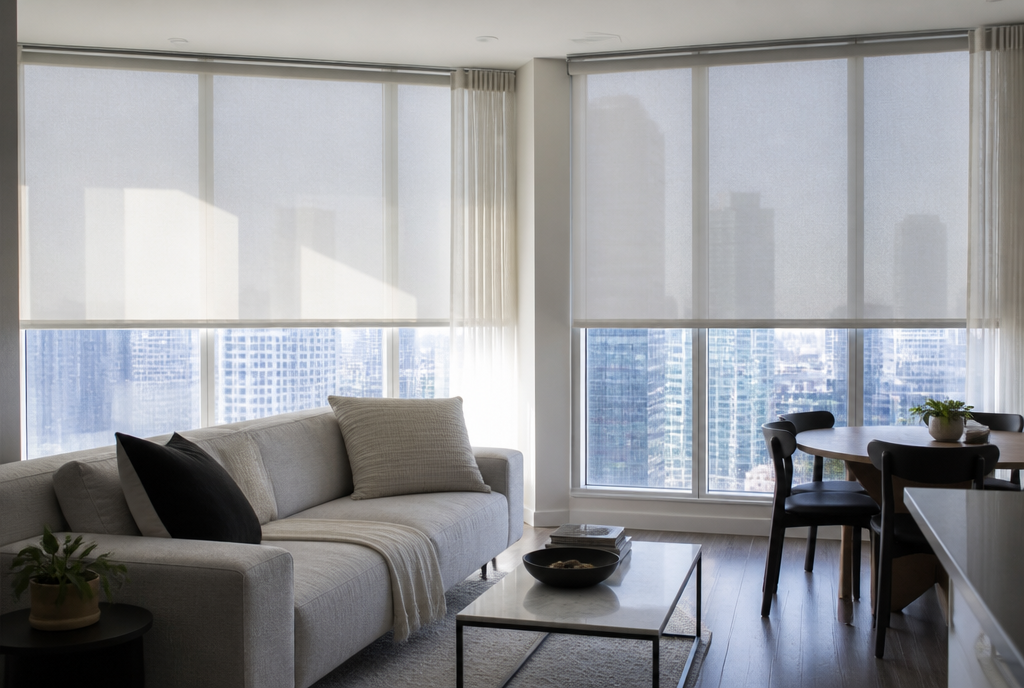
The weak point in any seasonal strategy is remembering to raise and lower everything at the right time. Motorized and smart shades solve that by running on a schedule. You can set them to close at dusk in winter, open to catch the low morning sun, or drop automatically on west windows during a summer heat wave. Some systems tie into sun sensors or home automation so the shades respond to actual conditions rather than a fixed clock. For hard-to-reach or numerous windows, automation is often what makes an energy routine stick. See motorized blinds, our smart blinds options, and the piece on motorized blinds for summer sun control.
Toronto Homes, Condos, and Rentals
The best energy choice also depends on the kind of space you live in and how much you are allowed to change.
High-rise condos with floor-to-ceiling glass
Downtown Toronto condos are often walls of glass, which is stunning and thermally demanding. Those large west and south exposures gain serious heat on summer afternoons and lose it on winter nights. Cellular shades cut both, and solar shades tame the glare and gain on the sunniest walls. Many buildings also have rules about what is visible from outside, so a neutral backing keeps you compliant. Our Toronto condo window covering guide covers building rules and large-window options.
Renters and damage-free options
Renters do not have to give up efficiency. No-drill and tension-mounted shades, including cellular styles, install without holes and come off cleanly at move-out. A layered no-drill shade with a freestanding curtain rod can still build a real air barrier. Our no-drill blinds guide for renters and condos shows the damage-free paths, and if cords are a concern in a rental with kids, cordless blinds keep things safe and simple.
How Much Can You Really Save?
Here is the honest version. Window coverings reduce heat loss and heat gain, but the size of the saving depends on your windows, your home, how many openings you treat, and how faithfully you operate the coverings with the seasons. A home with old single-pane windows and heavy insulating drapes will see a bigger relative change than a new home with high-performance glass. Coverings are best understood as an affordable comfort-and-efficiency upgrade that works alongside good windows, weatherstripping, and insulation, not as a replacement for them.
What you can count on is steadier room temperatures, fewer cold drafts near the glass in winter, less blast-furnace heat off sunny windows in summer, and a furnace and air conditioner that cycle less often. Those are real, everyday gains, and they are the reason energy efficient window coverings pay their way over the years you own them.
| What drives the payoff | Why it matters |
|---|---|
| Existing window quality | Older single-pane glass has the most to gain from a covering |
| Covering type and cell count | Double-cell and sealed products insulate more |
| Fit and mount | A sealed perimeter keeps the air pocket working |
| Window orientation | South and west exposures see the biggest summer gain |
| How you operate them | Seasonal open-and-close habits unlock the savings |
| Layering | Two layers stack their insulating value |
Choosing and Measuring for Efficiency
Picking an energy efficient covering comes down to a few honest questions about each room. Which direction does the window face? Is the goal warmth, cooling, darkness, or all three? Does the space need daytime privacy? Getting these straight before you shop prevents the classic mistake of buying a beautiful shade that fights the room’s actual needs. Precise measurement matters even more here than usual, because efficiency lives in the fit, and a custom size sealed to the opening is what turns the theory in this guide into a warmer, cheaper-to-run home.
| Question to ask | Why it guides the choice |
|---|---|
| Is winter warmth or summer cooling the priority? | Points you toward cellular versus solar fabrics |
| Which way does the window face? | Sets how aggressively to control solar gain |
| Do I want inside or outside mount? | Outside mount seals better for energy |
| Do I need blackout or just light filtering? | Affects fabric and privacy, not just insulation |
| Will I layer with drapery? | Changes the shade you choose underneath |
| Are there kids or pets in the room? | Points to cordless or motorized controls |
Care, Safety, and Longevity
An energy efficient covering only keeps saving if it stays in good shape. Cellular and roller fabrics do best with gentle regular dusting and the occasional light vacuum with a brush attachment, which keeps the pockets and weaves clean without crushing them. Drapery benefits from an annual freshen-up. Well-kept coverings hold their shape, their seal, and their performance for years.
Safety is part of a good buy, especially with children and pets. Canada regulates corded window coverings under the Corded Window Coverings Regulations, and cordless and motorized designs remove the hazard entirely while making daily operation easier. When you are already choosing a new covering, it is a natural moment to move to a safer, cord-free control.
Frequently Asked Questions
Do window coverings really reduce energy bills in Toronto?
Yes. By trapping still air against the glass they slow winter heat loss and block summer solar gain, which eases the load on your furnace and air conditioner. The saving depends on your windows and how consistently you operate the coverings with the seasons.
What is the most energy efficient window covering?
Cellular honeycomb shades, especially double-cell versions, insulate best because their pockets hold a full layer of still air across the window. They are the usual starting point when energy is the main reason for buying.
Are cellular shades worth it for a cold Toronto winter?
They are one of the best value upgrades for winter comfort. The honeycomb pockets cut the draft and radiant loss near the glass, so rooms feel warmer and the furnace runs less. Double-cell versions add even more for bedrooms and north-facing rooms.
Do blackout blinds save energy?
Blackout fabric blocks light well and adds some insulating value, but darkness and insulation are not the same thing. A blackout cellular shade combines both. A plain blackout roller is great for sleep and modest for insulation unless you layer or add side channels.
What window coverings are best for summer heat?
Solar and light-coloured roller shades on east, south, and west windows are the strongest summer performers because they reflect and block sunlight before it becomes indoor heat. Closing them proactively during peak sun matters more than the exact product.
Should I use inside or outside mount for energy efficiency?
Outside mount usually wins for energy because it overlaps the frame on all sides and seals the small gaps where air escapes. Inside mount looks more tailored but leaves edge gaps unless it is fitted with side channels.
Do curtains help with insulation?
Yes. Heavy or thermal-lined floor-to-ceiling curtains create a large trapped-air layer and seal the window edges when closed. They are one of the most underrated energy tools and pair well over a shade for a two-layer system.
What is a double-cell honeycomb shade?
It has two rows of honeycomb pockets instead of one, so it holds more still air and insulates more than a single-cell shade. It is the go-to choice when winter warmth is the top priority.
Are solar shades good for winter?
Solar shades are built for summer glare and heat control, so on their own they insulate modestly in winter. Layering a solar shade with drapery, or choosing a cellular shade for the coldest rooms, covers the winter side better.
Does the openness factor of a solar shade matter for energy?
Yes. A lower openness percentage blocks more sun and glare while keeping less view, which cuts more summer heat gain. Higher openness keeps more of the view but lets more light and heat through.
Can motorized blinds save more energy than manual ones?
They can, because scheduling removes the human error. Automated shades close at dusk in winter and drop during peak summer sun without anyone remembering, so the energy routine actually happens every day.
Do window coverings help with old single-pane windows?
They help the most there. Older, less efficient windows have the largest heat loss and gain, so adding an insulating covering makes a bigger relative difference than it would on new high-performance glass.
What are the best energy efficient blinds for a condo?
Cellular shades for insulation and solar shades for the sunny walls are the usual answer in Toronto condos with large glass. A neutral backing keeps you within building rules about the exterior look.
Do I need to seal the edges of a shade?
For the best winter performance, yes. Side channels on cellular or roller shades, or drapery that overlaps the wall, close the gaps where air slips past and keep the insulating pocket doing its job.
Will window coverings replace the need for new windows?
No, and it is fair to be clear about that. Coverings reduce loss and gain and improve comfort at a fraction of the cost of replacement, but they work best alongside good windows, weatherstripping, and insulation rather than in place of them.
How do I know a covering is genuinely energy rated?
Look for products tested against recognized standards. The Attachments Energy Rating Council rates window attachments for energy performance, and Canada’s ENERGY STAR program is the national reference for window and product efficiency.
Talk to a Toronto Window Covering Specialist
The most energy efficient window covering is the one measured, fitted, and operated for your specific rooms and exposures. If you want help matching cellular, solar, drapery, or a layered system to your Toronto or GTA home, our team can walk your windows with you, measure for a sealed fit, and set up a seasonal plan that lowers your bills. Contact Canadian Blinds Pros to book a free consultation, or browse the window blinds gallery to see options in real Toronto spaces.