
Custom Curtains and Drapery in Toronto: A Complete Buyer’s Guide to Fabrics, Opacity, and Hanging


Curtains and drapery do something no hard blind quite manages. They soften a room. A panel of fabric that falls from ceiling height to the floor changes how a space feels the moment you walk in, and it does the practical work too, filtering morning glare, holding a little warmth against a Toronto winter, and giving a bedroom the privacy it needs after dark. That mix of comfort and function is why fabric window treatments never really left, even through years of minimalist blinds and bare glass.
There is also a lot to sort through before you order. Sheer or blackout, pinch pleat or grommet, a rod or a track, ready made off a shelf or custom sewn to your window, hung inside the frame or floated high and wide above it. Each choice changes the look, the light, and the price. This guide walks through all of it in plain language, from fabrics and header styles to measuring, cost, care, and how curtains earn their place next to blinds and shades in a Toronto or GTA home.
Curtains, Drapes, and Sheers: What the Words Actually Mean
People use these terms loosely, and that is fine in conversation, but the differences matter when you order. Curtains usually means lighter, more casual fabric panels, often unlined, sometimes sold ready made in standard sizes. Drapes, or drapery, tends to describe heavier, lined, floor-length panels, frequently custom made and often pleated at the top for a tailored fall. Sheers are the featherweight layer, a semi-transparent fabric that softens daylight and blurs the view without blocking either.
In practice many Toronto homes use two of these together. A pair of sheers hung close to the glass handles daytime light and privacy, and a heavier drapery panel on an outer rod pulls across in the evening for full privacy and darkness. That layered approach is the same logic behind a sheer shade or a day-night blind, just done in loose fabric rather than a fixed mechanism.
Are Curtains Out of Style in 2026?
This question comes up a lot, usually from people who remember heavy swags, valances, and fussy tie-backs from decades ago. That specific look has faded, but curtains and drapery themselves are very much current. What has changed is the styling. The 2026 direction is simpler and cleaner: full-length panels that hang from just below the ceiling straight to the floor, minimal or no valance, tailored headings like pinch pleat or a soft wave fold, and calm fabrics in warm neutrals, muted earth tones, and quiet textures rather than shine and pattern.
What reads as dated now is short curtains that stop at the windowsill in a main living room, thin builder-grade panels bunched on a cheap rod, obvious swag-and-jabot treatments, and heavy dark florals used wall to wall. The move is toward fabric that looks intentional and generous, layered with a functional under-layer such as a roller shade or sheer. So curtains are not out of style. The old way of hanging them is.
Curtain and Drapery Fabrics
Fabric decides almost everything about how a curtain looks and behaves: how much light it lets through, how it drapes, how it wears, and how you clean it. Natural fibres like cotton and linen give a relaxed, breathable look with a soft fold, though linen creases and both can shift slightly with humidity. Polyester and poly-blends are the workhorses, holding their shape, resisting wrinkles and fading, and washing easily, which is why most machine-washable panels are synthetic. Velvet and heavier weaves bring weight, insulation, and a formal feel, and they block more light and sound than a light weave. Silk looks beautiful but usually needs a lining to protect it and rarely suits a busy family room.
Lining is the quiet upgrade that separates a flimsy panel from proper drapery. A standard lining adds body, protects the face fabric from sun, and improves privacy. A blackout or dim-out lining takes it further for bedrooms and media rooms. If a fabric you love is too sheer on its own, lining lets you keep the look and still control light. The table below sorts the common choices.
| Fabric | Look and drape | Best for | Keep in mind |
|---|---|---|---|
| Linen | Relaxed, textured, soft fold | Living rooms, casual modern spaces | Creases easily, line it for privacy and structure |
| Cotton | Crisp, clean, versatile | Bedrooms, everyday rooms | Can shrink if washed hot, check care label |
| Polyester and blends | Holds shape, even fold | High-use rooms, machine-wash panels | Most practical and fade resistant, less natural texture |
| Velvet and heavy weaves | Weighty, luxurious, full | Bedrooms, media rooms, formal spaces | Blocks more light and sound, heavier hardware needed |
| Sheer voile or linen-look sheer | Airy, soft, light-diffusing | Daytime privacy, layering under drapery | No night privacy or darkness on its own, pair with a second layer |
Opacity: From Sheer to Full Blackout
Opacity is the single most useful thing to get right, because it decides whether a room is bright, softly shaded, or genuinely dark. Curtains fall into roughly four bands, and the right one depends on the room and the time of day you care about most. A south-facing living room that bakes in afternoon sun has different needs than a bedroom where a night-shift worker sleeps during the day.
| Opacity level | What it does | Daytime privacy | Best rooms |
|---|---|---|---|
| Sheer | Softens light, keeps the view, adds almost no darkness | Partial by day, none at night | Living rooms, layering, sunny spaces |
| Light filtering | Glows with diffused light, hides the interior somewhat | Good by day, limited at night | Dining rooms, kitchens, family rooms |
| Room darkening | Cuts most light, leaves a little glow at the edges | Strong day and night | Bedrooms, nurseries, condos on bright streets |
| Blackout | Blocks essentially all light through the fabric | Full, day and night | Shift-worker bedrooms, media rooms, nurseries |
One honest caveat about blackout curtains: the fabric can block all light, but a panel on a rod still leaves gaps at the sides and top where daylight sneaks in. For true darkness you either extend the panels well past the window, add a wrap-around track, or pair the drapery with a blackout roller behind it. If total darkness is the goal, a dedicated blackout roller shade under the curtain usually does the heavy lifting while the drapery handles the look.
Header Styles and Pleats
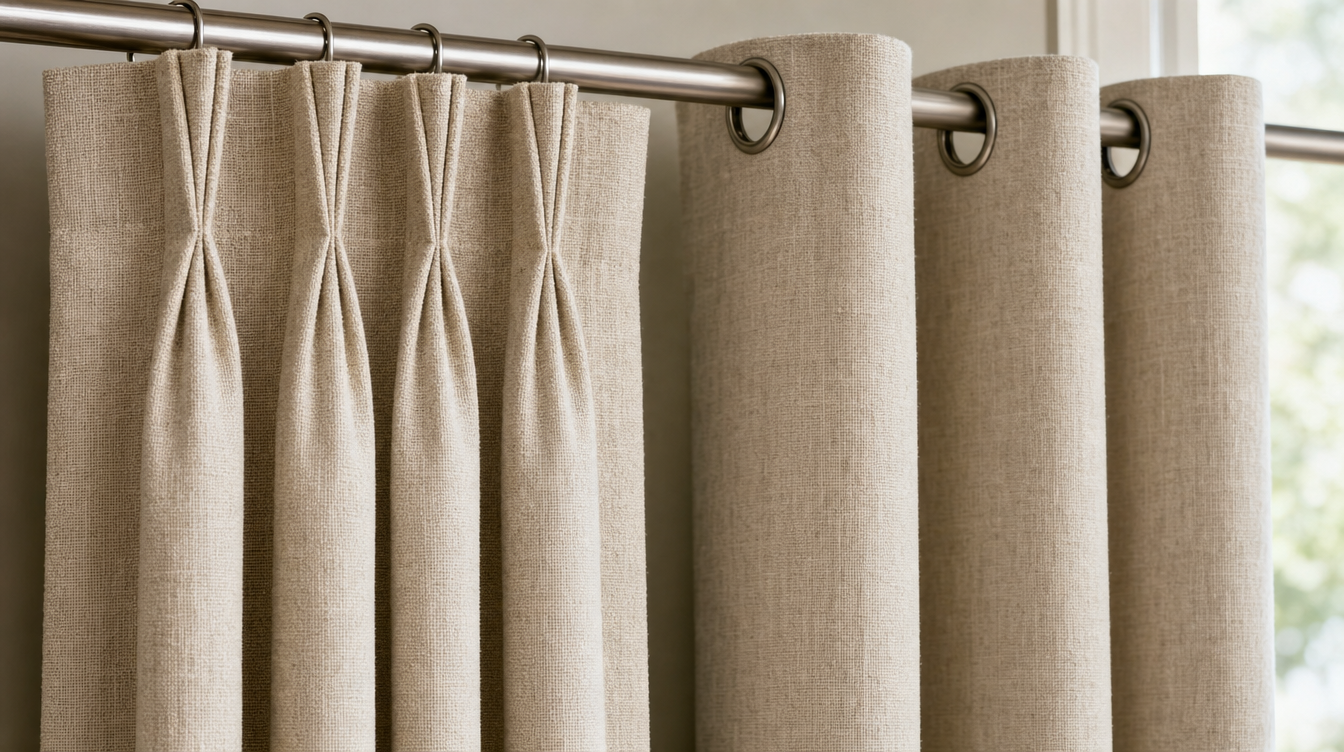
The heading is the top of the curtain, the part that attaches to the rod or track, and it sets the whole personality of the panel. It controls how deep and even the folds are, how the curtain stacks when open, and whether the look reads casual or tailored. This is one area where custom drapery pulls clearly ahead of ready made, because the pleats are sewn to your exact width for an even, generous fold instead of a flat sheet.
| Header style | Look | Hangs from | Good to know |
|---|---|---|---|
| Pinch pleat | Tailored, classic, deep even folds | Rod with rings or a track | The go-to for custom drapery, formal or modern |
| Grommet (eyelet) | Clean, contemporary, soft waves | Rod threaded through metal rings | Easy to slide, casual modern feel |
| Ripplefold or wave | Uniform soft S-curve, very current | Track with carriers | Popular in condos, reads like moving drapery |
| Rod pocket | Gathered, casual, soft | Rod slid through a sewn sleeve | Least easy to open and close, best for stationary panels |
| Tab top and back tab | Relaxed, cottage or casual | Fabric loops over a rod | Back tab hides the loops for a cleaner front |
Curtain Rods Versus Drapery Tracks
How you hang the fabric is a decision in its own right. A rod is the visible bar with decorative finials on the ends, and it suits grommet, rod pocket, and ringed pinch-pleat panels where the hardware is part of the look. A drapery track is a low-profile channel, often ceiling mounted, where the panels glide on carriers and the track itself nearly disappears. Tracks handle long, heavy, or curved runs far better, which is why they are the usual answer for wide living-room walls, bay windows, and condo glass walls, and they are what you need for a wave or ripplefold heading.
| Feature | Curtain rod | Drapery track |
|---|---|---|
| Look | Decorative, hardware on show | Minimal, nearly hidden |
| Best headings | Grommet, rod pocket, ringed pleat | Pinch pleat, ripplefold, wave |
| Wide or heavy runs | Can sag past a point, needs centre support | Handles long, heavy, curved runs smoothly |
| Curves and bays | Limited, needs corner joints | Bends around bays and corners |
| Motorization | Possible on some rods | Ideal, most motor systems are track based |
If you like the idea of drapery that opens at the touch of a button or on a schedule, a motorized track is the way there. The same smart-home thinking applies to fabric as it does to hard shades, and it is worth reading how motorized blinds compare with curtains before you commit to one or the other.
Where Curtains Work Best in a Toronto Home
Curtains are flexible, but they shine in specific spots. Knowing where they earn their keep, and where a blind or shade might serve better, saves money and regret.
Living Rooms and Large Windows
This is curtain territory. Full-length panels on a wide window add height, warmth, and a finished feel that hard blinds rarely match on their own. Many living rooms end up with sheers for the day and a heavier drapery layer for the evening, sometimes over a functional shade. If the window is very wide, a ceiling-mounted track keeps the whole run smooth.
Bedrooms and Nurseries
Darkness and quiet are the priorities here, so room-darkening or blackout drapery, often lined, is the usual pick. Curtains also soften the acoustics of a bedroom, which blinds do not. For a child’s room the safety of the controls matters as much as the fabric, and a cordless or motorized option removes the looped-cord risk entirely. Our guide to the best shades for bedrooms pairs well with drapery for a layered sleep setup.
Condos and Floor-to-Ceiling Glass
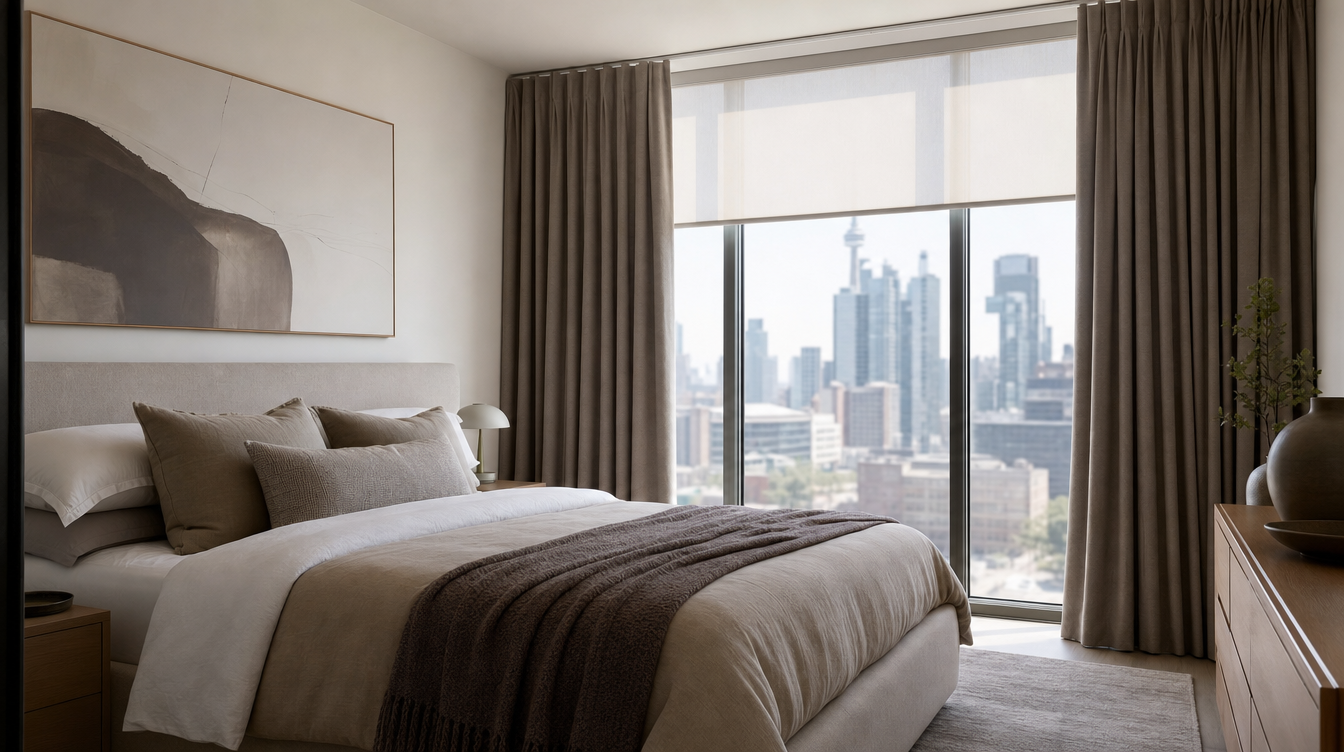
Toronto condos are full of tall glass and wide balcony sliders, and drapery on a ceiling track flatters that architecture, drawing the eye up and reading as clean modern fabric rather than clutter. Wave-heading sheers are especially popular on condo glass. Because you cannot always drill freely in a condo, and because balcony doors need clearance, it helps to plan the whole room, which our Toronto condo window covering guide and the notes on the best blinds for condos cover in detail.
Sliding and Patio Doors
Fabric works beautifully across a patio door when it is hung high and wide so the panels stack completely off the glass when open, leaving the doorway clear. A track handles the weight and the daily use better than a rod. That said, some households prefer a hard covering that clears a door handle cleanly, so it is worth weighing curtains against a vertical blind or one of the other best options for sliding doors.
Dining and Formal Rooms
Dining rooms are where drapery gets to be decorative. Since you rarely need blackout darkness over a dining table, light-filtering or lined panels in a richer fabric add warmth and a sense of occasion without much functional demand.
Layering Curtains Over Blinds and Shades
The most useful thing to understand about curtains in 2026 is that they are often not the only layer. Pairing soft drapery with a functional under-layer gives you the look of fabric and the precise control of a shade. A common setup is a roller blind or cellular shade close to the glass for daytime light control and insulation, with drapery panels on an outer track for privacy, warmth, and style in the evening.
Layering also fixes the weaknesses of each piece. Sheers give daytime softness but no night privacy, so a drapery layer covers the evening. A blind controls light precisely but feels hard on its own, so fabric warms it up. If insulation is the goal, a cellular shade behind lined drapery is one of the better window combinations for a cold Toronto winter. And where glare on a screen is the problem, drapery over a light-filtering layer, or the approaches in our guide on blocking window glare, handles it without plunging the room into darkness.
Curtains Versus Blinds: How to Choose
Curtains and blinds are not really rivals. Most well-dressed rooms use both. Still, if you are choosing one for a given window, the differences below help. For precise, adjustable light control in a small window, a blind or shade is often the cleaner answer, while for warmth, softness, and a finished look on a larger window, fabric wins.
| Consideration | Curtains and drapery | Blinds and shades |
|---|---|---|
| Feel of the room | Soft, warm, finished | Crisp, tailored, minimal |
| Precise light control | Open or closed, less fine-tuned | Tilt and lift for exact levels |
| Insulation and sound | Strong with lined or heavy fabric | Best with cellular shades |
| Small or tight windows | Can overwhelm the space | Fit neatly inside the frame |
| Cleaning | Wash or dry clean, occasional | Wipe or dust, quick |
| Best use | Large windows, bedrooms, layering | Everyday control, kitchens, baths |
Do Curtains Help With Toronto Winters and Energy Bills?
They can, and the effect is real enough to matter here. A large share of a home’s heat escapes through windows, and a lined or heavy drapery panel adds an insulating layer of still air between the room and the cold glass. Drawn on winter nights, it slows heat loss; open on sunny winter days, it lets free solar warmth in. Natural Resources Canada notes that windows are a major source of household heat loss, which is exactly the gap that a good fabric layer helps close. For the strongest thermal result, pair drapery with a cellular shade, since the honeycomb pockets trap air the way an insulated curtain does, and close both after dark. In summer the same panels, closed against afternoon sun, cut solar heat gain and keep rooms cooler.
How to Measure for Curtains
Curtains are more forgiving than a fitted blind, but a few rules make the difference between panels that look custom and panels that look like an afterthought. The two ideas that matter most are hanging high and hanging wide. Mount the rod or track well above the window, ideally close to the ceiling, and extend it past the frame on each side so the open panels sit against the wall rather than covering glass. That makes the window look larger and lets in more light when the curtains are open.
| Measurement | Guideline | Why it matters |
|---|---|---|
| Rod height | Well above the frame, often near the ceiling | Adds height and a sense of scale |
| Rod width | Extend past the frame on each side | Lets panels clear the glass when open |
| Panel length | To the floor, just kissing or a slight break | Floor length looks intentional, short looks dated |
| Fullness | Total panel width around two to two-and-a-half times the window | Gives a rich fold instead of a flat sheet |
| Clearance | Check radiators, trim, door swings, furniture | Avoids panels fouling on obstacles |
For length, the three common looks are just kissing the floor for a clean, practical finish, a slight break where the fabric touches and folds a little, and a puddle where extra fabric pools for a soft formal effect. Whichever you choose, the same inside-versus-outside logic that governs blinds applies to where you mount the hardware, and our note on inside mount versus outside mount is a useful companion. Because a small error over a wide window multiplies fast, a professional measure is worth it on anything large or custom.
What Custom Curtains and Drapery Cost
Price is the question everyone wants answered, and the honest response is that it ranges widely. Ready-made panels off a store shelf can be very inexpensive, sometimes tens of dollars a pair, but you accept fixed sizes, thinner fabric, and a flat heading. Custom drapery costs more because you are paying for fabric by the metre, lining, sewn-to-measure pleating, hardware, and installation, and the total scales with window size and fabric choice. Rather than quote a figure that would not hold across every window, the table below shows what actually drives the number so you can see where your budget goes.
| Cost driver | Lower cost | Higher cost |
|---|---|---|
| Made to fit | Ready made, standard sizes | Custom sewn to your window |
| Fabric | Basic polyester | Linen, velvet, designer weaves |
| Lining | Unlined | Blackout or interlined |
| Fullness and size | Small window, modest fullness | Wide wall, generous fullness |
| Hardware | Simple rod | Ceiling track, motorization |
| Installation | Self-install | Professional measure and install |
Because so many factors move the price, custom drapery is quoted per project after a measure. If you are budgeting, decide early whether you want custom or ready made, since that single choice moves the total more than any other.
Motorized and Smart Curtains
Motorized drapery has become one of the more requested upgrades, and it makes real sense on tall or wide runs you would otherwise reach behind furniture to close. A motor on the track opens and closes the panels with a remote, an app, a voice assistant, or a schedule, so the drapery can wake with the sunrise or close automatically at dusk. It is also a safety win in homes with children, since there is no cord to manage at all. The technology overlaps closely with hard shades, so the same considerations in our smart blinds and motorized blinds pages apply here: battery versus hardwired power, which app or voice platform you use, and whether you want everything on one schedule.
Cleaning and Care
Curtains hold dust, so a light routine keeps them fresh. Vacuum panels gently with an upholstery attachment every few weeks, or shake and air them outdoors. For washable fabrics, follow the care label closely, since hot water can shrink cotton and heat can damage some linings; cool water and a gentle cycle are safest, and rehang slightly damp to let creases fall out. Lined, pleated, and delicate fabrics like velvet or silk usually need dry cleaning to keep their shape. Spot-clean spills quickly with a damp cloth rather than rubbing them in. A quick steam on the hung panel handles wrinkles without taking anything down.
Child and Pet Safety
Any window covering with a pull cord or chain deserves care in a home with young children or pets, and drapery is no exception when it uses a corded traverse system. The safest route is a cordless or motorized track, or a wand-drawn panel, none of which leave a looped cord within reach. Canada regulates corded window coverings under the federal Corded Window Coverings Regulations, and Health Canada offers plain guidance on blind cord safety that is worth a read before you choose controls. If a corded system stays in place, keep cords tied up and anchored out of reach, and consider switching to a cordless option for the rooms children use most.
Choosing the Right Curtains: Questions to Ask
Before you order, running through a short checklist keeps the decision grounded in how you actually live in the room rather than how a fabric looks on a showroom rail.
| Question | Why it matters |
|---|---|
| How dark does the room need to get? | Decides sheer, light filtering, room darkening, or blackout |
| Will these be a stationary or working panel? | Affects heading style and hardware |
| Is there a radiator, trim, or door swing in the way? | Sets length and mounting clearance |
| Do I want to layer over a blind or shade? | Shapes the whole window plan and budget |
| Are there children or pets in the home? | Points toward cordless or motorized controls |
| Custom or ready made? | The single biggest driver of cost and fit |
| How will I clean them? | Machine washable versus dry clean narrows fabric |
How Canadian Blinds Pros Can Help
Choosing curtains and drapery is easier with fabric in hand and someone measuring the actual window. Canadian Blinds Pros works with homeowners, condo residents, renters, designers, and commercial clients across Toronto and the GTA on custom window treatments, and a free in-home consultation is the simplest place to start. You can see and feel fabrics in your own light, talk through opacity, lining, headings, and hardware, and get an accurate measure so the finished panels hang the way they should. It also helps to browse real installs in the window coverings gallery and to look at coordinating custom window shades if you plan to layer. When you are ready, reach out to book a consultation and we will help you plan the whole room, curtains, layering shades, and all.
Frequently Asked Questions About Curtains and Drapery
Where is the best place to buy curtains in Toronto?
For ready-made panels, big-box and home decor retailers cover the basics. For custom drapery sewn to your window, with a proper measure, fabric selection, and installation, a local window treatment specialist is the better route. A Toronto-based custom service can match fabric, lining, and hardware to your rooms and hang everything correctly.
Are curtains still in style in 2026?
Yes. Full-length panels hung high and wide, with tailored headings and calm neutral fabrics, are very current. What looks dated is short sill-length curtains in main rooms, thin bunched panels, and heavy swag-and-valance treatments.
What curtain colours are popular in 2026?
Warm neutrals lead: soft greige, oatmeal, taupe, and muted earth tones, along with quiet textured whites. These read calm and current and layer easily with wood and natural materials, which is why they dominate the newer curtain looks.
What kind of curtains look outdated?
Short curtains that stop at the sill in a living room, flimsy builder-grade panels on a thin rod, elaborate swags with jabots and valances, and heavy dark florals used across a whole room all read as dated. Floor-length, simply hung panels feel current.
What is the difference between curtains and drapes?
Curtains are usually lighter, more casual, often unlined, and frequently ready made. Drapes, or drapery, are typically heavier, lined, floor-length, and often custom with a pleated heading. In everyday speech the words overlap, but drapery implies a more tailored, made-to-measure treatment.
Should curtains touch the floor?
For a polished look, yes. Panels that just kiss the floor, break slightly, or puddle read as intentional. Curtains that stop above the floor or at the sill in a main room tend to look unfinished, though sill length can suit a kitchen or a window blocked by furniture.
How high should I hang curtains?
Mount the rod or track well above the window frame, often close to the ceiling, and extend it past the frame on both sides. Hanging high and wide makes the window look larger and lets the open panels clear the glass so more light comes in.
What is the right fullness for curtains?
Total panel width of roughly two to two-and-a-half times the window width gives a rich, gathered fold. Panels sized only to the window width hang flat and sparse, which is a common giveaway of an inexpensive treatment.
Do curtains help keep a room warm in winter?
Lined or heavy drapery adds an insulating air layer against cold glass and slows heat loss when drawn on winter nights. Paired with a cellular shade and closed after dark, curtains meaningfully cut the chill near large windows in a Toronto home.
What is the best fabric for curtains?
There is no single best fabric. Linen and cotton give a natural look, polyester blends are the most practical and washable, and velvet or heavy weaves insulate and darken best. Match the fabric to the room’s use, light needs, and how you plan to clean it.
Are sheer curtains enough for privacy?
Sheers soften the view and give some daytime privacy, but they hide almost nothing after dark once interior lights are on. For evening privacy, layer sheers with a room-darkening drapery panel or a blind behind them.
Can curtains and blinds be used together?
Yes, and it is one of the best setups. A blind or shade close to the glass handles precise light control and insulation, while drapery on an outer layer adds privacy, warmth, and a finished look. Layering covers the weak spots of each piece.
Do I need a rod or a track for curtains?
A decorative rod suits grommet, rod pocket, and ringed pleat panels where the hardware is part of the look. A track is better for wide, heavy, or curved runs, for wave and ripplefold headings, and for motorization, and it stays nearly hidden.
Are custom curtains worth it over ready made?
If fit, fabric quality, and a tailored heading matter to you, yes. Custom drapery is sewn to your exact window with even pleating and your choice of lining, which ready-made panels in fixed sizes cannot match. Ready made wins on speed and price.
How do I clean curtains?
Vacuum with an upholstery attachment regularly and follow the care label for washing. Cool water and a gentle cycle protect washable fabrics, and rehanging slightly damp releases creases. Lined, pleated, velvet, and silk panels usually need dry cleaning.
Are motorized curtains safe for children?
Yes. A motorized track has no pull cord at all, which removes the looped-cord hazard entirely and lets you open or close the panels by remote, app, voice, or schedule. Cordless and wand-drawn options are also child-safe choices.
Do curtains work on sliding patio doors?
They do, when hung high and wide on a track so the panels stack fully off the glass and leave the doorway clear. A track carries the weight and daily use better than a rod. Some homes still prefer a hard covering that clears the door handle cleanly.