
Specialty and Shaped Window Coverings in Toronto: A Complete Guide to Arched, Bay, Angled, and Odd-Shaped Windows
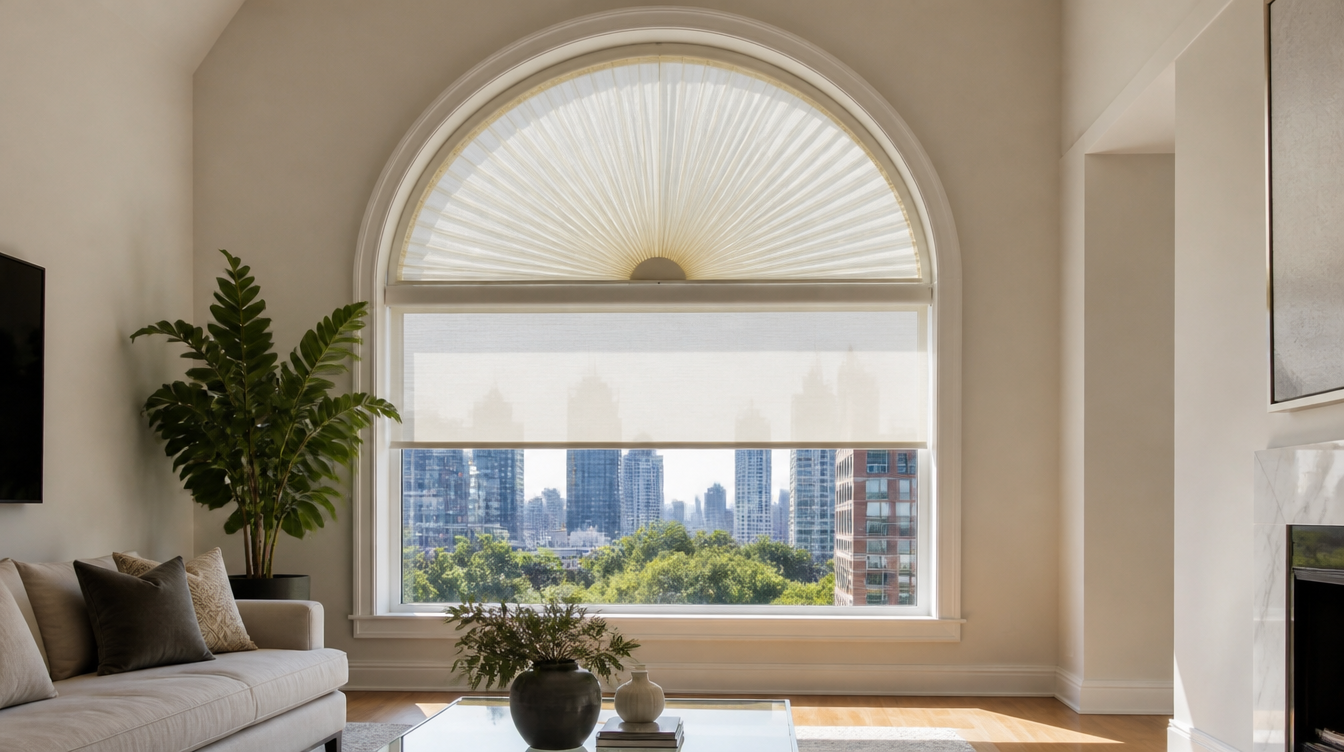

Most Toronto homes have at least one window that refuses to behave. A half-round arch over the front door, a three-panel bay in the living room, a sloped gable window in a converted attic, a little porthole in a powder room. These shapes give a house character, and they also create a real headache when it comes time to cover them. A standard blind cut to a rectangle will not sit against a curve, and an off-the-shelf shade bought to fit a square opening will leave gaps and bare glass on anything angled.
Specialty and shaped windows can be covered well. The job just takes the right product, accurate measuring, and in most cases a custom cut rather than a stock size. This guide walks through the common shapes you see across Toronto and the GTA, what actually works on each one, how light control and privacy change when a window is not square, what drives the cost, and the questions worth asking before you order. If you want the broader overview of choosing window coverings in the city first, our complete Toronto blinds buyer’s guide is a good starting point, and this article goes deep on the odd shapes it only touches on.
Why Specialty Windows Are Harder to Cover in Toronto
A specialty window is any opening that is not a plain rectangle, or a rectangle that sits somewhere awkward to reach. Arches, circles, angles, bays, corners, and tall two-storey glass all fall into this group. The difficulty comes from a few things at once.
First, the shape itself. A curve or an angle cannot be covered by a flat panel that only moves up and down. The covering either has to be shaped to match the glass, or you accept that part of the window stays bare. Second, many Toronto houses are old. Century homes in Leslieville, the Annex, and Cabbagetown, along with plenty of mid-century bungalows, have settled over the decades, so an opening that looks square is often out of square by a centimetre or more corner to corner. That small difference is enough to leave a visible wedge of light down one side of a stock blind.
Third, there is the climate. Toronto winters bring condensation to glass, and specialty windows are often fixed units that do not open, which means less air movement and more moisture sitting on the frame. Summer brings strong western sun through the large feature windows people love, and that light fades floors and furniture. A covering for a shaped window has to earn its place on light control and moisture tolerance, not only looks. For the energy side of that equation, cellular and honeycomb fabrics do the most work, which is why our guide to energy efficient window coverings keeps coming back to them.
The Main Types of Specialty and Shaped Windows
Before you pick a product, it helps to name the window correctly, because the vocabulary a workroom uses is specific. Here are the shapes that come up most often in Toronto homes, and the short version of what suits each one.
Arched and Half-Round Windows
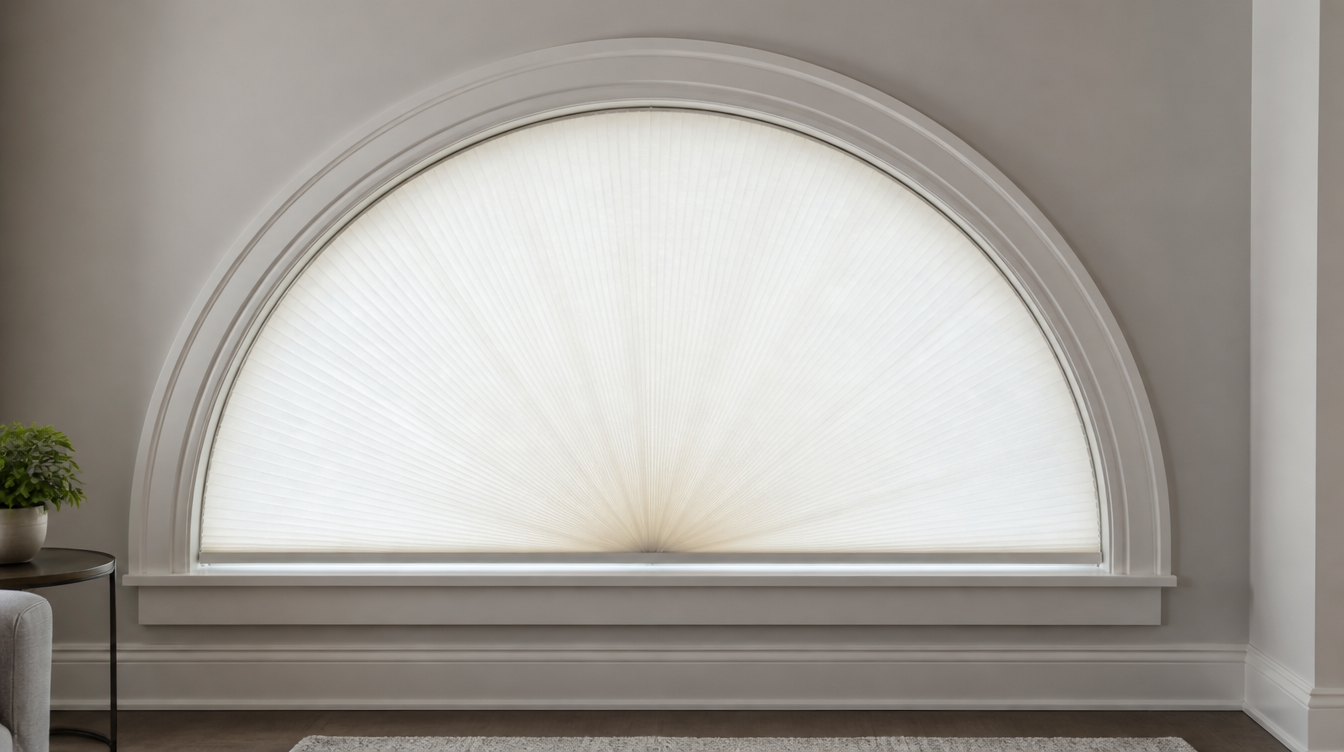
An arch sits above a rectangular window or door, usually as a half circle, a quarter round (an eyebrow), or a shallow segment. Arches are the single most common specialty shape in the city, and they are also where people get the most frustrated. You can cover an arch with a fixed sunburst insert, a movable fan shade, or leave it open and cover only the rectangle below. We cover the full decision in our dedicated piece on whether to put blinds on arched windows.
Bay and Bow Windows
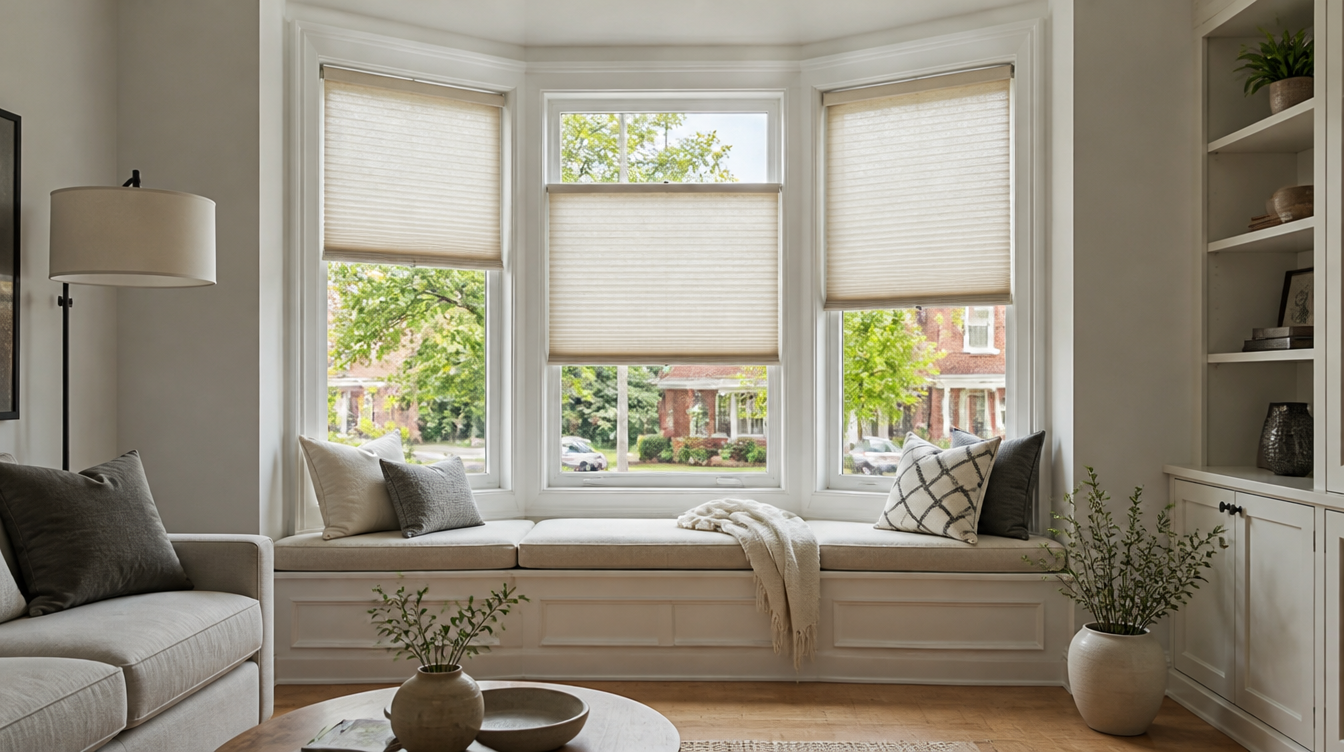
A bay window is three or more flat panels set at angles that push out from the wall, usually a wide centre pane flanked by two narrower sides. A bow window is the same idea built from four, five, or six panels that form a gentle curve. Both are covered panel by panel, with a separate blind or shade on each facet rather than one piece stretched across the whole run. The Soro team already wrote a short piece on bay window blinds that fit the view, and we expand on the mounting details further down.
Angled, Sloped, and Gable Windows
Angled windows follow a roofline. You see them in attic conversions, lofts, and modern builds with a cathedral ceiling, often as a triangle or a trapezoid where the top rail runs on a slope. These need a covering cut to the angle, and the best options are rigid cellular shades held on a track or a fixed panel, since a normal headrail cannot follow a diagonal.
Round, Circle, and Porthole Windows
A full circle or oval window shows up in gable ends, stairwells, and powder rooms. Small ones are often left bare or fitted with a fixed fabric insert or a stained decorative film. Larger circles can take a custom fan arrangement, though the hardware is specialized and the covering rarely operates.
Corner Windows
Corner windows meet at a 90 degree join with little or no wall between them, common in condos and newer homes that chase a view. Each pane is covered separately, and the trick is keeping the two coverings from colliding at the corner. Slim roller shades and cellular shades handle corners better than bulky slats.
French Doors and Sidelights
French doors and the narrow sidelight windows beside a front entry are technically rectangular, but they are tall, skinny, and attached to something that swings or sees heavy traffic. They need slim, shallow coverings that hug the glass so door hardware still clears. Cellular shades, shallow roller shades, and fabric held top and bottom are the usual answers.
Patio and Sliding Doors
Sliding glass doors and large patio openings are wide, they move, and one side of the opening is a doorway you walk through every day. These are their own category, and the strongest choices are panel track blinds that stack to one side, vertical blinds that rotate and draw, or a wide roller. We go deep on this in our guide to the best blinds for sliding doors.
Transom, Clerestory, and Skylight Windows
Transoms sit above a door or a main window, clerestory windows run in a high band near the ceiling, and skylights sit in the roof itself. All three are hard to reach, which pushes most people toward motorized coverings or, for the sloped roof units, a track-guided shade. Skylights are their own project, handled in our skylight blinds guide.
The table below maps each shape to the coverings that tend to work, as a quick reference before the detailed sections.
| Window shape | Coverings that work well | Does it usually operate? |
|---|---|---|
| Arch / half-round | Fixed sunburst insert, movable fan shade, or cover the rectangle only | Usually fixed |
| Bay / bow | Separate shade per panel: roller, cellular, Roman, or shutters | Yes, each panel |
| Angled / sloped / gable | Shaped cellular on a track, or fixed angled panel | Sometimes |
| Round / circle | Fixed fabric insert, decorative film, or leave bare | Rarely |
| Corner | Slim rollers or cellular on each pane | Yes, each pane |
| French door / sidelight | Shallow cellular, slim roller, or top-and-bottom fabric | Yes |
| Patio / sliding door | Panel track, vertical blinds, wide roller | Yes |
| Transom / clerestory / skylight | Motorized shade, track-guided skylight shade | Motorized recommended |
Covering Arched Windows in Toronto
Arched windows deserve their own section because there are really three honest approaches, and the right one depends on how the arch is built and what you want from it.
The first approach is to leave the arch bare and cover only the rectangular window beneath it. This is the most common choice for a reason. On a south or west arch, the curved glass sits high enough that privacy is rarely an issue, and the rectangle below carries a normal operable blind or shade. You keep the architecture on display and spend nothing on custom arch hardware. The downside is glare and heat from the uncovered curve on a bright afternoon.
The second approach is a fixed sunburst or fan insert shaped to the arch. A workroom cuts fabric or faux-wood slats into a radiating pattern that matches the curve exactly. It looks finished and it blocks the light, but it does not move. You set it once and it stays. For a window you only want to soften, a fixed insert is clean and durable.
The third approach is a movable arch shade, sometimes called a fan shade, that opens and closes along the curve. These exist, they are the most expensive option, and the mechanism is fussy. Most Toronto homeowners who want the arch to actually operate end up choosing a shaped cellular product. If you are weighing fabric against slats for the look, our comparison of blinds or shades for arched windows breaks down the trade-offs, and for the measuring itself there is a separate walkthrough on measuring an arched window for blinds.
| Arched window option | Light control | Operates? | Best for |
|---|---|---|---|
| Cover rectangle only, arch bare | Partial, arch stays open | Yes, lower blind | High arches, feature glass, lower budgets |
| Fixed sunburst / fan insert | Good, full coverage | No | Glare control where the view is secondary |
| Movable fan / arch shade | Good, adjustable | Yes | Rooms where you want the arch to open and close |
| Shaped cellular on the arch | Very good, adds insulation | Some designs | Energy loss through a large arch |
Bay and Bow Window Coverings
A bay or bow window is really several windows pretending to be one. The covering follows that logic. Each flat panel gets its own shade or blind, measured and mounted on its own, so the pieces meet neatly at the angled joints without fighting each other.
Inside mount is the cleaner look on a bay, since each covering sits inside its own frame and the angled posts between panels stay visible. It needs enough depth in each frame to hold the headrail, and on an older Toronto home you have to check that depth panel by panel because they are not always equal. Outside mount, where the coverings sit on the face of the wall above each panel, is more forgiving of out-of-square frames and shallow depth, but it takes careful alignment so the three or five pieces read as a set.
For product, roller and cellular shades are popular on bays because they are slim and stack tight, so they clear the angled mullions. Roller shades give a crisp modern line, cellular shades add insulation on what is usually a large glass area, and Roman shades or shutters bring a softer, more traditional feel if the room calls for it.
| Bay covering | Stacks tight? | Insulation | Style |
|---|---|---|---|
| Roller shades | Yes | Low to moderate | Clean, modern |
| Cellular shades | Yes | High | Simple, soft |
| Roman shades | Moderate stack | Moderate with lining | Traditional, warm |
| Shutters | No, panels fold | Moderate | Classic, architectural |
Angled, Sloped, and Gable Window Solutions
Angled windows are the ones that follow a roof. Because the top of the opening runs on a diagonal, an ordinary blind with a level headrail cannot sit flush against it. The reliable solution is a rigid cellular shade cut to the angle and held on a track, or a fixed shaped panel where operation is not needed. Some manufacturers make an angle-top cellular that raises and lowers on the vertical portion while the triangular tip stays covered. On a tall two-storey gable, motorization is worth considering simply because the window is out of arm’s reach.
For a pure triangle in a stairwell or loft that never needs to open, a stationary fabric panel or a shaped cellular insert covers the glass, cuts glare, and adds a little insulation against the heat that collects at the top of a vaulted room. The one honest caveat is that fully custom angled shades cost more and take longer to make, since every piece is cut to the exact slope of your roofline.
Round, Circle, and Corner Windows
Round and circle windows are usually small and often decorative, so the most common choice is to leave them bare or add a fixed fabric circle or a privacy film. A large circular window in a stairwell can take a custom fan of fabric wedges, but that is a specialty order with specialty hardware, and it does not operate.
Corner windows are a different problem. The two panes meet at the corner with almost no wall between them, so whatever you mount cannot overlap into its neighbour. Slim roller shades and cellular shades are the cleanest answer because their headrails and side profiles are narrow. Each pane gets its own covering, and an installer sets them so they close toward the corner without colliding. Shutters and wide slat blinds are usually too bulky to meet neatly in a tight corner.
French Doors, Sidelights, and Entry Glass
The glass around and within a front door is narrow, tall, and attached to something that moves or gets touched constantly. On a French door, a covering has to be shallow so the handle and any door hardware still clear it, and it is often held at the top and bottom so it does not swing when the door does. Cellular shades and slim roller shades mounted directly on the door are the standard, and many are held by a bottom bracket for exactly that reason.
Sidelights, the skinny fixed windows beside an entry, are about privacy more than light control. A cellular shade or a top-down bottom-up style lets you keep the lower glass private while daylight still comes in up high. If you want softness instead, a custom drapery panel on a slim rod can frame the entry, though it needs enough wall to stack back without blocking the door.
What Actually Opens: Operable Versus Fixed
This is the question that saves the most disappointment, so it is worth asking before anything else. Does this window need to open and close its covering, or do you just need the glass softened and shaded?
Arches, circles, and small transoms are usually fine as fixed coverings. They sit high, they are not about privacy, and a stationary insert does the job for years without a mechanism to wear out. Bays, corners, French doors, and patio doors almost always need to operate, because they are at eye level and they are about privacy and daily light control. Angled and skylight windows are a judgement call that often lands on motorization, because the covering needs to move but the window is hard to reach. Decide this per window, not per house, and you avoid paying for a mechanism you will never touch or, worse, fixing a shade you actually wanted to raise.
Measuring Specialty and Shaped Windows
Measuring is where shaped windows separate from standard ones. A rectangle needs a width and a height. A curve or an angle needs a template. For an arch, that usually means tracing the exact curve onto paper or a thin board so the workroom can cut fabric or slats to match, because no two arches off a job site are quite identical, especially in older homes. For an angled window you need the slope angle as well as the dimensions, and for a bay you measure every panel plus the angles between them.
This is the main reason professional measuring matters more on specialty windows than on plain ones. A one centimetre error on a rectangle is a small gap. The same error on a custom-cut arch means the piece does not fit the curve at all and has to be remade. Our general guide to measuring windows for blinds covers the standard method, and for shaped openings a free in-home measure by someone who makes templates for a living removes most of the risk.
| Shape | What you measure | Template needed? |
|---|---|---|
| Arch / half-round | Width, height to spring line, the curve itself | Yes |
| Bay / bow | Each panel width and height, angle at each joint | No, but angles matter |
| Angled / gable | Width, both heights, slope angle | Often |
| Round / circle | Diameter, frame depth | Yes for inserts |
| Corner | Each pane, plus clearance at the corner | No |
Light Control, Privacy, and Insulation on Specialty Windows
The same opacity choices apply to shaped windows as to any other, but the stakes are often higher because specialty windows tend to be large, high, or facing a strong exposure. Sheer and light-filtering fabrics soften daylight and protect furnishings while keeping some view, which suits a feature arch or a bay you do not want to black out. Room-darkening and blackout fabrics make sense on bedroom bays and any specialty window a bright western sun hits in the afternoon. For a window where you want a view by day and privacy by night, sheer shades are a strong middle ground.
Insulation deserves a note of its own. Specialty windows are frequently the largest panes of glass in the house, and large glass loses the most heat in a Toronto winter and gains the most in summer. Cellular shades, with their honeycomb pockets that trap a layer of air, do the most to slow that transfer, which is why they appear so often in the recommendations above. Natural Resources Canada explains how window performance and coverings affect home energy use through its ENERGY STAR Canada program, which is a useful primary source on the efficiency side.
| Opacity level | What it does | Good specialty use |
|---|---|---|
| Sheer | Softens light, keeps a view, little privacy | Feature arches, bay living rooms |
| Light-filtering | Diffuses light, daytime privacy | Corner windows, sidelights |
| Room-darkening | Blocks most light, strong privacy | Bedroom bays, west-facing glass |
| Blackout | Blocks light fully where the fabric covers | Nursery and bedroom specialty windows |
Motorization for Hard-to-Reach Specialty Windows
Many specialty windows sit where you simply cannot reach them: the top of a two-storey foyer, a clerestory band near the ceiling, a sloped gable, a skylight. Motorization is the practical fix. A motorized blind raises and lowers at the press of a button or on a schedule, and a smart blind can tie into a home system and respond to voice or an app. For high feature windows this is less a luxury than the only sensible way to use a covering you could otherwise never operate.
Power is the one decision to settle early. Battery or rechargeable motors install cleanly with no wiring, which suits a retrofit on an existing specialty window, though the batteries need recharging now and then. Hardwired motors never need charging but want wiring run to the window, which is easiest during a renovation when the wall is open. For a cluster of high windows that all move together, hardwiring often makes sense; for a single hard-to-reach arch or transom, a battery motor is usually the lighter touch.
Child and Pet Safety on Specialty Windows
Cords are a genuine hazard around young children and pets, and specialty windows can be worse than average because they are large and the cords can be long. Health Canada’s corded window covering regulation, SOR/2019-97, sets limits on accessible cord length and reachable loops on products sold in Canada. The simplest way to stay on the safe side is to choose cordless or motorized operation on any specialty window in a room children use. Cordless cellular and roller shades remove the hanging cord entirely, and motorized coverings keep the control off the glass altogether, which also happens to be the easier way to work a window you can barely reach.
What Specialty Window Coverings Cost in Toronto
There is no single price for a shaped window, and anyone who quotes one sight unseen is guessing. The cost is driven by the shape, the product, the size, and how it operates. A plain rectangle under a bare arch is close to a standard blind in price. A custom-cut sunburst for that same arch, or a shaped cellular for an angled gable, costs more because each piece is cut to order from a template. A five-panel bay carries five separate coverings, so it costs roughly five shades rather than one. Motorization adds the price of the motor and, if hardwired, the electrical work.
Rather than quote numbers that would be wrong for your window, the honest approach is a measured quote after someone has seen the opening. If you want a sense of the range for arches specifically, our piece on what blinds for arched windows typically cost walks through the drivers in more detail. The table below lays out what moves the price up or down.
| Cost driver | Lower cost | Higher cost |
|---|---|---|
| Shape complexity | Rectangle, bare arch above | Custom curve, angle, or circle cut to template |
| Number of panels | Single opening | Multi-panel bay or bow |
| Size | Small to standard | Oversized feature glass |
| Operation | Fixed or manual cordless | Motorized, and more so if hardwired |
| Fabric and material | Standard polyester | Premium fabric, real wood, specialty finish |
Custom Versus Ready-Made for Odd Shapes
For a plain rectangular window, a ready-made blind from a big-box store can be a fine, cheap answer. For a shaped window, that math breaks down. Stock sizes do not come in arches, angles, or circles, and a rectangular blind forced onto a non-rectangular opening leaves gaps, which defeats both the privacy and the light control you bought it for. Specialty windows are the clearest case for custom window shades made to the exact opening. You are paying for a template, a cut to your dimensions, and a fit that a stock product cannot deliver on a curve or a slope. If you want to see how different shapes look finished, our window coverings gallery has real installs across a range of windows.
Choosing a Specialty Window Company in the GTA
Not every blinds company is set up to handle shaped windows well. Templating an arch, cutting an angled cellular, and aligning a five-panel bay are skills, and the install matters as much as the product. A few things are worth confirming before you order.
Ask whether they measure and template shaped windows in your home rather than asking you to send numbers. Ask to see examples of arches, bays, or angled windows they have done, not only standard rooms. Ask how they handle an opening that turns out to be out of square, which is common in older Toronto houses. Ask about cordless and motorized options for high or child-occupied rooms. And ask for a written quote after the measure, so the price reflects your actual window rather than a phone estimate. Canadian Blinds Pros serves homes across downtown Toronto, Mississauga, Markham, and the wider GTA, with in-home measuring built into the free consultation.
Frequently Asked Questions
Can you put blinds on an arched window?
Yes. You can fit a fixed sunburst insert shaped to the curve, a movable fan shade that opens along the arch, or a shaped cellular cut to match. Many homeowners instead cover only the rectangle below the arch and leave the curve bare, which is the simplest and most affordable choice when the arch sits high.
What is the best covering for a bay window?
A bay is covered panel by panel, so the best choice is a slim shade on each facet. Roller and cellular shades stack tight and clear the angled joints, cellular adds insulation on the large glass, and Roman shades or shutters suit a more traditional room. The right pick depends on the look you want and how much insulation the room needs.
Do specialty windows have to be covered at all?
No. High arches, small circles, and clerestory windows are often left bare because they are above eye level and not a privacy concern. The reasons to cover one are glare, heat, fading of floors and furniture, and privacy on any pane you can see into from outside.
How do you cover an angled or sloped window?
Angled windows that follow a roofline need a covering cut to the slope, usually a rigid cellular shade on a track or a fixed shaped panel. A standard blind with a level headrail cannot sit flush against a diagonal top, so the piece is custom cut to the angle of your roof.
Can you put blinds on a round or circle window?
Small round windows are usually left bare, fitted with a fixed fabric circle, or given a privacy film. A large circular window can take a custom fan of fabric wedges, but that is a specialty order with specialty hardware and it does not operate.
How are corner windows covered?
Each pane of a corner window is covered on its own, with slim rollers or cellular shades whose narrow profiles let the two coverings meet at the corner without colliding. Bulky slat blinds and shutters are usually too wide to close neatly into a tight corner.
What is the best window covering for French doors?
French doors need a shallow covering that clears the door handle, often held at the top and bottom so it does not swing when the door moves. Cellular shades and slim roller shades mounted directly on the door are the standard, and cordless or motorized operation keeps cords off the glass.
Do I need custom blinds for a specialty window?
Almost always, yes. Stock blinds come only in rectangles, so an arch, angle, or circle needs a covering cut to the exact shape from a template. A rectangular blind forced onto a shaped opening leaves gaps that undo the privacy and light control you wanted.
Why do specialty windows cost more to cover?
The price reflects the work. A shaped covering is cut to order from a template of your window, a multi-panel bay carries several separate shades, and oversized feature glass uses more material. Motorization for a hard-to-reach window adds the cost of the motor and any wiring.
How do you measure an arched window for blinds?
You record the width and the height to the spring line, then trace the curve itself onto paper or a thin board so the workroom can cut to the exact shape. Because arches vary even within one home, a template is the reliable method, which is why an in-home measure matters more on shaped windows.
Can specialty window coverings be motorized?
Yes, and they often should be. Motorization is the practical way to operate a covering on a two-storey foyer window, a clerestory band, a sloped gable, or a skylight that you cannot reach by hand. Battery motors install without wiring, while hardwired motors suit a renovation or a cluster of high windows.
Are specialty windows less energy efficient?
They can lose more heat simply because they are often the largest panes in the house. A cellular shade with honeycomb pockets slows that heat transfer better than most coverings, which is why it is a frequent recommendation for large arches, bays, and gable windows in a Toronto climate.
What covers a skylight best?
Skylights sit in the roof and are hard to reach, so a track-guided shade or a motorized skylight shade is the usual answer. Because the glass is overhead and gains a lot of heat, a light-blocking or insulating fabric earns its place. Skylights are their own project with their own hardware.
Should I cover the arch or just the window below it?
It depends on the exposure and the view. Covering only the rectangle below keeps the architecture on display and costs less, which works well on a high arch. Covering the arch too makes sense when a bright western sun comes through it, when glare is a problem, or when the large curved glass is driving heat loss.
How long do custom specialty coverings take to make?
Custom shaped coverings take longer than stock blinds because each piece is cut to your template. Lead time varies by product and workroom, so the honest answer is to confirm it with your supplier at the time of the quote rather than assume a standard turnaround.
Who installs specialty window coverings in Toronto?
Look for a company that templates and measures shaped windows in your home, can show examples of arches, bays, and angled installs, and offers cordless or motorized options for high rooms. Canadian Blinds Pros provides in-home measuring across Toronto and the GTA as part of a free consultation.
Cover Your Toughest Windows With Confidence
Shaped and specialty windows are the ones that make a Toronto home feel distinctive, and they are also the ones worth getting right, because a poor fit shows more on a curve than it ever does on a rectangle. The path is straightforward: name the shape, decide whether it needs to open, match it to the product that suits it, and have it measured and templated in person. If you have an arch, a bay, an angled gable, or any window that has had you stumped, book a free in-home consultation with Canadian Blinds Pros. We will measure the window, show you the options that actually fit it, and give you a quote based on your real opening rather than a guess.