
Venetian Blinds in Toronto: A Complete Buyer’s Guide to Aluminum, Wood, and Faux Wood Slats
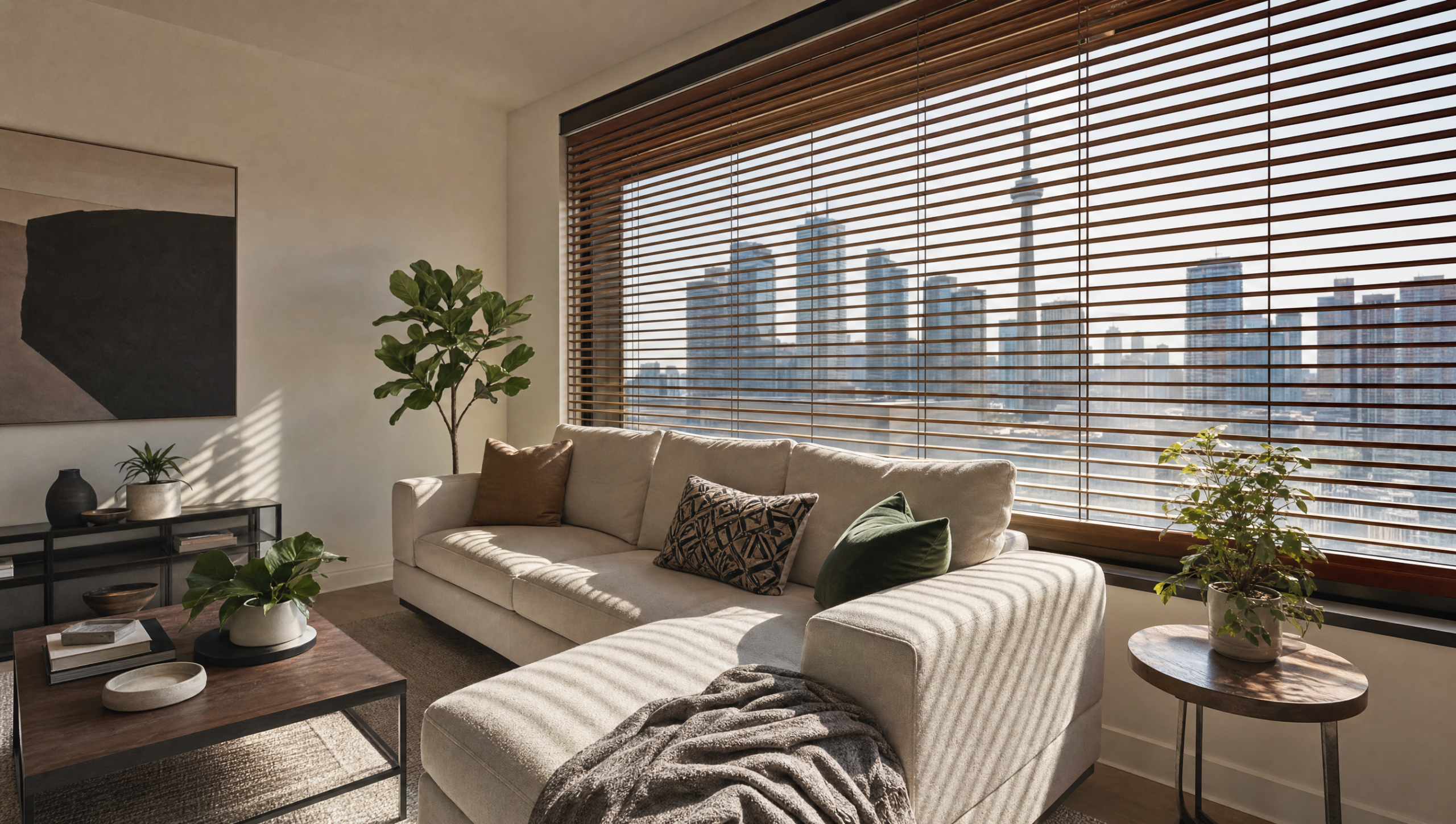

Venetian blinds have been dressing windows for so long that most people picture the same thing when they hear the name: flat horizontal slats you tilt open with a wand or a cord. That basic idea has held up because it works, but the product itself has moved on. Today you can order Venetian blinds in warm real wood, in tough moisture resistant faux wood, or in slim aluminum, with cordless and motorized lifts that were not around a generation ago. To layer soft fabric over hard slats, see our custom curtains and drapery guide.
To see how each style handles heat and cold, read our energy efficient window coverings guide.
Choosing coverings for a wet room? See our companion guide to bathroom and kitchen window coverings for the moisture-resistant options.
Choosing coverings for a wet room? See our companion guide to bathroom and kitchen window coverings for the moisture-resistant options.
For a Toronto or GTA home, the appeal is control. You can tilt the slats a few degrees to keep glare off a screen while still seeing the street, or close them flat for privacy after dark. That tilt is the feature that sets Venetian blinds apart from a roller shade or a curtain, and it is the reason they still sell well in condos, older brick homes, and new builds alike.
This guide covers what Venetian blinds actually are, how the three slat materials differ, which rooms suit them, how they compare with other window coverings, and the practical details around safety, cleaning, measuring, and cost. The aim is to help you walk into a consultation already knowing which questions matter, so you spend that time narrowing choices instead of starting cold.
Prefer vanes that hang vertically for a wide slider? Compare them in our guide to vertical blinds in Toronto.
What Are Venetian Blinds?
A Venetian blind is a window covering built from horizontal slats held on a ladder of cords or fabric tapes. You raise and lower the whole stack with a lift cord or a motor, and you tilt the slats open or closed with a wand, a cord, or a remote. The name goes back centuries, but the mechanism is simple and it is the same whether the slats are wood, faux wood, or aluminum.
The tilt is the heart of the design. Because each slat pivots, you get fine control over how much light enters and how much of the room a person outside can see. Open the slats halfway and you get soft, striped daylight with a view. Close them one way and you block the view while letting a sliver of light in. Close them the other way and you get the most privacy the blind can offer. That range is hard to match with a single flat shade.
How Venetian Blinds Work
Two separate controls run a Venetian blind. The lift raises and lowers the slats so you can uncover the glass or stack the blind at the top. The tilt rotates the slats around their own axis without moving them up or down. On a corded blind these are two different cords or a cord plus a wand. On a cordless blind you push the bottom rail up or pull it down by hand, and you tilt with a wand. On a motorized blind a small motor in the headrail handles the lift, the tilt, or both, and you control it by remote, wall switch, app, or schedule.
The slats sit in a headrail at the top and a bottom rail that gives the blind weight so it hangs straight. The tapes or cords that hold the slats are called the ladder. Higher end blinds often use cloth tapes that hide the route holes in each slat, which gives a cleaner look and blocks a little more light at the edges.
Venetian Blinds Versus Blinds in General
People often ask what the difference is between blinds and Venetian blinds. The short answer is that Venetian blinds are one type of blind. The word blinds is a broad term that covers anything with slats or vanes you can tilt, so it includes horizontal Venetian blinds and vertical blinds. Roller shades, Roman shades, and cellular shades are technically shades rather than blinds because they raise and lower as a solid piece and do not tilt. If you want the tilt feature with horizontal slats, Venetian is the style you are describing. It helps to know the difference between blinds and curtains too, since the two solve privacy and light in different ways.
The Three Slat Materials: Aluminum, Wood, and Faux Wood
Almost every buying decision with Venetian blinds comes down to the slat material. Aluminum, real wood, and faux wood each behave differently around moisture, weight, price, and looks, so the right pick depends on the room more than on personal taste alone.
Aluminum Venetian Blinds
Aluminum slats are thin, light, and hold a crisp flat shape. They come in a wide colour range, from plain white to metallics and darker tones, and they suit a modern or minimal room. Because the metal shrugs off humidity and wipes clean, aluminum works in spots where wood would warp. The trade off is sound and feel. Thin metal slats can rattle in a draft and they dent if handled roughly, so they read as more utilitarian than warm. Slim aluminum blinds are also a common rental choice because they are inexpensive and easy to replace.
Wood Venetian Blinds
Real wood slats, usually basswood, bring warmth and a natural grain that painted metal cannot copy. They feel substantial, they insulate a touch better than metal, and they finish a living room or a study in a way that looks custom. Wood is light for its size, so even wide blinds stay manageable. The catch is moisture. Real wood can warp, swell, or discolour in a steamy bathroom or over a kitchen sink, so it belongs in dry rooms. If you like the wood look but need it near water, faux wood is the answer. Our overview of wood and faux wood blinds goes deeper on that comparison.
Faux Wood Venetian Blinds
Faux wood slats are made from PVC or a composite of PVC and wood fibre, moulded and finished to look like painted or stained timber. They resist moisture, they do not warp in humidity, and they clean up with a damp cloth, which makes them the go to for bathrooms, kitchens, and laundry rooms. Faux wood is heavier than real wood, so very wide windows may need an extra slat or a mid rail for support, and the added weight is worth keeping in mind on a large span. For most homeowners the small loss in authenticity is a fair trade for a slat that holds up in a humid Toronto summer.
| Feature | Aluminum | Real wood | Faux wood |
|---|---|---|---|
| Look and feel | Crisp, modern, utilitarian | Warm, natural grain, high end | Wood look without the grain depth |
| Moisture tolerance | Excellent, will not warp | Poor, warps in steam | Excellent, made for damp rooms |
| Weight | Very light | Light for its size | Heaviest, support wide spans |
| Best rooms | Rentals, offices, utility spaces | Living rooms, bedrooms, studies | Bathrooms, kitchens, basements |
| Durability | Dents if knocked | Long lived in dry rooms | Tough, holds finish well |
| Relative cost | Lowest | Highest | Middle |
Slat Sizes and What They Change
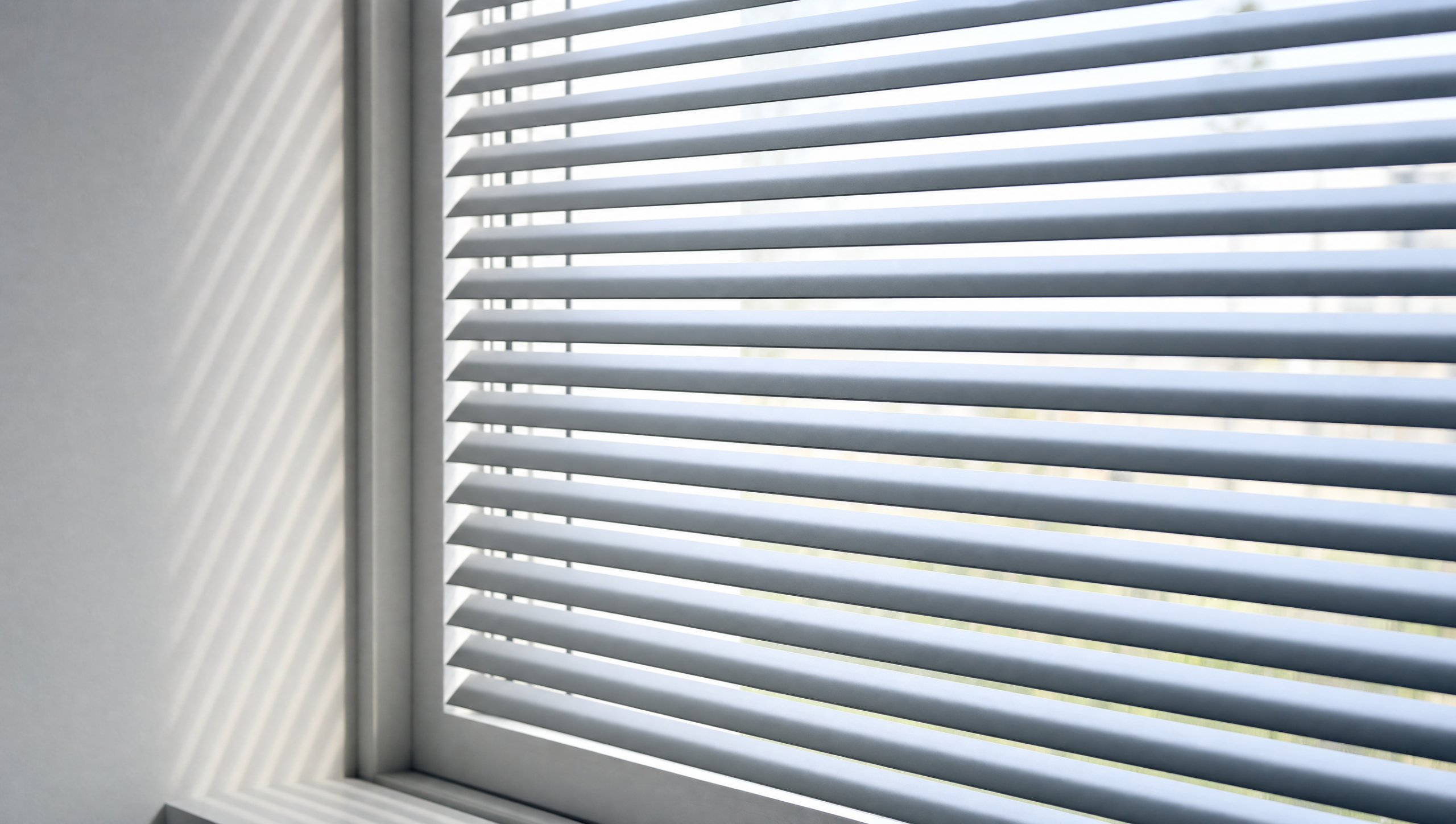
Venetian slats come in a few standard widths, and the size you pick changes both the look and the view. Narrow slats give a tighter, more traditional pattern and stack into a smaller bundle at the top. Wider slats look more contemporary, let through a broader view when open, and block a little more light when closed because there are fewer gaps to line up.
| Approx. slat width | Common material | Look | Best for |
|---|---|---|---|
| 16 mm (mini) | Aluminum | Fine, dense stripes | Small windows, offices, rentals |
| 25 mm (1 in) | Aluminum, faux wood | Classic, versatile | Most rooms and window sizes |
| 50 mm (2 in) | Wood, faux wood | Broad, contemporary | Living rooms, larger windows |
| 63 mm (2.5 in) | Wood, faux wood | Bold, open view | Feature windows, wide spans |
As a rule, small windows look better with narrow slats and large windows carry wider slats well. On a big picture window, wide wood or faux wood slats give a clean, architectural line, which is one reason they show up so often on blinds for large windows.
Light Control, Privacy, and Glare
The reason people choose Venetian blinds usually comes back to light. A tilt gives you settings a fixed shade cannot. During the day you can angle the slats up so light bounces off the ceiling and fills the room without a harsh beam on a television or a monitor. In the evening you close them for privacy. The one thing to know is that a Venetian blind is not a blackout product on its own. Light slips through the route holes and around the edges even when the slats are shut tight, so a bedroom that needs full darkness is better served by pairing the blind with a drape or choosing a different style.
| Slat position | Light | Privacy | Typical use |
|---|---|---|---|
| Fully open (flat) | Maximum daylight and view | None | Daytime with no overlooking |
| Tilted up | Soft, bounced light | Partial from below | Reducing glare on screens |
| Tilted down | Diffused light | Partial from above | Street level windows |
| Closed | Dim, some edge light | High, not total | Evening privacy |
| Raised fully | Open glass | None | Clear view, washing windows |
If glare control matters more than a view, a roller blind or a solar shade can be a better fit, and if you want privacy without losing the daytime view, dual sheer styles are worth a look. Venetian blinds sit in the middle, giving you a bit of everything through the tilt.
Best Rooms for Venetian Blinds in a Toronto Home
Venetian blinds fit almost anywhere, but the material has to match the room. Here is how the three slat types usually get placed around a house.
Living and Dining Rooms
These are the rooms where wood Venetian blinds earn their price. The grain warms up the space, wide slats suit larger windows, and the tilt lets you set the light for reading in the afternoon or hosting in the evening. Faux wood is a sensible stand in if the budget is tighter or the room gets direct sun that could fade real wood over time.
Kitchens and Bathrooms
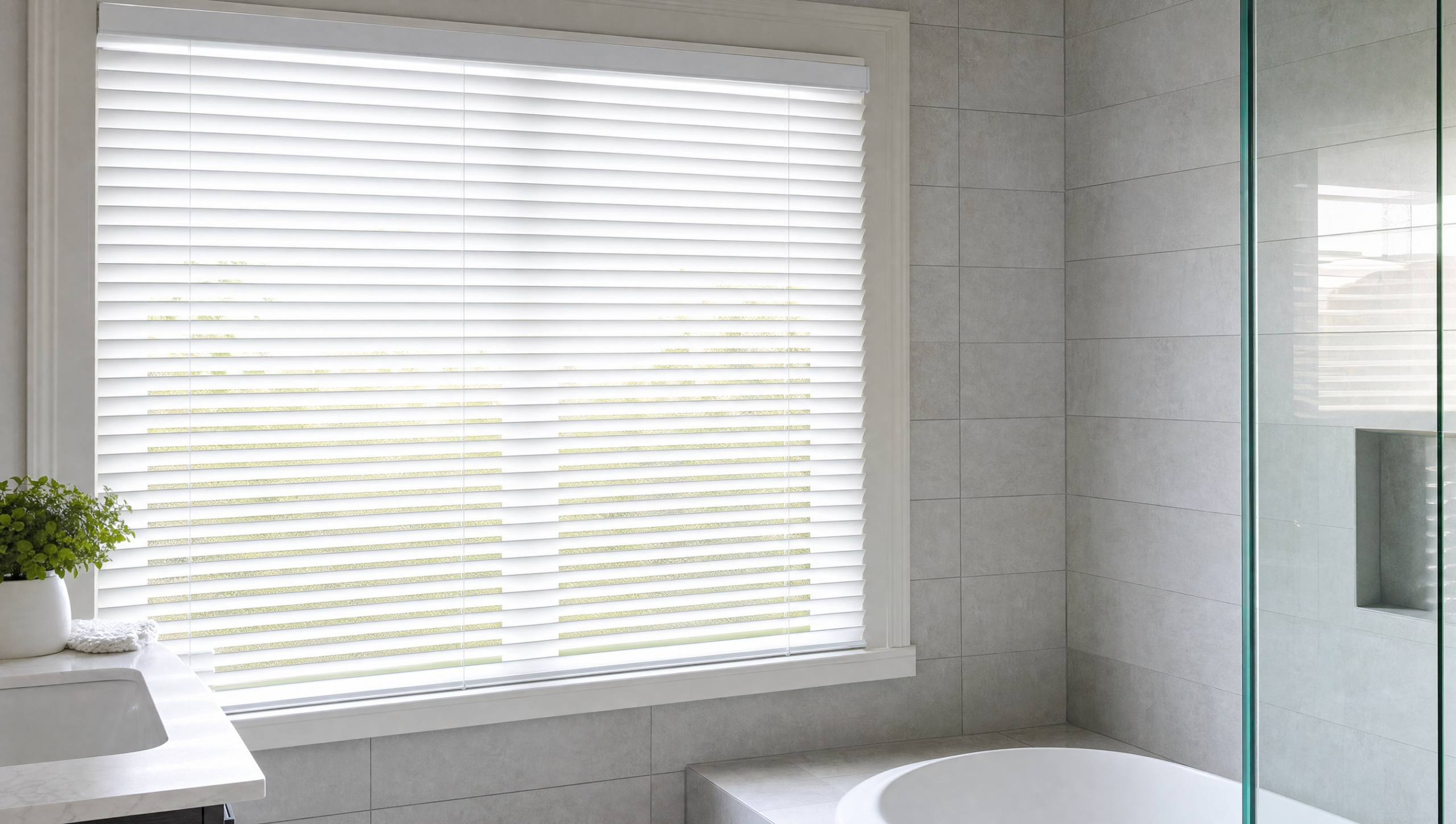
Damp rooms are where faux wood and aluminum shine. Both wipe clean and neither warps when the air turns humid, which matters over a sink or near a shower. Real wood does not belong here. If you are weighing options for these spaces, our notes on the best blinds for a bathroom and on choosing roller blinds for a kitchen window cover the moisture question in more detail.
Bedrooms
Venetian blinds work in a bedroom for privacy and for setting a calm light in the evening, but light gaps around the slats mean they rarely deliver full darkness on their own. Many homeowners pair them with a curtain, or choose a blackout style when sleep is the priority. Our roundup of shades for a bedroom walks through the darker options.
Home Offices
An office is a strong case for Venetian blinds because glare on a screen is the daily problem and the tilt solves it directly. Angle the slats to lift the light off the monitor while keeping the room bright. Aluminum or slim faux wood keeps the look clean, and the same logic scales up to workplaces, where tilt control and easy cleaning make them a practical pick for office blinds.
| Room | Best material | Why |
|---|---|---|
| Living room | Wood or faux wood | Warmth and wide slats for larger windows |
| Bathroom | Faux wood or aluminum | Handles steam without warping |
| Kitchen | Faux wood or aluminum | Wipes clean of grease and moisture |
| Bedroom | Wood, paired with a drape | Privacy plus added darkness |
| Home office | Aluminum or faux wood | Precise glare control on screens |
| Basement | Faux wood or aluminum | Tolerates damp and cooler air |
Inside Mount Versus Outside Mount
Where the blind sits changes the look as much as the fabric or slat does. An inside mount fits the blind inside the window opening for a clean, built in appearance that shows off the frame. It needs enough depth in the recess for the headrail to sit flush. An outside mount fixes the blind on the wall or trim above the opening, which covers more glass, blocks more light at the edges, and can make a small window look larger. The right call depends on your window depth and the look you want, and our guide to inside mount and outside mount covers the measurements that decide it.
| Factor | Inside mount | Outside mount |
|---|---|---|
| Look | Clean, recessed, shows the frame | Covers the frame, looks larger |
| Light control | Small gaps at the edges | Blocks more edge light |
| Needs | Enough recess depth | Wall or trim space above |
| Good for | Deep frames, a tailored look | Shallow frames, small windows |
Venetian Blinds Versus Other Popular Window Coverings
Venetian blinds are one option among several, and the best choice depends on whether you value the tilt, a soft look, energy savings, or full darkness. Here is how they stack up against the styles Toronto homeowners ask about most.
| Covering | Strength | Limitation |
|---|---|---|
| Venetian blinds | Precise tilt for light and privacy | Not blackout, slats collect dust |
| Roller shades | Clean look, blackout options | No tilt, view is all or nothing |
| Zebra shades | Switch between sheer and solid | Less tilt precision than slats |
| Vertical blinds | Suits wide and patio doors | Less classic on small windows |
| Cellular shades | Strong insulation at the window | No tilt, softer look |
| Shutters | Built in look, tilt like slats | Higher cost, permanent fit |
If insulation is your main goal, cellular shades trap air at the glass in a way slats cannot. For a wide patio door, vertical blinds for a patio door stack to the side and clear the traffic path. And if you love the tilt but want a more permanent, built in look, California shutters use the same slat principle in a framed panel. Venetian blinds hold their ground when you want that tilt control at a friendlier price than shutters.
Cord Safety and the Question of Blinds Banned in Canada
A common search is whether Venetian blinds are banned in Canada. They are not banned. What changed is that Canada brought in some of the strictest corded window covering safety rules in the world, and they apply to blinds sold here. Since May 2021, corded window coverings offered for sale in Canada must meet limits designed to remove the strangulation hazard that loose or looped cords pose to young children. You can read the federal rules in the Corded Window Coverings Regulations, and Health Canada explains the risk to families in its guidance on window covering cord safety.
In practice this pushed the whole industry toward cordless and motorized lifts, which is good news for anyone with kids or pets. If child safety is on your mind, a cordless blind removes the reachable cord entirely, and our roundup of child safe window coverings explains the safer lift systems. So the honest takeaway is that you can still buy Venetian blinds in Canada, and the ones sold today are safer than the corded blinds many of us grew up with.
What Affects the Cost of Venetian Blinds
There is no single price for Venetian blinds because so many choices move the number. Material is the biggest lever, with aluminum at the low end, faux wood in the middle, and real wood at the top. Beyond that, window size, slat width, the lift system, and any upgrades like cloth tapes or motorization all add up. Rather than quote a figure that would not fit your windows, the table below shows what drives the cost so you can see where your money goes.
| Cost driver | Lower cost | Higher cost |
|---|---|---|
| Slat material | Aluminum | Real wood |
| Window size | Small, standard openings | Wide or tall custom sizes |
| Lift system | Standard corded | Cordless or motorized |
| Tapes and finish | Standard ladder cords | Cloth tapes, premium finishes |
| Install | A few standard windows | Many windows or tricky access |
Because the variables interact, the most reliable way to price a project is a measured quote. For a fuller picture of how quotes come together across styles, our guide on what affects window covering pricing is a good next read, and the same logic applies whether you are outfitting one room or a whole condo.
Cleaning and Maintaining Venetian Blinds
Slats collect dust, and that is the honest downside of any Venetian blind. The upside is that cleaning is quick if you do it often. A weekly pass with a duster or a microfibre cloth, run along the closed slats, keeps most of the buildup off. For a deeper clean, close the slats one way, wipe, then close them the other way and wipe again so you catch both faces.
Cleaning by Material
Aluminum and faux wood handle water well, so a damp cloth or a mild soapy wipe is fine, and faux wood can even take the occasional wipe with a slightly wetter cloth in a bathroom. Real wood does not like moisture, so keep it to a dry duster or a barely damp cloth and dry it right away. Never soak wood slats. If a slat bends or a cord frays, most Venetian blinds can be repaired rather than replaced, which is worth asking about before you write one off.
| Material | Routine clean | Deeper clean |
|---|---|---|
| Aluminum | Dry duster weekly | Damp or mild soapy cloth |
| Faux wood | Duster or dry cloth | Damp cloth, safe near water |
| Real wood | Dry duster only | Barely damp cloth, dry at once |
Measuring and Installation
Accurate measurements are what separate a blind that looks built in from one that looks like an afterthought. For an inside mount you measure the width in three places and use the narrowest, then the height, and you check the recess depth so the headrail fits. For an outside mount you decide how far past the opening you want the blind to reach on each side and above. Small errors show up as light gaps or a blind that binds, which is why a professional measure is worth it on anything but the simplest window. Our step by step measuring guide walks through the process if you want to try it yourself first.
Installation itself is straightforward on a standard window, with brackets at the top holding the headrail. Wider or heavier blinds, especially faux wood on a big span, benefit from a centre support bracket so the headrail does not sag. If you would rather skip the ladder and the drill, or if the window is high or awkward, this is a job many homeowners hand to an installer.
How to Choose the Right Venetian Blinds
With the pieces in place, choosing comes down to a few clear questions. Match the material to the room first, since that rules out the wrong options quickly. Then pick a slat width for the look and window size, decide on a lift system with safety in mind, and settle the mount based on your window depth. The checklist below pulls it together.
| Question | What it decides |
|---|---|
| Is the room damp? | Faux wood or aluminum over real wood |
| How big is the window? | Narrow slats for small, wide slats for large |
| Are there kids or pets? | Cordless or motorized lift |
| Do you need darkness? | Pair with a drape or choose blackout |
| How deep is the frame? | Inside mount if deep, outside if shallow |
| What is the budget? | Aluminum low, faux wood mid, wood high |
If you are still weighing Venetian blinds against other styles, it can help to see how a full home comes together. Our custom window coverings in Toronto page and the broader guide to custom window coverings show how the same room can be handled several ways, and the window blinds gallery gives a sense of how each finish looks in a real space. For a hands free option on hard to reach windows, motorized blinds can run Venetian slats on a schedule.
Bring the Slats to Your Windows
Venetian blinds keep selling because the tilt gives you a kind of control that a flat shade cannot, and the three materials mean there is a version that fits almost any room in a Toronto home. Wood warms a living room, faux wood shrugs off bathroom steam, and aluminum keeps an office bright without glare. The trick is matching the material and the mount to the window in front of you.
If you would like a hand doing that, the Canadian Blinds Pros team measures, advises, and installs across Toronto and the GTA. Book a free consultation and we will bring samples of aluminum, wood, and faux wood slats to your home so you can see the finishes in your own light before you decide.
Frequently Asked Questions
What is a Venetian blind?
A Venetian blind is a window covering made of horizontal slats held on cords or fabric tapes. You raise and lower the whole stack with a lift, and you tilt the slats open or closed to control light and privacy. The slats can be aluminum, real wood, or faux wood.
What is the difference between blinds and Venetian blinds?
Venetian blinds are one type of blind. Blinds is the broad word for any covering with slats or vanes you can tilt, which includes horizontal Venetian blinds and vertical blinds. Roller and Roman styles are technically shades because they do not tilt. So every Venetian blind is a blind, but not every blind is Venetian.
What are Venetian blinds made of?
The slats come in three main materials. Aluminum is light, modern, and moisture proof. Real wood, usually basswood, is warm and natural but not suited to damp rooms. Faux wood is a PVC or composite slat that looks like wood and resists moisture, which makes it popular for kitchens and bathrooms.
Are aluminum or faux wood Venetian blinds better for a bathroom?
Both work well in a bathroom because neither warps in humidity. Faux wood gives a warmer, wood look and feels more substantial, while aluminum is lighter, slimmer, and usually cheaper. If you want the room to feel finished, faux wood tends to win. If budget or a clean modern look leads, aluminum is fine.
What is the difference between wood and faux wood Venetian blinds?
Real wood is lighter, has a genuine grain, and looks high end, but it can warp in moisture and costs more. Faux wood is heavier, made from PVC or a wood and PVC blend, resists humidity, and costs less. Choose real wood for dry living spaces and faux wood for damp rooms or a tighter budget.
What slat width should I choose?
Match the slat to the window. Narrow slats around 16 to 25 mm suit small windows, offices, and a traditional look. Wider slats around 50 to 63 mm suit larger windows and a contemporary style, and they give a broader view when open. Wider slats also block a little more light when closed.
Are Venetian blinds banned in Canada?
No. Venetian blinds are not banned in Canada. Since May 2021 the country has enforced strict corded window covering safety rules, so blinds sold here must meet those cord limits. The effect has been a shift toward cordless and motorized lifts, which are safer for homes with children and pets.
Are Venetian blinds child and pet safe?
They can be. A corded Venetian blind carries the usual cord risk, so families should choose a cordless or motorized version that removes the reachable cord. Canadian safety rules now push manufacturers toward these safer lifts, and cordless is the simplest way to make any blind safer around young children and pets.
What are common problems with Venetian blinds?
The usual complaints are dust on the slats, slats that bend if handled roughly, tilt cords or wands that wear over time, and light gaps that keep them from full blackout. Most of these are minor and fixable. Regular dusting handles the first, and a repair often solves a bent slat or a worn cord.
How do I clean Venetian blinds?
Dust them weekly with a microfibre cloth or a duster along the closed slats. For a deeper clean, close the slats one way and wipe, then close them the other way and wipe again. Aluminum and faux wood take a damp or mild soapy cloth, while real wood should only get a dry or barely damp wipe.
Do Venetian blinds block out all light?
No. Even with the slats shut, light slips through the route holes and around the edges, so a Venetian blind is not a blackout product on its own. For a dark bedroom, pair the blind with a curtain, add cloth tapes to reduce edge light, or choose a dedicated blackout shade instead.
Are Venetian blinds good for privacy?
Yes, for everyday privacy they work well. Close the slats and you block the view from outside, and tilting lets you keep privacy while still letting light in. The one gap is at night with a light on, when a person outside may see shapes, which is when a liner or a paired drape helps.
Can Venetian blinds be motorized?
Yes. A motor in the headrail can handle the lift, the tilt, or both, controlled by remote, wall switch, app, or schedule. Motorization suits tall, wide, or hard to reach windows, and it also removes the cord, which improves safety. It is a popular upgrade on larger living room and stairwell windows.
Should Venetian blinds be inside or outside mount?
Inside mount looks clean and recessed when the window frame is deep enough for the headrail. Outside mount fixes the blind above the opening, covers more glass, blocks more edge light, and can make a small window look larger. Your window depth and the look you want decide which fits better.
How much do Venetian blinds cost in Toronto?
Cost depends on the slat material, window size, slat width, lift system, and any upgrades like cloth tapes or motorization. Aluminum is the most affordable, faux wood sits in the middle, and real wood is the priciest. A measured quote is the only way to get an accurate number for your specific windows.
Are Venetian blinds outdated in 2026?
Not at all. Wide wood and faux wood Venetian blinds remain a popular, current look, especially in warm and natural interiors. What has aged out is the thin corded aluminum mini blind in every window. Modern wide slats, cordless lifts, and richer finishes keep the style firmly in fashion.
Where can I use Venetian blinds in a condo?
Venetian blinds suit most condo rooms, with faux wood or aluminum in the kitchen and bathroom and wood or faux wood in the living areas. Slim slats stack neatly at the top to keep the view, and cordless lifts meet condo family safety needs. Check your building rules on any street facing look first.
How long do Venetian blinds last?
With regular dusting and gentle use, quality Venetian blinds last many years. Faux wood and aluminum hold up longest because they resist moisture and hold their finish, while real wood lasts well in dry rooms. Worn cords or a bent slat can usually be repaired, which extends the life of the blind.