
Vertical Blinds in Toronto: A Complete Buyer’s Guide to Patio Doors, Wide Windows, and Modern Vanes
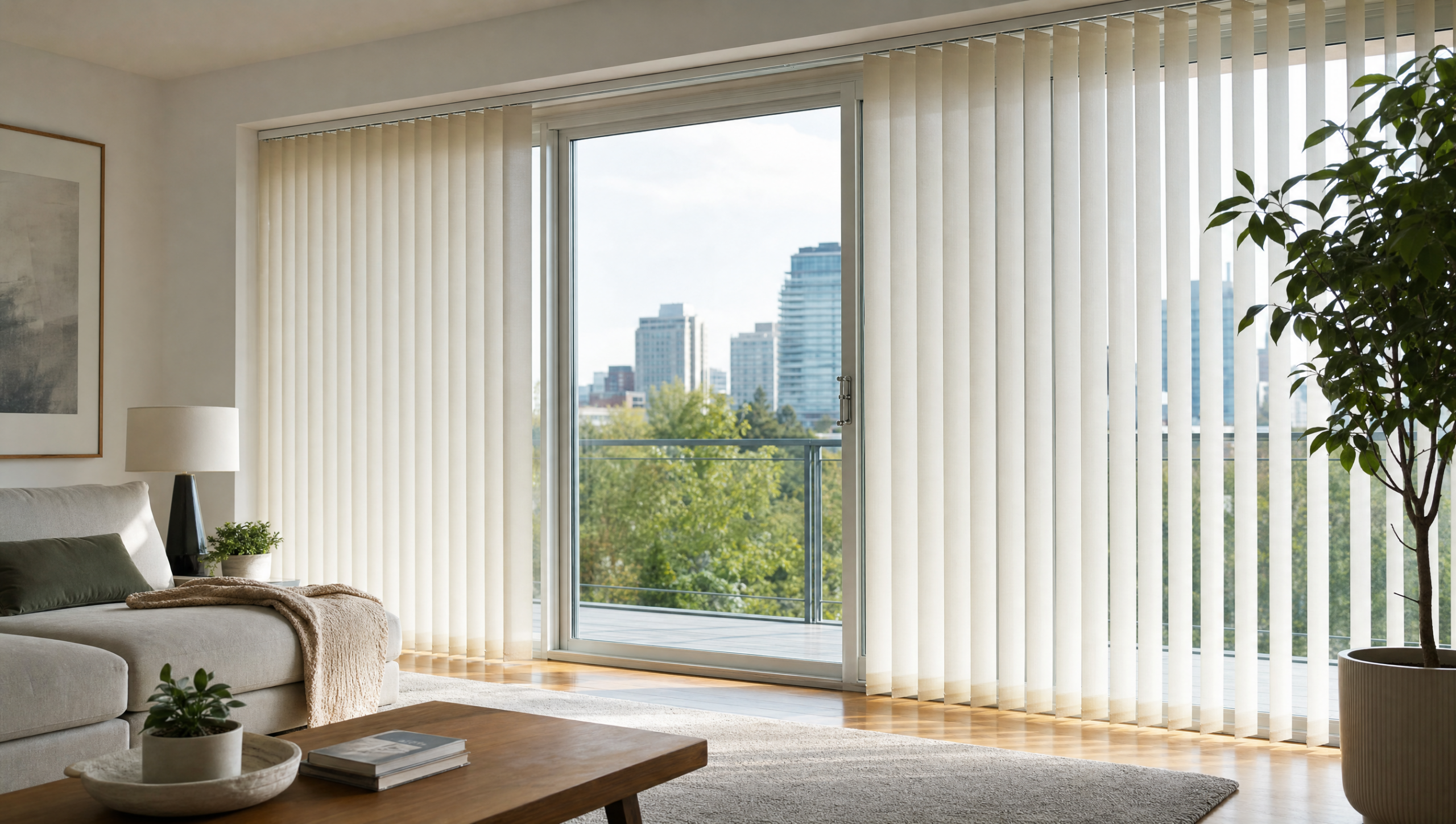

Vertical blinds are the quiet workhorse of Toronto homes. They are the covering most people reach for when a window is too wide, a patio door needs to open and close every day, or a glass wall in a condo has to switch from open view to private in a second. The louvers hang from a track at the top, rotate to let in as much or as little light as you want, and slide to one side so you can walk straight through the door underneath. Full-length fabric is another way to dress a wide slider, which our Toronto curtains and drapery guide covers in detail.
On very wide glass, if the narrow vanes feel dated, a set of panel track blinds slides a few broad fabric panels sideways for a cleaner, more modern face.
They also carry a bit of a reputation. Say the words vertical blinds and some people picture a builder-grade rental from decades ago, the vanes yellowed and a few of them missing. That version still exists, but it is not what a modern vertical blind looks like. Today you can order them in soft fabric, in curved S-shape vinyl that overlaps for a fuller look, in sheer versions that float the vanes inside a screen, or as wide panel tracks that read more like moving drapery than old-school slats.
This guide walks through how vertical blinds actually work, where they earn their keep in a Toronto or GTA home, the vane materials worth knowing about, how they compare with the newer alternatives, and what to check before you order. The goal is that by the end you know whether verticals are right for your space, and if they are, how to spec them so they look good and last.
What Are Vertical Blinds?
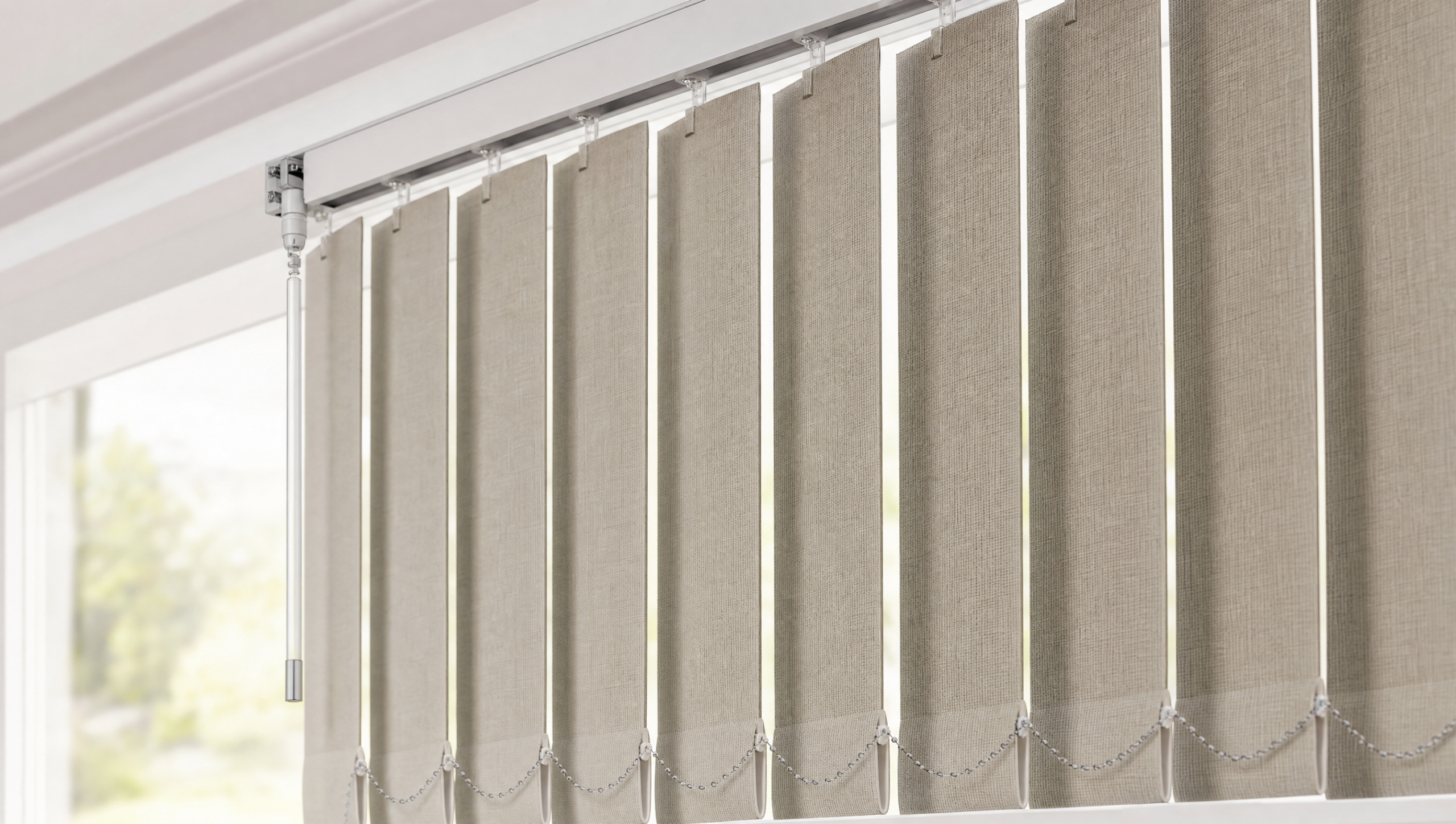
Vertical blinds are a window covering made of long slats, called vanes or louvers, that hang down from a headrail track mounted along the top of the window or door. Each vane clips onto a carrier in the track. You tilt them with a wand or chain to control light and privacy, and you traverse them along the track to slide the whole set open. Because they stack sideways rather than lifting up, they suit tall and wide openings that horizontal blinds struggle with.
The two movements matter, so it helps to separate them. Tilting rotates every vane at once, up to about 180 degrees, which is how you go from fully open to fully closed without moving the vanes off the glass. Traversing pulls the vanes to one side, or splits them to both sides, so you clear the opening to step through a door or wash the window. That combination is what makes verticals so practical on doors: you can crack them for airflow, close them for privacy, or sweep them aside completely.
Are Vertical Blinds Out of Style in 2026?
This is the question that comes up most, so it is worth answering plainly. Vertical blinds are not out of style. What went out of style is the specific look of thin, gappy, plastic vanes in a beige rental unit. The category itself is very much alive, and for wide glass it is often the most sensible choice on the market. Google’s own People Also Ask results show searchers asking whether verticals are dated and what people are replacing them with, which tells you the perception is out there. The reality on the ground is more nuanced.
A few things have changed the picture. Fabric vanes now come in linens, textures and soft neutrals that look far closer to drapery than to old vinyl. S-curve vinyl vanes overlap slightly instead of sitting flat, which softens the light lines and blocks more glare. Sheer vertical shades suspend fabric vanes between two layers of sheer knit, so you get the traverse-and-tilt function of a vertical with a look that reads like a modern shade. And panel track systems replace narrow vanes with a handful of wide flat panels, a style that suits contemporary condos and very wide openings.
So if someone tells you verticals are outdated, what they usually mean is the old vinyl look. Choose a current material and a clean headrail, and a vertical blind looks completely at home in a 2026 Toronto living room or condo.
Vertical Blind Vane Materials
Most of the decision comes down to what the vanes are made of. Each material behaves differently on light, moisture, sound and price, so this is where it pays to slow down. Here is how the common options stack up.
| Vane material | Best for | Light control | Notes |
|---|---|---|---|
| PVC / vinyl | Kitchens, bathrooms, patio doors, high-traffic doors | Good, near-room-darkening when closed | Most affordable, wipes clean, resists humidity, individual vanes are easy to replace |
| S-curve vinyl | Living rooms and doors where you want a softer look | Very good, overlapping curve reduces light gaps | Vanes curve and overlap for a fuller, less flat appearance |
| Fabric | Living rooms, bedrooms, offices | Ranges from light filtering to room darkening by fabric | Softest look, many textures and colours, some vanes are removable and washable or replaceable |
| Faux wood | Rooms that want a warmer, wood-look finish | Good | Heavier vanes, a wood look without the cost or warping of real wood on a vertical track |
| Sheer vertical | Modern living rooms and wide feature windows | Soft, diffused, adjustable | Fabric vanes float inside a sheer layer, tilt to filter or open to a near-clear view |
For a moisture-heavy spot like a kitchen slider or a bathroom window, vinyl is the safe pick because it shrugs off steam and splashes and wipes down in seconds. If you want the practicality of a vertical but a look that fits a design-led living room, fabric or sheer vertical vanes are worth the step up. Our full walkthrough of sheer shades, including sheer verticals covers that softer family in detail.
Where Vertical Blinds Work Best in a Toronto Home
Verticals shine on big glass. The wider and taller the opening, the more sense they make, because they stack sideways and are not fighting gravity the way a heavy horizontal shade would be on a three metre window. Here are the spots where they tend to be the right answer in GTA homes and condos.
Sliding Patio Doors
This is the classic use, and search demand backs it up: interest in vertical blinds for patio doors has climbed sharply over the past year. A patio door needs a covering you can sweep fully aside to walk through, then close again for privacy at night. Verticals do exactly that, and because the vanes hang clear of the glass, they do not bang around every time the door slides. If you are weighing your options for that specific opening, our guide to the best blinds for sliding doors that actually fit compares verticals against panel tracks and roller options side by side. There is also a dedicated look at the best window coverings for sliding glass doors if you want more depth.
Wide and Large Windows
On a picture window or a wide living room window, a single horizontal shade can be awkward to raise and heavy to handle. Verticals handle the width gracefully and let you angle the vanes to cut afternoon glare without dropping the whole window into darkness. Our roundup of the best blinds for large windows puts this in context.
Condo Balcony Doors and Glass Walls
Toronto condos are full of floor-to-ceiling glass and balcony sliders, and verticals suit them well. They give you privacy from the building across the street and let you reclaim a balcony that otherwise feels like a fishbowl. We wrote about that exact problem in our piece on how vertical blinds solve glass privacy issues, and there is broader room-by-room advice in our guide to the best blinds for condos.
Offices and Room Dividers
In offices, verticals control glare on screens and give staff quick privacy, which is why they are still a staple in commercial spaces. Wide fabric verticals and panel tracks also make effective room dividers in open-concept homes and studios. If you are outfitting a workspace, our office blinds page covers the commercial side.
| Opening | Are verticals a good fit? | Why |
|---|---|---|
| Sliding patio door | Excellent | Stacks aside to clear the doorway, no banging against the glass |
| Wide picture window | Excellent | Handles width without a heavy lift mechanism |
| Condo balcony slider | Excellent | Fast privacy on floor-to-ceiling glass |
| Office window | Very good | Glare control and quick privacy, easy per-vane replacement |
| Small standard window | Usually overkill | A roller, cellular or zebra shade is neater at this size |
| Bay window | Depends | Workable with separate tracks per section, but often better suited to other styles |
Vertical Blinds Versus the Alternatives
Verticals are not the only way to cover wide glass, and part of choosing well is knowing what you are choosing against. The main competitors are panel track blinds, sheer verticals, wide roller shades and drapery. Each has a personality.
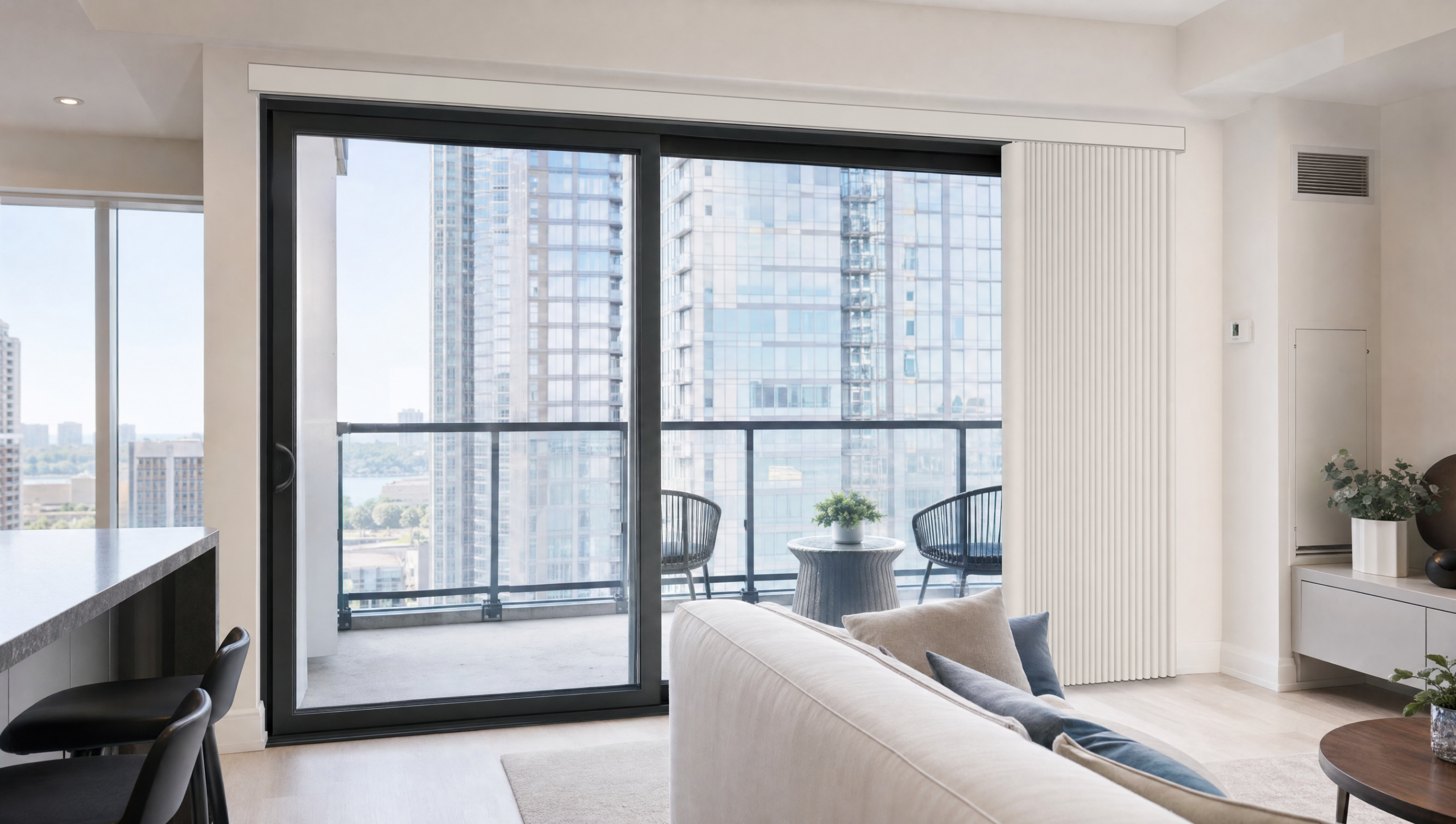
Panel track blinds use a small number of wide fabric panels that slide on a multi-channel track and stack behind one another. They read as more contemporary than narrow vanes and are excellent on very wide openings and as room dividers, though they do not tilt to fine-tune light the way vanes do. Sheer verticals give you the traverse-and-tilt control of a vertical with a soft, diffused look, at a higher price. A wide roller or solar shade is clean and minimal but has to be lifted as one piece, which gets heavy and does not let you walk through a door. Drapery looks warm and rich but does not angle light and needs stacking space on either side.
| Option | Walk-through door | Fine light control | Look | Relative cost |
|---|---|---|---|---|
| Vertical blinds | Yes, stacks aside | Yes, vanes tilt | Classic to modern by material | Low to mid |
| Panel track | Yes, slides aside | No, panels do not tilt | Contemporary, minimalist | Mid |
| Sheer vertical | Yes, stacks aside | Yes, soft and diffused | Modern, upscale | Mid to high |
| Wide roller / solar | No, lifts as one piece | Limited, up or down only | Clean, minimal | Low to mid |
| Drapery | Yes, draws aside | No, open or closed | Warm, soft, decorative | Mid to high |
If your priority is walking through a door and dialling in light, verticals or sheer verticals win. If you want the cleanest modern face and do not need to tilt, panel track is the one to look at. For a narrower window, a roller shade, zebra blind or cellular shade is usually tidier than a vertical.
Light Control and Privacy
The appeal of a vertical is that you get two separate levers on light. Tilting the vanes changes how much daylight and how much sightline you allow, and traversing them opens the view entirely. During the day, angled vanes let you keep the room bright while blocking the direct sun and the neighbour’s line of sight. At night the calculus flips, the same way it does with any light covering.
Here is the honest limitation. Standard vinyl and fabric vanes overlap only slightly, so when interior lights are on after dark, someone outside can catch glimpses between vanes at certain angles, and a small amount of light leaks at the edges. If a room needs true blackout, for a bedroom or a media room, a vertical alone is not the tool. Pair it with a second layer, or choose S-curve vinyl or room-darkening fabric vanes to tighten the overlap. For rooms where sleep is the priority, our guide to the best shades for bedrooms and our blackout blinds options are a better starting point, and there is broader advice in our piece on the best blinds for privacy.
| Vane position | Daytime | After dark with lights on |
|---|---|---|
| Fully closed | Strong privacy, room stays shaded but not pitch dark | Good privacy, minor gaps and edge light possible |
| Angled | Bright room, glare cut, partial view out | Reduced privacy, silhouettes visible |
| Traversed open | Full view and full light | No privacy, clear view in |
Stack, Draw and Control Options
A few setup choices decide how a vertical blind lives day to day, and they are easy to get wrong if nobody asks the right questions. The first is draw direction. A one-way draw stacks all the vanes to a single side, which is what you usually want on a patio door so the stack sits away from the handle. A split or centre draw parts the vanes to both sides from the middle, which suits a symmetrical picture window. You choose the stack side based on where the door handle is and which way you walk through.
The second choice is control. Traditional verticals use a wand to tilt and a bead chain to traverse. That chain is the part to think hard about if you have young children or pets, because a looped cord is a strangulation hazard. The modern answer is a wand-only or fully cordless control, or a motorized headrail you tilt and traverse by remote or app. Motorized verticals are genuinely convenient on a wide or hard-to-reach patio door, and they tie into a smart home setup if you want scheduling.
| Control type | How it works | Child and pet safety |
|---|---|---|
| Wand and chain | Wand tilts, bead chain traverses | Chain loop is a hazard, needs a tensioner or tie-down |
| Wand only | One wand both tilts and pulls the vanes | Much safer, no looped cord |
| Cordless | Manual glide with no exposed cords | Safest manual option |
| Motorized | Remote or app tilts and traverses | No cords, convenient on wide or tall doors |
Health Canada now regulates corded window coverings sold in the country, and its guidance is worth reading if young kids are in the home. See Health Canada on corded window covering safety, and the federal Corded Window Coverings Regulations. Our own write-up on cordless blinds for safer windows covers the practical side.
Measuring for Vertical Blinds
Measuring a vertical is a little different from a horizontal blind because you are working around a door that has to keep functioning. The first decision is inside mount versus outside mount. An inside mount sits the headrail inside the window or door frame for a clean built-in look, which needs enough depth in the frame to clear the track. An outside mount fixes the headrail on the wall or trim above the opening, which is the common choice for patio doors because it lets the vanes clear the door handle and overlap the frame for better light and privacy coverage.
Our guide to inside mount versus outside mount walks through which to pick. A few vertical-specific points to keep in mind while measuring:
| Measuring point | What to check |
|---|---|
| Door handle clearance | Vanes must hang clear of a protruding patio door handle, which usually means an outside mount or a wider projection bracket |
| Overlap for privacy | For an outside mount, add width and height beyond the glass so closed vanes overlap the frame and cut light gaps |
| Floor clearance | Vanes should hang just above the floor or sill so they swing freely without dragging |
| Stack space | Leave room to the side for the vanes to bunch when drawn fully open |
| Mounting surface | Confirm you are fixing into something solid above the opening, especially on a long, heavy track |
Because a long vertical track carries real weight and has to clear a working door, this is one covering where a professional measure genuinely pays off. A track that is even slightly off can leave vanes dragging, gapping or catching the handle.
What Vertical Blinds Cost
Price depends far more on size, material and control type than on the fact that it is a vertical. As a rough market reference, off-the-shelf vinyl vertical kits at Canadian retailers commonly run from around fifty dollars for a small window up to a few hundred dollars for a wide patio-door width at the time of writing. Custom fabric, S-curve, sheer vertical and motorized versions cost more, and a made-to-measure order sized and installed for your exact opening is quoted individually. The main cost drivers are below.
| Cost driver | Effect on price |
|---|---|
| Width and height | Wider and taller openings use more vanes and a longer track, so cost rises with size |
| Vane material | Vinyl is the most affordable, fabric and sheer vertical cost more |
| Control type | Manual wand is cheapest, motorized adds the most |
| Custom versus stock | Made-to-measure sizing and installation cost more than a boxed kit but fit properly |
| Installation | Professional measure and install add cost but avoid dragging vanes and gaps |
For a fuller breakdown across window covering types, see our guide to how much custom window coverings cost. The most reliable way to know your number is a quick measure and quote for your actual doors and windows.
Cleaning and Maintenance
One of the underrated advantages of verticals is how easy they are to maintain. Because the vanes hang straight down, they collect less dust on their faces than horizontal slats that sit flat. A quick wipe or a vacuum with a brush attachment every few weeks keeps them looking fresh. Vinyl vanes take a damp cloth with mild soap, and fabric vanes can often be spot cleaned or, on many systems, unclipped and cleaned individually. If a vane gets damaged, you usually replace just that one vane rather than the whole blind, which is a real cost saver over the years.
Our step-by-step on how to clean vertical blinds covers the details, and if your current set is tired but functional, a few simple updates can refresh the look without a full replacement.
Common Problems and How to Avoid Them
Verticals have a handful of well-known annoyances, and every one of them is preventable with the right spec and a bit of care. Vanes that flip or spin in a draft usually mean the bottom weights and connecting chain were removed or never installed, so keep them in place. Vanes catching on a door handle almost always trace back to an inside mount on a door that needed an outside mount with more projection. Warping shows up on cheap vinyl left in harsh direct sun over years, so a quality vane and, where the heat is extreme, a more sun-stable material make a difference. And a single missing or cracked vane is a five minute replacement on most systems, not a reason to redo the whole window. Choosing a wand or cordless control from the start also sidesteps the tangled-chain problem entirely.
Child and Pet Safety
If there are young children or pets in the home, treat cords as the first safety decision, not an afterthought. A looped bead chain on a traditional vertical is exactly the kind of hazard Canada’s corded window covering rules are meant to address. The simplest fix is to skip the exposed cord entirely with a wand-only, cordless or motorized control. Where an older corded set stays in place, keep the chain tensioned and anchored to the wall so no loop hangs loose, and keep furniture that a child could climb away from the covering. Health Canada’s blind cord safety guidance is the authority to follow here.
Choosing the Right Vertical Blinds: Questions to Ask
Before you order, run through this short checklist. The answers point you to the right material, mount and control, and they are the same questions we ask during a consultation.
| Question | Why it matters |
|---|---|
| Is this a door you walk through daily? | Points to a one-way draw and an outside mount that clears the handle |
| Is the room humid, like a kitchen or bathroom? | Vinyl vanes over fabric |
| Do you need true darkness? | Add a second layer or choose another style, since verticals leak some light |
| Are there young children or pets? | Choose wand, cordless or motorized controls |
| Do you want a modern or classic look? | Sheer vertical or panel track for modern, vinyl or fabric for classic |
| How wide is the opening? | Very wide spans favour panel track or a split-draw vertical |
How Canadian Blinds Pros Can Help
We fit vertical blinds and their modern cousins across Toronto and the GTA, and the value of a local measure is that someone stands in front of your actual patio door and works out the mount, the draw direction and the material before anything is ordered. If you are weighing verticals against panel tracks or sheer verticals, we can show you samples against your own light and glass. Browse our window blinds gallery to see finished installs, explore our full range of custom window shades, or reach out through our contact page to book a free in-home consultation. We serve homeowners and condo residents across the city and suburbs, including Mississauga and Scarborough.
Frequently Asked Questions About Vertical Blinds
How much should I pay for vertical blinds?
It depends on width, vane material and control type. Off-the-shelf vinyl kits at Canadian retailers commonly run from around fifty dollars for a small window to a few hundred for a wide patio door. Custom fabric, sheer vertical and motorized versions cost more, and a made-to-measure quote is the only way to know your exact number.
Are vertical blinds out of style in 2026?
No. What is dated is the old thin vinyl look. Current fabric vanes, S-curve vinyl, sheer verticals and panel tracks look modern and suit contemporary Toronto homes and condos. For wide glass and patio doors, verticals remain one of the most practical choices available.
What are the disadvantages of vertical blinds?
The main drawbacks are that standard vanes leak some light and privacy after dark when interior lights are on, vanes can sway or flip in a draft if the weights are removed, and cheaper vinyl can warp in years of harsh direct sun. Choosing quality vanes, keeping the bottom chain in place and adding a second layer where you need darkness solves most of these.
What are people replacing vertical blinds with?
Many people upgrade within the same category rather than leaving it, moving from old vinyl to fabric verticals, sheer verticals or panel track blinds. Others switch to wide roller or cellular shades on windows that do not need to open like a door. The right replacement depends on whether the opening is a walk-through door.
What is the best material for vertical blinds?
There is no single best. Vinyl is best for humid rooms and doors that see heavy use, fabric is best for a soft living-room look, and sheer vertical is best when you want a modern, diffused appearance with view-through. Match the material to the room.
Do vertical blinds work on sliding patio doors?
Yes, this is their strongest use. They stack to one side to let you walk through, close for privacy, and hang clear of the glass so they do not bang when the door slides. An outside mount usually works best so the vanes clear the door handle.
Which way should vertical blinds stack?
Usually to the side away from the door handle and the direction you walk through, so the stacked vanes are out of your path. On a symmetrical window a split draw that parts from the centre can look balanced. Decide the stack direction before you order.
Can vertical blinds be cordless or motorized?
Yes. Wand-only and cordless controls remove the looped chain, and motorized headrails tilt and traverse by remote or app, which is especially handy on wide or hard-to-reach patio doors and integrates with a smart home system.
Are vertical blinds good for privacy?
They give strong daytime privacy when closed and let you angle the vanes to keep sightlines out while staying bright. After dark with lights on, standard vanes leave small gaps, so pair them with a second layer or room-darkening vanes where night privacy matters most.
Do vertical blinds block light completely?
Not fully. Even closed vanes overlap only slightly and leak light at the edges and between vanes, so a room stays shaded rather than pitch dark. For true blackout in a bedroom, add a blackout layer or choose a different style.
How do you clean vertical blinds?
Dust or vacuum the vanes with a brush attachment every few weeks. Wipe vinyl vanes with a damp cloth and mild soap. Many fabric vanes can be spot cleaned or unclipped and cleaned individually. Because they hang straight, verticals collect less face dust than horizontal slats.
Can you replace a single vertical blind vane?
Usually yes. If one vane cracks, warps or goes missing, most systems let you order and clip in a matching replacement rather than replacing the whole blind, which keeps long-term costs down.
What is the difference between vertical blinds and panel track blinds?
Vertical blinds use many narrow vanes that tilt and traverse. Panel track blinds use a few wide fabric panels that slide on a track and stack behind one another but do not tilt. Panel tracks look more contemporary and suit very wide openings, while verticals give finer light control.
Do vertical blinds help with heat and energy in Toronto?
Closed vanes block direct sun and cut solar heat gain on hot days, and layering them with a cellular shade improves insulation against Toronto winters. Verticals on their own are moderate insulators, so pair them with a more thermally efficient layer if energy is a priority.
Should I choose inside mount or outside mount for a patio door?
Outside mount is the usual choice for patio doors. It lets the vanes clear a protruding door handle, overlaps the frame for better light and privacy coverage, and does not depend on frame depth. Inside mount suits windows with enough frame depth and a clean built-in look.
Are vertical blinds safe for homes with children?
They can be, if you choose the right controls. A wand-only, cordless or motorized vertical removes the looped cord hazard. If an older corded set stays, keep the chain tensioned and anchored to the wall and follow Health Canada’s corded window covering guidance.
Do vertical blinds suit condos?
Very well. Toronto condos are full of wide balcony sliders and floor-to-ceiling glass, and verticals give quick privacy and glare control on that glass while stacking aside to keep the balcony usable. Fabric and sheer verticals or panel tracks read especially modern in a condo.
Ready to see which vertical style fits your space? Book a free in-home consultation with Canadian Blinds Pros and we will measure your doors and windows, show you samples, and handle the install.