
Panel Track Blinds in Toronto: A Complete Buyer’s Guide to Sliding Panels for Wide Windows and Patio Doors
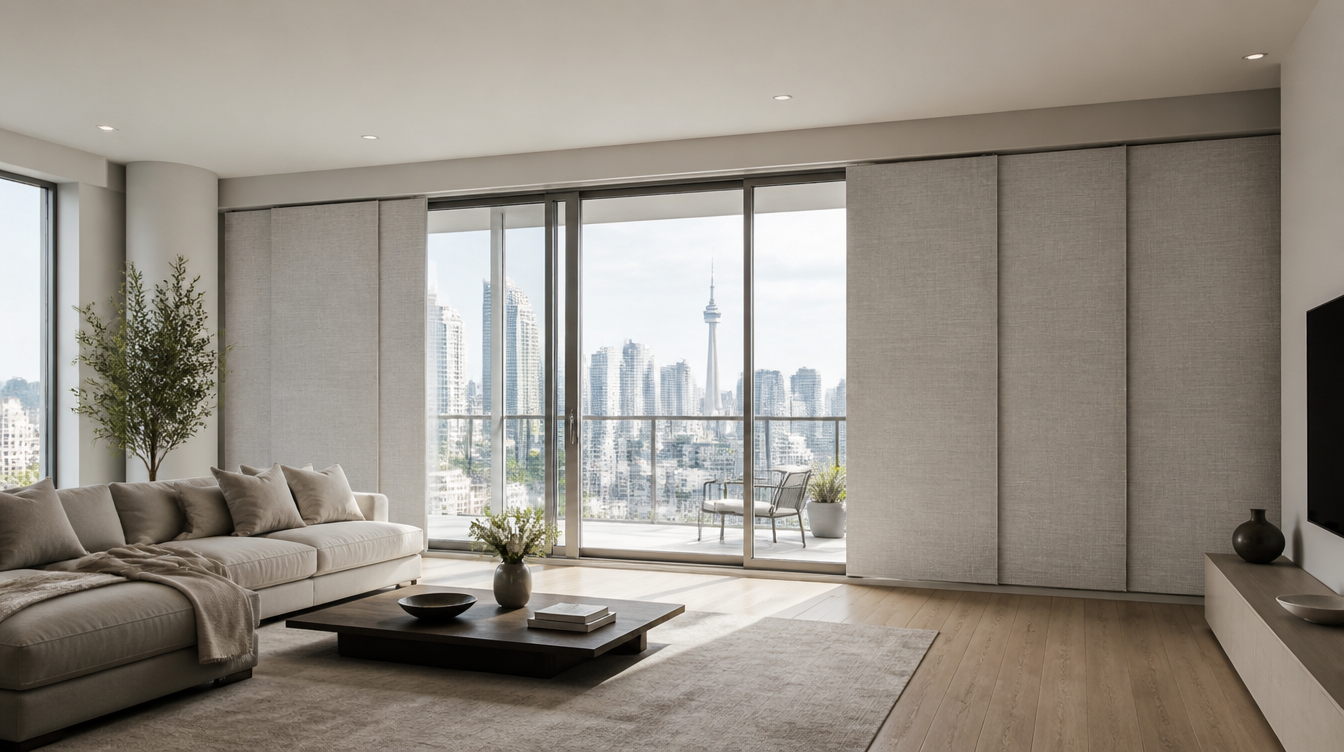

Panel track blinds are the covering people reach for when a window or door is simply too wide for anything else to look right. Instead of dozens of narrow slats, you get a handful of broad flat panels that hang from a track along the top and glide sideways to stack neatly out of the way. On a Toronto balcony slider or a condo wall of glass, they read more like moving fabric screens than traditional blinds, and that is exactly why designers keep specifying them for modern spaces.
They go by a few names. You will see them sold as panel track blinds, sliding panels, panel glide blinds, or panel track shades, and the differences are mostly branding rather than mechanics. What stays constant is the idea: wide fabric panels on a top track that you slide open and closed like a set of doors. If you have already looked at vertical blinds for a patio door and found the narrow vanes a bit dated, panel tracks are usually the more current answer to the same problem.
This guide covers how panel track blinds actually work, where they earn their place in a Toronto or GTA home, the fabrics worth knowing about, how the track and stacking is configured, what they cost in general market terms, and how to spec them so they fit and last. By the end you should know whether a panel track is right for your space and, if it is, exactly what to ask before you order.
What Are Panel Track Blinds?
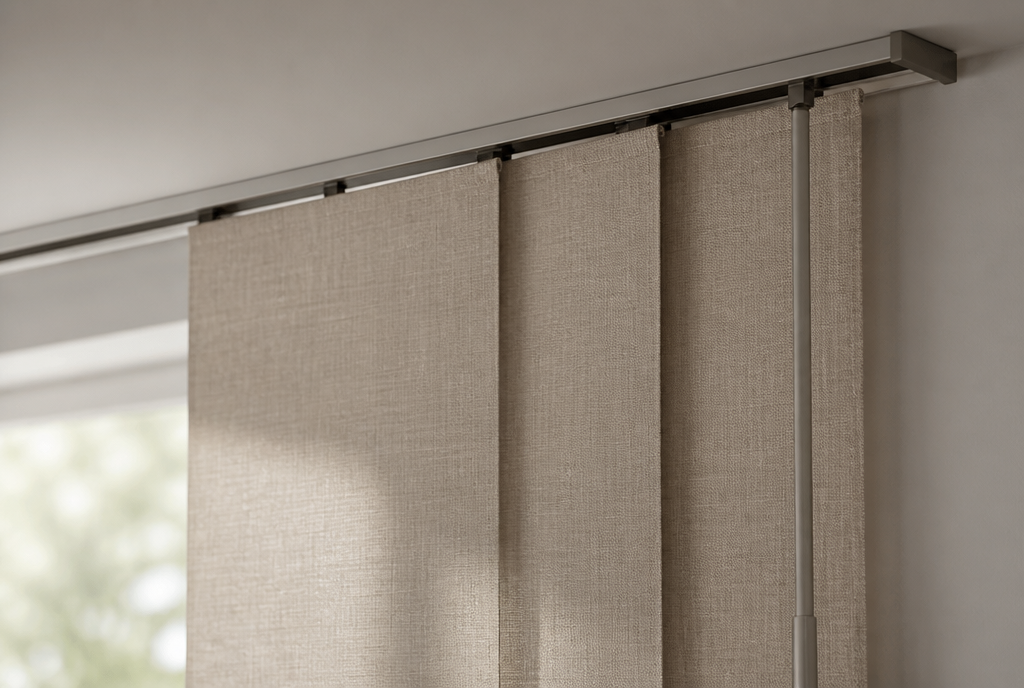
Panel track blinds are a window covering made of several wide, flat fabric panels that hang from a headrail track mounted across the top of a window or door. Each panel sits in its own channel in the track and slides horizontally. You draw them open by sliding the panels so they overlap and stack to one side, and you close them by spreading the panels across the opening. Unlike vertical blinds, the panels do not tilt. They give you an open view or a covered window, with the in-between handled by how far you slide them.
Think of them as a cross between a vertical blind and a sliding door. The track can carry anywhere from two to five panels depending on the width of the opening and the system, and each panel is typically somewhere between about a foot and two feet wide. Wider openings simply get more panels and more channels in the track. Because the panels are broad and hang perfectly flat, the look is clean and architectural, which suits the straight lines of a contemporary condo or a renovated open-plan main floor.
How Panel Track Blinds Work
The mechanics are refreshingly simple. A headrail with multiple channels runs across the top of the opening. Each fabric panel clips or hangs into one channel by way of a carrier. A wand, a cord, or a motor moves the carriers along the track. Some systems move every panel with a single lead panel, so one pull sweeps the whole set aside, and others let you position panels individually. When open, the panels sit behind one another in a tidy stack that takes up only a small slice of the wall. When closed, they spread to cover the glass edge to edge with slight overlaps so light does not pour through the seams.
What Panel Track Blinds Are Also Called
If you have been shopping around and feel like every retailer uses a different word, you are not imagining it. The same product shows up as sliding panels, panel glide blinds (common in Australian and British catalogues), panel track shades, sliding panel track blinds, and simply panel blinds. Some brands attach their own trade names to their version. When you are comparing quotes, focus on the fabric, the track quality, and the panel count rather than the marketing name, because the underlying system is the same category.
Why Panel Track Blinds Work So Well in Toronto Homes and Condos
Toronto’s housing stock is full of exactly the openings panel tracks were made for. Downtown condos come with balcony sliders and floor-to-ceiling glass. Suburban homes across the GTA have wide patio doors off the kitchen and big picture windows in the living room. These are the spots where narrow slats look busy and where fabric drapery can get in the way of a door that opens every day.
On a condo’s floor-to-ceiling wall of glass, panel tracks give you quick privacy and glare control without hiding the view when you want it. Slide them fully to one side and the glass reads as open as it did bare. Spread them across and you have an even, modern fabric wall. The same logic makes them a favourite for the condo high-rise window covering question that comes up in almost every downtown unit.
They also shine on the wide, low windows and doors that horizontal blinds struggle with. If a covering has to lift straight up, a very wide blind becomes heavy and awkward. Panel tracks sidestep that entirely because they move sideways, which is why they compete directly with the best blinds for large windows and with the sliding options many homeowners weigh for patio doors.
Panel Track Blinds Compared With the Alternatives
Panel tracks solve the wide-opening problem, but so do a few other coverings. Knowing where each one wins saves you from second-guessing after installation. Here is how the main contenders line up.
| Covering | How it moves | Best for | Trade-offs |
|---|---|---|---|
| Panel track blinds | Wide panels slide and stack sideways | Very wide windows, patio and sliding doors, room dividers | Panels do not tilt, so light control is open or closed rather than angled |
| Vertical blinds | Narrow vanes tilt and traverse | Wide glass where you want fine tilt control | Slats can look dated in older vinyl, and many vanes mean more edges |
| Drapery | Fabric gathers on a rod or track | Soft, layered, decorative look on wide openings | Gathered fabric stacks fuller and can crowd a door swing |
| Vertical sheer shades | Fabric vanes float inside a sheer, tilt and traverse | Soft light with a view-through option | Higher cost, and the sheer look is not for everyone |
Panel Track vs Vertical Blinds
This is the comparison that trips people up most, because both cover wide glass by moving sideways. The difference is the panel width and the tilt. Vertical blinds use many narrow vanes that rotate up to about 180 degrees, so you can angle daylight without moving the vanes off the window. Panel tracks use a few broad panels that do not rotate at all. You get a cleaner, more contemporary face and fewer edges collecting dust, but you trade away the fine tilt adjustment. If angling light matters to you, verticals still have an edge. If you want the modern flat look and mostly switch between open and covered, panel tracks win.
Panel Track vs Drapery and Curtains
Drapery brings softness and a decorative, layered feel that panel tracks cannot quite match. The catch on a working door is stacking. Gathered custom curtains and drapery bunch up when open and can spill into the path of a slider you use daily. Panel tracks stack tight and flat against the wall, so they clear a doorway more cleanly. Many Toronto homeowners run panel tracks on the working patio door and save drapery for the picture window beside it, which gives them the practical covering where they need it and the soft look where they want it.
Panel Track vs Vertical Sheer Shades
Vertical sheer shades float fabric vanes between two layers of sheer knit, so you get a diffused glow and a view-through setting. They are gorgeous and they cost more. Panel tracks are the more budget-friendly, more opaque option when privacy and coverage matter more than a soft view-through. If you like the idea of sheers but not the price, the sheer shades guide walks through where they make sense.
Panel Fabric and Opacity Options
Most of the decision comes down to the fabric you hang in the track. Panels come in a wide range of opacities and textures, and the same track can usually take different fabrics, so you are really choosing how much light and privacy you want. Here is how the common choices behave.
| Fabric type | Light and privacy | Best for | Notes |
|---|---|---|---|
| Light filtering | Softens daylight, daytime privacy, glow at night | Living rooms, dining areas, main-floor glass | The most popular pick, keeps a room bright while cutting glare |
| Solar or screen | Cuts UV and heat, keeps an outward view | Sun-facing balconies and hot rooms | Openness factor sets how much you see through and how much heat it blocks |
| Room darkening or blackout | Strong privacy, blocks most light | Bedrooms, media rooms, nurseries | Panels overlap only slightly, so expect some light at the seams and edges |
| Woven wood or natural | Textured filtering, warm tone | Rooms that want an organic, tactile look | Reads like the woven wood shades many homes use, in panel form |
| Sheer or dual | Soft diffused light, limited privacy | Rooms where a gentle glow matters most | Often layered behind a heavier panel for evening privacy |
One honest limitation worth flagging early: because the panels sit side by side rather than sealing against each other, even a blackout fabric will let a little light slip through the vertical seams and around the edges. For a bedroom where you want true darkness, plan on an outside mount that overruns the opening, or pair the panel track with a blackout roller behind it. The panels alone will darken a room well, but they will not give you a light-sealed cave, and any installer who promises that is overselling.
Track Configurations and How the Panels Stack
The track is the part most people never think about until it matters, so it is worth a moment. Panel tracks come with a set number of channels, usually two to five, and each channel carries one panel. The number of channels, the width of each panel, and the direction the panels stack all shape how the finished covering looks and works.
| Channels in track | Typical use | What to expect |
|---|---|---|
| 2 to 3 channels | Standard patio doors and medium windows | Covers most single sliders, tidy stack, easy to operate |
| 4 channels | Wide sliders and large picture windows | More coverage, a slightly deeper stack when fully open |
| 5 channels | Very wide glass walls and room dividers | Widest reach, needs the most wall space to park the stack |
Which Way Should the Panels Stack?
Decide this before you order, because it changes the whole feel of the room. Panels can stack to the left, to the right, or split from the centre to both sides. On a patio door, you usually stack away from the handle and the direction you walk through, so the parked panels sit out of your path. On a symmetrical picture window, a centre split can look balanced and formal. The stack also needs somewhere to live, so make sure there is enough clear wall beside the opening for the panels to park without covering an adjacent window or bumping into a wall return.
Panel Width and Track Length
The installer sizes the panels to your opening rather than the other way around. A wider opening gets either wider panels or more of them. There is a bit of overlap built in so the panels seal against each other and against the frame, which is why the total fabric is always a little wider than the glass. If you want the panels to disappear almost entirely when open, ask for an extended track that runs past the frame so the whole stack parks on the wall rather than over the glass. This is the same trick that makes drapery look intentional, applied to a hard track.
Mounting Panel Track Blinds
Panel tracks can mount inside the window or door recess or outside on the wall or ceiling above it, and the choice affects both the look and how well they cover. Because the panels stack to the side, an outside or ceiling mount is often the smarter call on doors, since it lets the panels clear the frame and the handle. The full inside mount versus outside mount breakdown applies here, with a few panel-specific notes.
| Mount type | Best when | Watch for |
|---|---|---|
| Inside mount | Deep recess, clean built-in look wanted | Needs enough depth for the track, and it cannot clear a protruding door handle |
| Outside mount (wall) | Doors, shallow frames, maximum coverage | Track extends past the frame, so leave clear wall for the stack |
| Ceiling mount | Floor-to-ceiling glass, a clean modern line | Needs solid backing above the glass, and the panels hang the full drop |
In a condo with floor-to-ceiling windows, a ceiling mount usually looks best because the track disappears into the ceiling line and the panels read as a clean fabric wall. In a house with a standard patio door, an outside wall mount is the reliable default. If you are unsure what your frame can take, the safest move is to have someone measure on site, which is where measuring your windows correctly pays off.
Panel Track Blinds on Sliding and Patio Doors
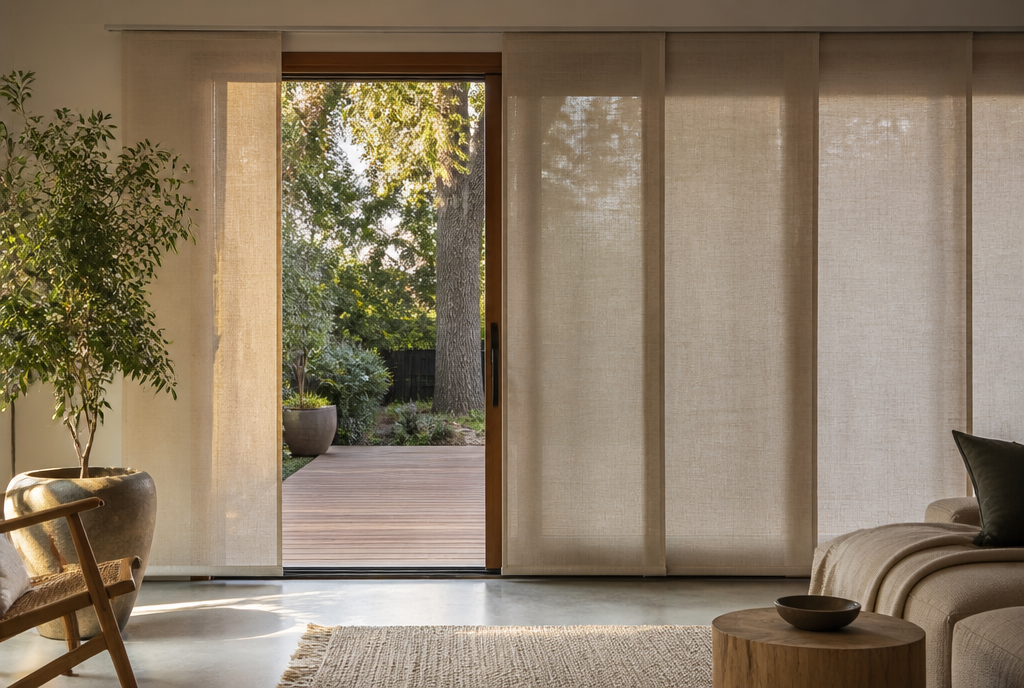
This is where panel tracks do their best work. A sliding patio door needs a covering that moves out of the way just as easily as the door does, and panel tracks match that motion exactly. Slide the panels to one side and you have a clear path to the deck. Spread them across and you have privacy and glare control on the glass. Because the panels stack flat rather than gathering, they do not billow into the doorway the way loose fabric can.
Set the stack to park on the opposite side from the door’s opening panel so your walk-through is always clear. Many households running a busy kitchen slider find panel tracks less fussy than the alternatives they had before, which is why they keep showing up in conversations about the best blinds for sliding doors and the broader question of window coverings for sliding glass doors. If your old covering was a set of narrow verticals that rattled every time the door opened, a panel track is the quiet, flat upgrade.
Panel Track Blinds as Room Dividers
One use that surprises people is the room divider. Because panel tracks run on a ceiling track and slide, you can hang them across an open space to separate a work nook from a living area, screen a laundry zone, or close off a studio’s sleeping corner. They give you a soft, movable wall that tucks away when you want the space open. In a downtown loft or an open-plan condo, this is often cheaper and more flexible than building a partition, and it keeps the light moving through the space.
For a divider, plan the track path and the parking space carefully, since the panels need a clear run and somewhere to stack when the space is open. A ceiling with solid backing is essential here because the track carries the full weight without a window frame to help.
Motorized and Smart Panel Track Blinds
Panel tracks take to motorization well, and on a very wide opening it is a genuine convenience rather than a gadget. A motor moves the lead carrier along the track, sweeping the whole set open or closed from a remote, a wall switch, or an app. On a glass wall that spans the living room, being able to close everything with one tap beats walking the length of the track by hand. Motorized panels also integrate with a broader motorized blinds setup so they open on a schedule with the rest of the home.
If you are building toward voice control and automation, panel tracks slot into a smart blinds system alongside your other shades. Whether motorization is worth it depends on the width, the height, and how often you open the covering, so treat it as an option to price out rather than a default. For a working patio door you open constantly, a smooth manual wand may be all you need.
Child and Pet Safety
Panel tracks have a real safety advantage over old corded coverings, and it is one of their quieter selling points. Most systems operate with a wand or a motor rather than a looped cord, which removes the strangulation hazard that made older blinds a concern in homes with young children and pets. Canada regulates corded window coverings tightly, and choosing a wand-operated or motorized panel track keeps you comfortably on the safe side of that.
If a system does come with any accessible cord, keep it short, tensioned, and anchored, and follow the guidance from Health Canada on blind cord safety. Canada’s Corded Window Coverings Regulations set out the current requirements that manufacturers must meet, which is useful background if you are comparing products. For a nursery or a toddler’s room, a cordless or motorized panel is the straightforward choice.
What Panel Track Blinds Cost in Toronto
Cost is the question everyone asks first, so here is an honest picture. Panel track blinds span a wide price range depending on where you buy and how they are made. As general market context, ready-made and DIY panel track kits from big-box and online retailers commonly run from roughly one hundred to a few hundred dollars per configuration, while premium custom fabric panels from national retailers often start around three hundred dollars and climb from there. Larger custom sliding panel systems for very wide glass can reach well into four figures once you add motorization and premium fabric.
Those figures are the broad market, not a quote for your project. What you actually pay depends on the drivers below. Rather than invent a price, the sensible move is to have your exact opening measured and specced, then get a written quote. Canadian Blinds Pros gives a free in-home consultation for that, so you get a real number for your fabric, track, and panel count rather than a guess.
| Cost driver | Why it moves the price |
|---|---|
| Opening width and height | More width means more panels and a longer track |
| Fabric grade | Solar, blackout, woven wood, and designer fabrics cost more than basic light filtering |
| Number of channels | A five-channel track costs more than a two-channel one |
| Manual vs motorized | Motors, batteries or wiring, and remotes add to the base price |
| Custom vs ready-made | Made-to-measure panels cost more but fit exactly and last longer |
| Professional installation | Correct mounting on wide or ceiling tracks is worth paying for |
Measuring and Planning Your Panel Track
Panel tracks are more forgiving to measure than many coverings because they move sideways, but width and stack space still need care. Get these wrong and the panels either fall short of the opening or park over glass you wanted clear. Run through the checklist below before you order, and when in doubt, measure twice.
| Step | What to check |
|---|---|
| Width | Measure the glass or door opening, then add coverage past the frame for an outside mount |
| Height | Measure the drop and decide whether panels sit at the sill or run to the floor |
| Stack space | Confirm clear wall beside the opening for the panels to park |
| Mount surface | Check the wall or ceiling has solid backing for the track |
| Obstructions | Note handles, trim, light switches, and anything the track could hit |
| Stack direction | Decide left, right, or centre split before ordering |
Cleaning and Maintenance
Panel tracks are easy to keep looking sharp, which is part of their appeal. Because the panels hang flat and vertical, they collect far less face dust than horizontal slats, and there are only a few broad surfaces to wipe rather than dozens of narrow ones. A regular pass with a vacuum brush attachment keeps most fabrics fresh. Many panels can be unclipped from their carriers and spot cleaned, and some fabrics tolerate a gentle damp wipe, though you should always check the maker’s care notes first since solar and blackout coatings vary.
The track itself benefits from an occasional dusting so the carriers keep gliding smoothly. If a panel starts to drag, it is usually dust in the channel rather than a fault. Keep the leading edges clean where hands touch them, and the whole system stays quiet and smooth for years.
How to Choose: Questions to Ask Before You Order
A short conversation before you buy prevents the most common regrets. Bring these questions to your consultation and you will spec a panel track that fits both the opening and how you actually live with it.
| Question | Why it matters |
|---|---|
| How much privacy and darkness do I need here? | Drives the fabric choice, from sheer to blackout |
| Which way should the panels stack? | Keeps the parked stack out of your path and off adjacent glass |
| Inside, outside, or ceiling mount? | Depends on frame depth, coverage, and the look you want |
| Manual wand or motorized? | Width, height, and how often you open it decide the payoff |
| Are there kids or pets in the room? | Points you to a cordless or motorized control |
| Can I replace a single panel later? | A repairable system keeps long-term costs down |
Panel Track Blinds and 2026 Design Trends
If you have wondered whether panel tracks are a current look or a passing one, the honest answer is that they sit right in the middle of where window coverings are heading. The move toward clean lines, natural textures, and coverings that all but disappear when open is exactly the space panel tracks occupy. Broad flat panels in a soft neutral linen read as calm and architectural, which is the look filling design feeds for contemporary Toronto interiors.
People often ask what makes a covering look expensive, and the answer is usually restraint. A panel track hung high and wide, in a quiet colour that sits close to the wall tone, with the track tucked into the ceiling, looks tailored rather than fussy. Pair it with a light-filtering fabric for daytime softness and you get the understated, gallery-like feel that designers reach for. For rooms where glare is the real enemy, a solar panel does the same job as the strategies in the block window glare guide while keeping the modern flat face.
Panel tracks also pair well with other coverings across a home. Many Toronto projects run panel tracks on the wide glass, roller blinds on the standard windows, and cellular shades where insulation matters, which keeps the look consistent while matching each covering to its job. If you are furnishing a whole unit, the best blinds for condos room by room breakdown is a useful companion read, and renters who cannot drill will want the no-drill options instead.
Frequently Asked Questions
What are panel track blinds?
Panel track blinds are a window covering made of several wide, flat fabric panels that hang from a top track and slide sideways to stack out of the way. They cover wide windows and sliding doors with a clean, modern face and open like a set of soft sliding screens.
What else are panel track blinds called?
They are sold as sliding panels, panel glide blinds, panel track shades, sliding panel track blinds, and simply panel blinds. The names vary by retailer and region, but the product is the same category: wide fabric panels on a sliding top track.
How much do panel track blinds cost in Toronto?
As general market context, ready-made kits often run from roughly one hundred to a few hundred dollars, while custom fabric panels typically start around three hundred dollars and climb with size, fabric, and motorization. Your exact price depends on the opening, so book a measured quote for a real number.
Are panel track blinds worth it?
For wide windows, patio doors, and room dividers, they usually are. They cover big openings cleanly, move out of the way easily, collect little dust, and look current. On a narrow standard window, a roller or cellular shade is often the better value.
What is the difference between panel track blinds and vertical blinds?
Vertical blinds use many narrow vanes that tilt and traverse, so you can angle the light. Panel track blinds use a few wide panels that slide but do not tilt, giving a cleaner, more modern face with fewer edges. Verticals win on fine light control, panel tracks on contemporary looks.
Do panel track blinds work on sliding glass doors?
Yes, this is their strongest use. The panels slide aside to clear the door and spread across for privacy, and because they stack flat they do not billow into the doorway. Set the stack to park on the opposite side from the door’s opening panel.
Can panel track blinds be used as a room divider?
Yes. Hung from a ceiling track, they make a soft, movable partition that separates zones in an open-plan space and tucks away when you want the room open. You need solid ceiling backing for the track and clear space for the panels to park.
Do panel track blinds block out all light?
Not completely. Even blackout fabric panels overlap only slightly, so some light slips through the seams and around the edges. For true darkness in a bedroom, use an outside mount that overruns the opening or pair the panel track with a blackout roller behind it.
Can panel track blinds be motorized or cordless?
Yes. Most systems run on a wand rather than a looped cord, and motorized versions sweep the panels open or closed by remote, switch, or app. Motorization is especially handy on very wide glass walls and integrates with a smart home system.
Are panel track blinds good for privacy?
They give strong daytime privacy when closed and let you slide them to screen exactly the part of the glass you want. After dark with lights on, the seams leak a little, so choose a room darkening fabric or a second layer where night privacy matters most.
How do you clean panel track blinds?
Vacuum the panels with a brush attachment regularly. Many panels unclip for spot cleaning, and some fabrics take a gentle damp wipe, though you should check the care notes first. Dust the track occasionally so the carriers keep gliding smoothly.
Can panel track blinds be cut or trimmed to size?
Some ready-made panels can be trimmed for height with scissors, and the track can often be cut for width. Custom panels are made to your exact opening instead, which fits better and looks cleaner. If you plan to trim a kit yourself, confirm it is designed for that before buying.
How many panels do I need?
It depends on the width. A standard patio door often takes three to four panels, while a wide glass wall or divider can need five or more. The installer sizes the panels and channels to your opening, building in overlap so the panels seal against each other and the frame.
How much stack space do panel track blinds need?
When fully open, the panels sit behind one another in a stack that takes up a slice of wall beside the opening. Wider systems with more channels need more parking space. If you want the glass fully clear when open, ask for an extended track so the stack parks on the wall.
Are panel track blinds out of style?
No. Their clean flat panels and natural fabrics fit current design trends toward simple, architectural coverings that disappear when open. In a soft neutral fabric with the track tucked into the ceiling, a panel track looks tailored and modern in a 2026 Toronto interior.
Are panel track blinds safe for children and pets?
Yes, when you choose the right control. A wand-operated or motorized panel track has no looped cord, which removes the main hazard. If any cord is present, keep it short, tensioned, and anchored, and follow Health Canada’s corded window covering guidance.
Should I choose inside or outside mount for a patio door?
Outside or ceiling mount is usually best on a patio door. It lets the panels clear a protruding handle, overruns the frame for better coverage, and does not depend on recess depth. Inside mount suits deep recesses where you want a clean built-in look.
Do panel track blinds work on regular windows too?
Yes. They suit any wide opening, including large picture windows and bay-adjacent walls of glass, and not doors alone. On a narrow standard window they can look oversized, so they are best kept for wide openings where the sliding motion earns its place.
Talk to a Toronto Panel Track Specialist
Panel track blinds reward a bit of planning, and the fit details, the stack direction, the fabric, and the mount are all easier to get right with someone measuring on site. If you have a wide window, a patio door, or a glass wall you want to dress cleanly, Canadian Blinds Pros can help you compare fabrics and configurations and give you a real quote. You can book a free in-home consultation to see samples in your own light, browse the window blinds gallery for ideas, or read how panel tracks compare with motorized blinds and curtains before you decide.