
Roman Shades in Toronto: A Complete Buyer’s Guide to Fabrics, Fold Styles, Lining, and Cordless Controls
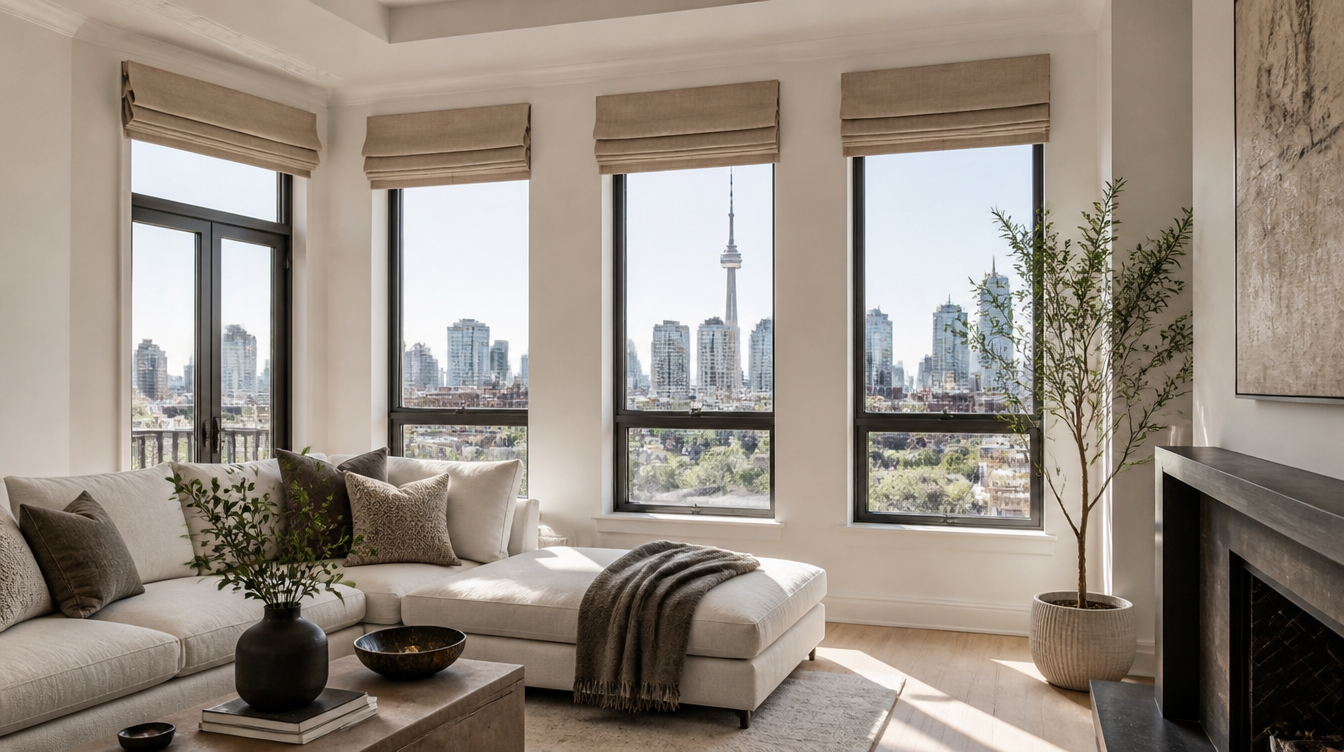

Roman shades are the window covering people reach for when they want fabric at the window without the fuss of full drapery. One panel of cloth hangs flat over the glass, and when you raise it the fabric gathers into soft horizontal folds that stack neatly at the top. Lower it again and the folds smooth out into a clean, tailored face. That mix of soft fabric and a tidy silhouette is why Roman shades show up in so many Toronto living rooms, bedrooms, and condos.
New to measuring? See measure your windows accurately before you order for a step-by-step walkthrough.
The tricky part is that “Roman shades” is a broad label. The same basic idea covers a crisp flat shade in a modern condo, a soft hobbled shade with rounded folds in a traditional dining room, and a blackout-lined shade that keeps a west-facing bedroom dark past sunrise. The fold style, the fabric, the lining, and the way you raise and lower the shade all change how it looks and how it performs. This guide walks through each of those decisions so you can pick a Roman shade that suits your room, your light, and the way you actually live in the space.
What Are Roman Shades?
A Roman shade is a soft fabric shade that folds up on itself as it rises. Behind the fabric sits a headrail at the top and a series of horizontal rods or battens sewn into pockets across the back. Cords, a chain, or a motor lift the bottom rail, and as it climbs, the fabric folds along those rods and stacks into pleats. Because the whole panel is fabric rather than slats or a rolled tube, a Roman shade reads more like a piece of drapery than a hard blind.
That soft look is the main reason people choose them. A Roman shade brings texture, colour, and a bit of warmth to a window that a plain roller or an aluminum blind cannot. It also stacks into a fairly compact bundle at the top, so it clears most of the glass when raised and lets the daylight in. For a deeper look at the crisp, minimal alternative, our guide to roller shades in Toronto is a useful companion, since many homeowners end up choosing between the two.
Roman Shades or Roman Blinds: Is There a Difference?
In everyday use, “Roman shades” and “Roman blinds” mean the same thing. Both describe the fabric shade that folds up as it lifts. “Blinds” usually points to hard products with slats or vanes, so purists reserve it for venetian and vertical styles, but the window covering trade and most Toronto shoppers use the two Roman terms interchangeably. If you search either phrase, you will land on the same product. We use “Roman shades” through most of this guide and treat “Roman blinds” as a synonym.
How a Roman Shade Actually Works
Picture the shade lowered flat against the window. Sewn horizontally across the back are thin rods spaced every few inches. Lift cords run down the back through small rings, and when you pull the cord or turn the chain, the bottom rail rises and each rod folds forward against the one above it. The folds stack in a soft pile at the top. Lower the shade and gravity pulls the folds back down into a smooth panel. On a cordless version, an internal spring or a hidden lift system does the same job without any operating cord dangling at the side.
Roman Shade Fold Styles
The fold style is the decision that shapes the whole look of the shade, so it is worth settling first. Two shades in the exact same fabric can feel formal or casual, traditional or modern, depending only on how the folds are built. Here are the four styles you will run into most often in the GTA.
Flat (Tailored) Roman Shades
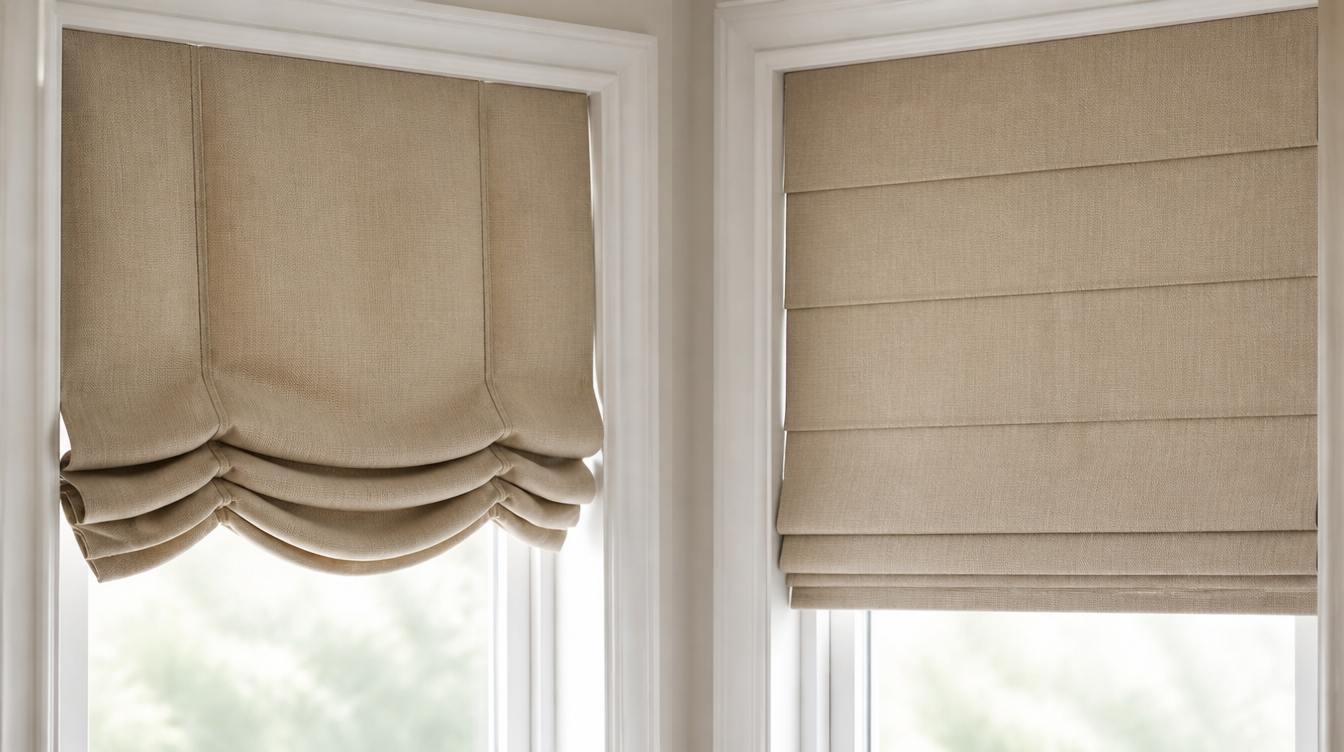
A flat Roman shade, sometimes called a tailored Roman, hangs as a smooth panel when lowered and folds into clean, even horizontal pleats when raised. There are no folds visible when the shade is all the way down, which shows off a patterned or textured fabric beautifully. This is the most modern and versatile style, and it suits contemporary condos, minimalist interiors, and any room where you want the fabric itself to be the feature. If you are unsure which fold to pick, a flat Roman is the safe, broadly flattering default.
Hobbled (Teardrop) Roman Shades
A hobbled Roman shade, also called a teardrop or looped Roman, keeps soft cascading folds even when it is fully lowered. Extra fabric is built in so the front always shows a series of rounded loops, top to bottom. The effect is lush and traditional, and it reads well in dining rooms, formal living rooms, and older Toronto homes with detailed trim. The trade-off is that a hobbled shade uses more fabric, sits a little deeper off the window, and blocks slightly more of the glass at the top because the stacked folds are bulkier when raised.
Relaxed (Slouch) Roman Shades
A relaxed Roman shade, also known as a slouch or swag Roman, has no rods along the bottom, so the hem dips into a gentle smile-shaped curve. The look is soft and casual, popular in kitchens, breakfast nooks, and cottage-style rooms. It works best on narrower windows, since a very wide relaxed shade can sag unevenly. Because there is no structure at the base, this style is more decorative than precise, so it is a poor choice where you need the shade to sit crisp and level.
Front-Slat and Modern Cordless Romans
Beyond the three classic folds, several manufacturers make a structured modern Roman where each fold is reinforced with a hidden batten so the pleats stay sharp and uniform. There are also fabric-vane shades that look like a Roman when lowered but tilt open like a soft blind, sold under brand names such as Hunter Douglas Vignette. These modern versions usually come cordless or motorized as standard and give you the fabric look with cleaner operation. They cost more than a basic flat Roman, so weigh the upgrade against how much the refined fold really matters to you.
| Fold style | Look when lowered | Best suited to | Things to weigh |
|---|---|---|---|
| Flat (tailored) | Smooth flat panel | Modern rooms, patterned fabric, condos | Most versatile, folds only show when raised |
| Hobbled (teardrop) | Rounded folds top to bottom | Traditional and formal rooms | More fabric, bulkier stack, sits deeper |
| Relaxed (slouch) | Soft curved hem | Kitchens, casual and cottage rooms | Best on narrow windows, less precise |
| Modern structured or vane | Crisp uniform folds | Contemporary spaces wanting clean operation | Higher cost, often cordless or motorized only |
Fabric and Lining: Light, Privacy, and Insulation
Once the fold is settled, the fabric and lining decide how much light the shade lets through, how private the room feels, and how much the shade helps with Toronto’s temperature swings. This is where a Roman shade earns its keep, because the same fold style can be sheer and airy or fully room-darkening depending on what sits behind the face fabric.
Fabric Weight and Weave
Roman shade face fabrics run from light linens and cottons to heavier textured weaves and patterned decorator cloth. A loose, light linen glows in the sun and gives a relaxed, natural feel, while a tighter, heavier weave holds its shape and blocks more light on its own. Linen is the most requested look in Toronto right now, and it pairs well with a lining that adds the privacy the open weave lacks. Keep in mind that very light fabrics show the folds and any lining seams more, so a slightly heavier cloth often hangs cleaner.
Unlined, Light Filtering, and Privacy Liners
An unlined Roman shade lets the most light through and shows the truest fabric colour, but it offers little nighttime privacy and no real insulation. A light filtering or privacy lining is the middle ground most people choose. It softens the incoming light, hides the view in from outside after dark, and protects the face fabric from sun fade. If daytime glow with evening privacy is your goal, a privacy-lined Roman covers it without going all the way to blackout. Our overview of sheer shades is worth a look if you lean toward the airy, light-filtering end.
Blackout-Lined Roman Shades
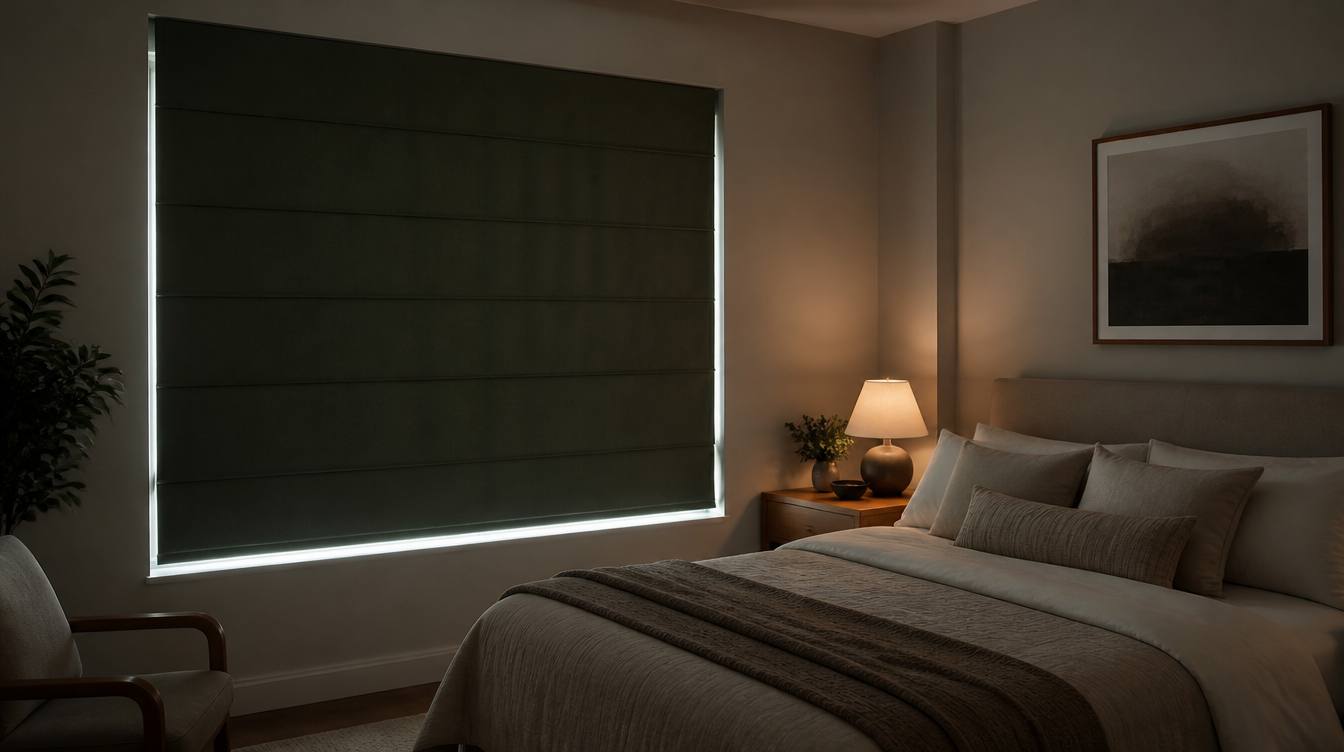
A blackout lining is a dense, opaque backing sewn behind the face fabric that stops light passing through the cloth itself. It is the right call for bedrooms, nurseries, and media rooms where you want the room dark. One honest point about any Roman shade: because the fabric hangs slightly in front of the glass and there are small gaps at the sides, a blackout-lined Roman darkens a room strongly but rarely reaches the total blackout of a cassette roller or an outside-mounted shade. Mounting outside the frame and running the shade wider and taller than the opening reduces the light gaps. For rooms where full darkness is the priority, compare notes with our guide to blackout blinds and our piece on blackout blinds for nurseries.
Interlining for Warmth
An interlining is a soft middle layer added between the face fabric and the lining. It gives the shade a fuller, more luxurious drape and adds a modest layer of insulation at the window. In a drafty older Toronto home, an interlined Roman helps take the edge off a cold window in winter. It will not match the sealed-air performance of a honeycomb shade, so if energy saving is the main goal rather than looks, read our guide to cellular shades and the broader energy efficient window coverings guide before deciding.
| Lining choice | Daytime light | Night privacy | Warmth added | Best rooms |
|---|---|---|---|---|
| Unlined | Soft glow, most light | Low | Minimal | Living rooms wanting an airy feel |
| Light filtering or privacy | Diffused | Good after dark | Some | Living, dining, home office |
| Blackout lined | Very dim | Full through the fabric | Moderate | Bedrooms, nurseries, media rooms |
| Interlined | Depends on face and liner | Good to full | Best of the fabric options | Drafty windows, colder rooms |
Controls: Corded, Cordless, Continuous Loop, and Motorized
How you raise and lower the shade matters for safety, convenience, and the clean look of the window. Roman shades come in four control types, and the right one depends on the room, whether children or pets use the space, and how many windows you are dressing.
Traditional Cord and Continuous-Loop Chain
The oldest style uses a lift cord you pull to raise the shade and cleat off at the side. It is simple and inexpensive, but a free-hanging cord is a strangulation hazard around young children, which is why it is being phased out of many product lines. A continuous-loop chain, similar to the one on a roller shade, is a step up. The loop is tensioned to the wall or frame with an anchor, which removes the dangling free end and gives smooth control on larger, heavier shades.
Cordless Roman Shades
A cordless Roman shade has no operating cord at all. You raise it by pushing up on the bottom rail and lower it by tugging gently, and an internal mechanism holds the position. The window looks clean, there is nothing for a child or pet to reach, and it is the style we recommend for most homes with kids. Cordless works best on small to mid-size shades, since a very large, heavy Roman can be a stretch to lift by hand. Our guide to cordless blinds covers the safety case in more depth, and the comparison of corded versus cordless blinds lays out the trade-offs side by side.
Motorized and Smart Roman Shades
A motorized Roman shade replaces the cord or chain with a quiet internal motor you operate by remote, wall switch, app, or voice through a smart-home assistant. It is the most convenient option for tall or hard-to-reach windows, for a bank of shades you want to move together, and for anyone who likes to schedule shades to rise in the morning and lower at dusk. Motors run on a rechargeable battery or hardwired power, and the smart versions integrate with the same systems that run motorized roller and cellular shades. If automation appeals to you, our overview of motorized blinds and the how-to on automating shades explain the power and control options.
| Control type | Child and pet safety | Best for | Relative cost |
|---|---|---|---|
| Lift cord | Hazard if unsecured | Budget projects, adult-only rooms | Lowest |
| Continuous-loop chain | Safer when anchored to the wall | Larger, heavier shades | Low to moderate |
| Cordless | No cord to reach, best for kids | Most homes, small to mid windows | Moderate |
| Motorized or smart | No cord, safest and most convenient | Tall windows, multiple shades, automation | Highest |
Inside Mount or Outside Mount
Where the shade sits relative to the window frame changes both the look and how well it controls light. An inside mount fits the shade within the window opening, so the frame stays visible and the shade has a built-in, trimmed appearance. It needs enough depth in the frame for the headrail, and it leaves small light gaps at the sides that matter in a bedroom. An outside mount fixes the shade on the wall or trim above the window, covering the whole opening and then some. It hides an out-of-square frame, blocks more light around the edges, and can make a window look larger.
For Roman shades specifically, an inside mount gives the cleanest tailored look and is the popular choice in living and dining rooms. An outside mount is the better pick when darkness is the priority, when the frame is too shallow for an inside fit, or when you want the shade to visually enlarge a small window. Our detailed comparison of inside mount versus outside mount walks through the measuring and depth requirements for each.
| Factor | Inside mount | Outside mount |
|---|---|---|
| Look | Trimmed, shows the frame | Covers frame, can enlarge the window |
| Light control | Small side gaps | Blocks more edge light |
| Frame depth needed | Requires enough depth | Works on shallow frames |
| Hides an uneven frame | No | Yes |
Best Rooms and Windows for Roman Shades in Toronto
Roman shades work in almost any room, but the fabric, lining, and control you pick should shift with how the space is used. Here is how they tend to play out across a typical GTA home or condo.
Living and Dining Rooms
These are the rooms where Roman shades shine. A flat or hobbled shade in a linen or textured fabric adds warmth and a designer touch, and a light filtering lining keeps the room bright by day while giving privacy at night. Because these windows are on show, the soft fabric look pays off here more than anywhere else.
Bedrooms and Nurseries
In bedrooms, a blackout-lined Roman shade helps with sleep, especially on east and west windows that catch the early sun. Go cordless or motorized in a nursery or a child’s room for safety, and consider an outside mount if you want the room as dark as possible. Many families pair a Roman with a separate blackout layer when total darkness matters.
Kitchens and Bathrooms
Kitchens suit a relaxed or flat Roman in a washable, tighter-weave fabric that stands up to steam and cooking. Keep the shade clear of the range and sink where it can get greasy or wet. Bathrooms need moisture-tolerant materials, and in a busy, damp bathroom a fabric Roman is not always the best fit. Our guide to bathroom and kitchen blinds covers moisture-resistant options if a fabric shade feels risky over the sink.
Wide Windows and Patio Doors
A single Roman shade gets heavy and hard to operate past a certain width, so very wide windows are often better served by two shades side by side or by a different product. Sliding patio doors, in particular, are usually handled better by a covering that stacks to the side. If you have a wide opening or a patio slider, compare a Roman with our guides to panel track blinds and blinds for sliding doors before committing.
Condos and High-Rise Windows
Flat Roman shades suit modern Toronto condos well, since the clean panel matches contemporary interiors and the soft fabric warms up a lot of glass and concrete. Check your building’s rules first, because many condo corporations require a neutral or white backing visible from outside. Cordless or motorized control keeps the look tidy on floor-to-ceiling windows. Our Toronto condo window covering guide covers the backing and bylaw details worth knowing before you order.
Home Offices
In a home office, glare on a screen is the enemy. A light filtering Roman softens harsh sun without plunging the room into darkness, and pairing it with the shade raised to the right height controls the angle of light through the day. For screen-heavy rooms, our piece on blocking window glare has practical tips that apply to Roman shades too.
| Room | Suggested fold and lining | Suggested control |
|---|---|---|
| Living or dining | Flat or hobbled, light filtering | Cordless or chain |
| Bedroom or nursery | Flat, blackout lined | Cordless or motorized |
| Kitchen | Relaxed or flat, washable weave | Cordless |
| Condo or high-rise | Flat, privacy lined, neutral back | Cordless or motorized |
| Home office | Flat, light filtering | Cordless or motorized |
Roman Shades and Toronto’s Climate
Toronto asks a lot of a window covering. Winters are cold enough that a bare window bleeds heat, and summers bring strong afternoon sun that heats rooms and fades furniture. A Roman shade helps with both, within limits. The fabric layer slows heat loss on a cold night, and an interlined or blackout-lined shade does more of that than an unlined one. In summer, a closed Roman blocks direct sun and cuts the heat gain that pours through south and west windows.
The honest framing is that a Roman shade is a fabric layer, not a sealed insulator. A honeycomb cellular shade traps air in its pockets and outperforms a Roman on pure energy numbers, so if cutting heating and cooling costs is your first priority, weigh that option too. Where the Roman wins is the balance of looks, softness, and decent everyday performance. For the full picture on window heat, the shades that reduce summer heat article and Natural Resources Canada’s guidance on ENERGY STAR windows and coverings are good background reading.
What Roman Shades Cost in Toronto
Roman shade pricing covers a wide range because so much depends on the choices above. A small, ready-made flat Roman from a big-box store sits at the low end, while a large, custom, interlined and motorized shade in a designer fabric sits far higher. Rather than quote a figure that would be out of date by the time you read it, it is more useful to know what actually drives the price so you can plan your budget.
| Cost driver | How it affects price |
|---|---|
| Size of the window | More fabric and stronger hardware raise the price |
| Fabric grade | Designer and natural fabrics cost more than basic cloth |
| Lining and interlining | Blackout and interlined shades add material and labour |
| Fold style | Hobbled uses more fabric than flat |
| Control type | Cordless costs more than corded, motorized most of all |
| Custom versus ready-made | Made-to-measure fits better and costs more than off-the-shelf |
| Installation | Professional measuring and fitting add to the total but reduce errors |
For a clear sense of whether custom is worth the extra over a ready-made shade, our honest look at whether custom blinds are worth it for Toronto homes weighs fit, fabric choice, and lifespan against price.
How to Measure for Roman Shades
Accurate measurements are the difference between a shade that hangs crisp and one that gapes or drags. For an inside mount, measure the width at the top, middle, and bottom of the window opening and use the narrowest figure, then measure the height at the left, centre, and right. Check the frame depth to make sure the headrail will fit flush. For an outside mount, decide how far past the opening you want the shade to extend on each side and above, then measure the full width and height you want the fabric to cover, adding overlap for better light control.
Measuring a Roman shade has less room for error than a hard blind, because the fabric will show any unevenness. If you are ordering several windows or working with a tricky bay or arched opening, a professional measure is the safest route. Our overview of professional blind measurement explains when it is worth booking one, and for shaped openings the notes in our bay window blinds guide are useful.
Installation
A Roman shade mounts on brackets fixed to the top of the window frame for an inside mount, or to the wall or trim above for an outside mount. The job needs the brackets level, anchored into something solid, and spaced to carry the weight of the fabric, which is heavier than a roller or an aluminum blind. A continuous-loop chain or a corded shade also needs its tension device or cleat secured to the wall so the control is safe and works smoothly.
Handy homeowners can install a small cordless Roman with a drill, a level, and patience. Larger shades, motorized units, and any window where the fabric must hang perfectly level are better left to a professional, since a shade that mounts even slightly out of level will fold unevenly. If you would rather not drill, a few damage-free options exist, and our no-drill blinds guide covers what works for renters and condo dwellers.
Cleaning and Maintenance
Roman shades collect dust in their folds, so regular light care keeps them looking fresh. Vacuum the shade gently with a brush attachment every few weeks, working from the top down, and spot-clean small marks with a damp cloth and mild soap, testing an unseen corner first. Most fabric Roman shades are not machine washable, and the rods and rings inside make full immersion a bad idea. For a deeper clean, professional cleaning that suits the specific fabric is the safest choice. Raising the shade fully when you are away from the window reduces sun fade on the face fabric over the years.
Child and Pet Safety
Corded window coverings are a known strangulation risk for young children, and Roman shades with interior lift cords have historically been a particular concern because a child can reach a loop of cord between the folds. The safest choice in any home with children or pets is a cordless or motorized Roman with no accessible operating cord. If you keep a corded shade, anchor the tension device or use a cleat to keep the cord out of reach, and move cribs and furniture children can climb away from the window.
In Canada, corded window coverings sold since 2021 must meet the federal Corded Window Coverings Regulations, which limit accessible cord length and loop hazards on products sold in Canada. Our roundup of child-safe window coverings pulls the practical steps together.
Roman Shades Compared With Other Window Coverings
Roman shades are one of several soft and hard options, and the right pick depends on the look you want and how the window is used. The table below sums up how a Roman stacks up against the products people most often weigh against it.
| Covering | Look | Strength | Weakness versus a Roman |
|---|---|---|---|
| Roman shade | Soft folded fabric | Warm, decorative, custom fabric | Heavier, bulkier stack, higher cost |
| Roller shade | Flat single panel | Clean, compact, budget friendly | Less soft and decorative |
| Cellular shade | Honeycomb pleats | Best insulation | Less of a fabric, drapery feel |
| Drapery | Full-length fabric panels | Grand, softens a whole wall | Takes more space and fabric |
If you are torn between the two most common fabric shades, our direct comparison of roller blinds versus Roman shades is the quickest way to decide, and the custom curtains and drapery guide helps if you are leaning toward full-length panels instead.
How to Choose the Right Roman Shade
Putting it all together, the choice comes down to a handful of questions about the room and how you live in it. Answer these before you order and the rest of the decisions fall into place.
| Question to ask | What it decides |
|---|---|
| How dark does the room need to be? | Unlined, light filtering, or blackout lining |
| Modern or traditional look? | Flat versus hobbled or relaxed fold |
| Children or pets in the room? | Cordless or motorized control |
| How wide and tall is the window? | One shade, two shades, or a different product |
| Inside or outside mount? | Look, light gaps, and frame depth needed |
| Is winter warmth a priority? | Interlining, or a cellular shade instead |
Working With Canadian Blinds Pros
Roman shades reward getting the details right, and that is easier with someone measuring the window and showing you fabric in your own light. Canadian Blinds Pros works with homeowners, condo residents, renters, designers, and builders across Toronto and the GTA to match the fold, fabric, lining, and control to each room. We bring samples to you, measure so the shade hangs level and true, and handle the installation so nothing is left to chance.
If you are weighing Roman shades against other options, or you already know the look you want and need a precise fit, book a free in-home consultation through our contact page. We will talk through your windows, your light, and your budget, and give you honest guidance on whether a Roman shade is the right call or whether something like a roller blind or zebra blind would serve the room better.
Frequently Asked Questions About Roman Shades
What are Roman shades?
Roman shades are soft fabric window shades that fold up into neat horizontal pleats as they rise and smooth into a flat panel when lowered. They give a window the warm, decorative look of fabric with a tidier profile than full drapery.
Are Roman shades and Roman blinds the same thing?
Yes. The two names describe the same fabric shade that folds as it lifts. “Blinds” is often used for hard slatted products, but for Romans the two terms are used interchangeably by shoppers and the trade alike.
What is the downside of Roman blinds?
The main drawbacks are that the fabric collects dust in its folds, the stacked folds block a little of the window when raised, and a large Roman gets heavy to operate. Corded versions also carry a child-safety risk, which cordless and motorized models remove.
What is the average cost of Roman shades?
Cost varies widely with size, fabric grade, lining, fold style, and control type. A small ready-made shade is inexpensive, while a large custom motorized shade in a designer fabric costs much more. A quote based on your actual windows is the only reliable figure.
Are Roman shades out of style in 2026?
No. Roman shades remain a popular choice, especially clean flat styles in natural fabrics like linen. The fold styles and fabrics shift with trends, but the shade itself is a lasting classic rather than a passing look.
Do Roman shades block all light?
Not completely. A blackout-lined Roman darkens a room strongly, but small gaps at the sides where the fabric meets the frame let a little light through. An outside mount run wider and taller than the opening reduces those gaps for near-darkness.
What is the difference between flat and hobbled Roman shades?
A flat Roman hangs as a smooth panel and only shows folds when raised, giving a modern look. A hobbled Roman keeps soft rounded folds even when fully lowered, giving a fuller, more traditional appearance and using more fabric.
Are cordless Roman shades safer for children?
Yes. Cordless Roman shades have no accessible operating cord, which removes the strangulation hazard that free-hanging cords pose to young children. Cordless or motorized shades are the recommended choice for nurseries and children’s rooms.
Can Roman shades be motorized?
Yes. Motorized Roman shades use a quiet internal motor run by remote, wall switch, app, or voice assistant. They suit tall or hard-to-reach windows, banks of shades operated together, and anyone who wants shades on a schedule.
Are Roman shades good for bedrooms?
They are a strong bedroom choice when fitted with a blackout lining, ideally on an outside mount for less edge light. Choose a cordless or motorized control for safety, and pair with a separate blackout layer if you need total darkness.
Do Roman shades look better inside or outside the window frame?
An inside mount gives the cleanest tailored look and shows off the frame, so it suits most living and dining rooms. An outside mount blocks more light, hides an uneven frame, and can make a small window look larger, which helps in bedrooms.
Are Roman shades better than roller shades?
Neither is better across the board. Roman shades offer a softer, more decorative fabric look, while roller shades are cleaner, more compact, and usually cheaper. The right pick depends on your room’s style, your budget, and how much fabric texture you want.
Do Roman shades help with insulation and energy costs?
A lined or interlined Roman adds a modest layer of insulation and cuts summer heat gain when closed. For the best energy performance, a honeycomb cellular shade traps air and outperforms a Roman, so weigh both if energy saving is your first priority.
Can Roman shades work on large windows and patio doors?
A single Roman becomes heavy and awkward past a certain width, so wide windows often use two shades side by side. Sliding patio doors are usually better served by a covering that stacks to the side, such as a panel track or vertical style.
How do I clean Roman shades?
Vacuum gently with a brush attachment from the top down every few weeks and spot-clean small marks with a damp cloth and mild soap after testing a hidden corner. Most fabric Romans are not machine washable, so use professional cleaning for a deep clean.
How long do Roman shades last?
A quality custom Roman shade lasts many years with light care. Sun exposure is the main factor in fabric fade over time, so raising the shade when a window gets strong direct sun and choosing a lined fabric both extend its life.
Where can I buy Roman shades in Toronto?
You can buy ready-made Roman shades from big-box and online retailers, or order custom shades through a local window covering specialist who measures and installs. Canadian Blinds Pros provides custom Roman shades with in-home measuring across Toronto and the GTA.